Ruonan Peng, FNU Yuqing, Taralyn J. Wiggins, Negin Bahadori, Joshua S. Rogers, Jacob Waitkus, Yun Chen, Gregory J. Tobin, Stephen J. Dollery, Ke Du
{"title":"Multiple-Channel Funnel Adapted Sensing Tube (MFAST) for the Simple and Duplex Detection of Parasites","authors":"Ruonan Peng, FNU Yuqing, Taralyn J. Wiggins, Negin Bahadori, Joshua S. Rogers, Jacob Waitkus, Yun Chen, Gregory J. Tobin, Stephen J. Dollery, Ke Du","doi":"10.1021/acssensors.4c03306","DOIUrl":null,"url":null,"abstract":"Leishmaniasis poses a significant global health threat, infecting millions of people annually, particularly in tropical and subtropical regions. Timely and accurate detection of the <i>Leishmania</i> species is crucial for effective treatment and control of this debilitating disease. This study introduces the multi-channel funnel adapted sensing tube (MFAST) chip, a simple diagnostic tool designed for the rapid detection of <i>Leishmania panamensis</i>. MFAST is fabricated through 3D printing and sacrificial molding of acrylonitrile butadiene styrene (ABS) and the reagents are transported between reservoirs by gravity. We combine experiments and finite element analysis to facilitate smoother fluid flow, improving the overall performance of the device. Highly sensitive and specific RPA-CRISPR/Cas12a assay is utilized in the chip, achieving a detection limit as low as 1000 parasites/mL (detecting as few as 5 parasites per reaction). The multichannel design enables duplex detection, allowing for simultaneous identification of both <i>L. braziliensis</i> and <i>L. panamensis</i> through distinct channels. Furthermore, stability tests indicate that lyophilized reagents retain functionality for up to 15 days when stored at 4 °C, underscoring the potential of this chip for practical diagnostic applications in low-resource settings.","PeriodicalId":24,"journal":{"name":"ACS Sensors","volume":"36 1","pages":""},"PeriodicalIF":10.9000,"publicationDate":"2025-03-27","publicationTypes":"Journal Article","fieldsOfStudy":null,"isOpenAccess":false,"openAccessPdf":"","citationCount":"0","resultStr":null,"platform":"Semanticscholar","paperid":null,"PeriodicalName":"ACS Sensors","FirstCategoryId":"92","ListUrlMain":"https://doi.org/10.1021/acssensors.4c03306","RegionNum":1,"RegionCategory":"化学","ArticlePicture":[],"TitleCN":null,"AbstractTextCN":null,"PMCID":null,"EPubDate":"","PubModel":"","JCR":"Q1","JCRName":"CHEMISTRY, ANALYTICAL","Score":null,"Total":0}
引用次数: 0
Abstract
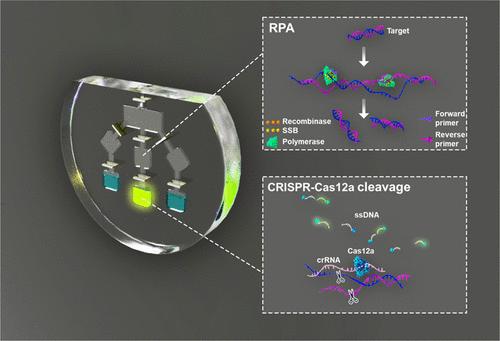
Leishmaniasis poses a significant global health threat, infecting millions of people annually, particularly in tropical and subtropical regions. Timely and accurate detection of the Leishmania species is crucial for effective treatment and control of this debilitating disease. This study introduces the multi-channel funnel adapted sensing tube (MFAST) chip, a simple diagnostic tool designed for the rapid detection of Leishmania panamensis. MFAST is fabricated through 3D printing and sacrificial molding of acrylonitrile butadiene styrene (ABS) and the reagents are transported between reservoirs by gravity. We combine experiments and finite element analysis to facilitate smoother fluid flow, improving the overall performance of the device. Highly sensitive and specific RPA-CRISPR/Cas12a assay is utilized in the chip, achieving a detection limit as low as 1000 parasites/mL (detecting as few as 5 parasites per reaction). The multichannel design enables duplex detection, allowing for simultaneous identification of both L. braziliensis and L. panamensis through distinct channels. Furthermore, stability tests indicate that lyophilized reagents retain functionality for up to 15 days when stored at 4 °C, underscoring the potential of this chip for practical diagnostic applications in low-resource settings.
期刊介绍:
ACS Sensors is a peer-reviewed research journal that focuses on the dissemination of new and original knowledge in the field of sensor science, particularly those that selectively sense chemical or biological species or processes. The journal covers a broad range of topics, including but not limited to biosensors, chemical sensors, gas sensors, intracellular sensors, single molecule sensors, cell chips, and microfluidic devices. It aims to publish articles that address conceptual advances in sensing technology applicable to various types of analytes or application papers that report on the use of existing sensing concepts in new ways or for new analytes.




 京公网安备 11010802042870号
京ICP备2023020795号-1
京公网安备 11010802042870号
京ICP备2023020795号-1

 分享
分享
 求助内容:
求助内容: 应助结果提醒方式:
 扫码关注我们
