Runhao Yuan , Xiaolong Zhong , Weiming Sun , Jian Wang , Chuanhui Huang , Zhenyu Lin , Jianping Zheng
{"title":"Electrochemistry sensing of ascorbic acid based on conductive metal-organic framework (Cu3(benzenehexathiol)) nanosheets modified electrode","authors":"Runhao Yuan , Xiaolong Zhong , Weiming Sun , Jian Wang , Chuanhui Huang , Zhenyu Lin , Jianping Zheng","doi":"10.1016/j.aca.2025.343980","DOIUrl":null,"url":null,"abstract":"<div><h3>Background</h3><div>Bulk-type conductive metal-organic frameworks (c-MOFs) had been applied to modify the electrode and used in electrochemical sensing because of the high conductive properties. But which still suffer from low mass permeability, restricted active site exposure, and poor accessibility due to the coordination saturation at metal sites in the bulk-type c-MOF. Recent studies have demonstrated that transforming bulk-type MOFs into MOFs nanosheets (NSs) can maximize the exposure of active sites and mass transfer. However, c-MOF NSs have rarely been applied in electrochemical sensing.</div></div><div><h3>Results</h3><div>This study presents NSs type c-MOF Cu<sub>3</sub>(benzenehexathiol) (CuBHT), synthesized using a simple sacrificial template method. CuBHT NSs were modified onto a glassy carbon electrode (GCE) to prepare CuBHT NSs/GCE, which was then applied to sense the model target ascorbic acid (AA), the system exhibits high sensitivity of 1.521 mA mM<sup>−1</sup> cm<sup>−2</sup> and a wide linear range of 1–789 μM, low detection limit of 0.46 μM. The sensitivity is 1.90 times higher than that of bulk-type CuBHT nanoparticles (NPs) modified GCE, which can be attributed to the CuBHT NSs having more exposed Cu sites on their surfaces. CuBHT NSs/GCE was then used to monitor AA levels in human sweat during daily activities or exercise, and the results indicated high reliability compared to the vitamin C ASA kit method.</div></div><div><h3>Significance</h3><div>The design of c-MOF CuBHT NSs/GCE lead to better performance in terms of sensitivity and low detection limit in AA sensing compared to bulk-type nanoparticles. The AA sensing mechanism based on CuBHT was investigated, and the sensing system was demonstrated by detecting AA in sweat. This work advances both the fundamental understanding and practical applications of c-MOF NSs in AA sensing.</div></div>","PeriodicalId":240,"journal":{"name":"Analytica Chimica Acta","volume":"1353 ","pages":"Article 343980"},"PeriodicalIF":6.0000,"publicationDate":"2025-06-01","publicationTypes":"Journal Article","fieldsOfStudy":null,"isOpenAccess":false,"openAccessPdf":"","citationCount":"0","resultStr":null,"platform":"Semanticscholar","paperid":null,"PeriodicalName":"Analytica Chimica Acta","FirstCategoryId":"92","ListUrlMain":"https://www.sciencedirect.com/science/article/pii/S0003267025003745","RegionNum":2,"RegionCategory":"化学","ArticlePicture":[],"TitleCN":null,"AbstractTextCN":null,"PMCID":null,"EPubDate":"2025/3/28 0:00:00","PubModel":"Epub","JCR":"Q1","JCRName":"CHEMISTRY, ANALYTICAL","Score":null,"Total":0}
引用次数: 0
Abstract
Background
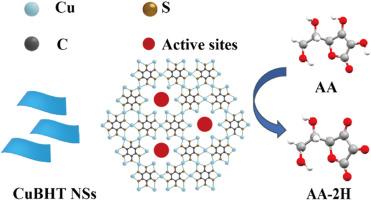
Bulk-type conductive metal-organic frameworks (c-MOFs) had been applied to modify the electrode and used in electrochemical sensing because of the high conductive properties. But which still suffer from low mass permeability, restricted active site exposure, and poor accessibility due to the coordination saturation at metal sites in the bulk-type c-MOF. Recent studies have demonstrated that transforming bulk-type MOFs into MOFs nanosheets (NSs) can maximize the exposure of active sites and mass transfer. However, c-MOF NSs have rarely been applied in electrochemical sensing.
Results
This study presents NSs type c-MOF Cu3(benzenehexathiol) (CuBHT), synthesized using a simple sacrificial template method. CuBHT NSs were modified onto a glassy carbon electrode (GCE) to prepare CuBHT NSs/GCE, which was then applied to sense the model target ascorbic acid (AA), the system exhibits high sensitivity of 1.521 mA mM−1 cm−2 and a wide linear range of 1–789 μM, low detection limit of 0.46 μM. The sensitivity is 1.90 times higher than that of bulk-type CuBHT nanoparticles (NPs) modified GCE, which can be attributed to the CuBHT NSs having more exposed Cu sites on their surfaces. CuBHT NSs/GCE was then used to monitor AA levels in human sweat during daily activities or exercise, and the results indicated high reliability compared to the vitamin C ASA kit method.
Significance
The design of c-MOF CuBHT NSs/GCE lead to better performance in terms of sensitivity and low detection limit in AA sensing compared to bulk-type nanoparticles. The AA sensing mechanism based on CuBHT was investigated, and the sensing system was demonstrated by detecting AA in sweat. This work advances both the fundamental understanding and practical applications of c-MOF NSs in AA sensing.
期刊介绍:
Analytica Chimica Acta has an open access mirror journal Analytica Chimica Acta: X, sharing the same aims and scope, editorial team, submission system and rigorous peer review.
Analytica Chimica Acta provides a forum for the rapid publication of original research, and critical, comprehensive reviews dealing with all aspects of fundamental and applied modern analytical chemistry. The journal welcomes the submission of research papers which report studies concerning the development of new and significant analytical methodologies. In determining the suitability of submitted articles for publication, particular scrutiny will be placed on the degree of novelty and impact of the research and the extent to which it adds to the existing body of knowledge in analytical chemistry.




 京公网安备 11010802042870号
京ICP备2023020795号-1
京公网安备 11010802042870号
京ICP备2023020795号-1

 分享
分享
 求助内容:
求助内容: 应助结果提醒方式:
 扫码关注我们
