Jingheng Xie, Li Yang, Wei Hu, Jie Song, Liuqing Kuang, Yingjie Huang, Dechun Liu, Yong Liu
{"title":"The CsMYB44-csi-miR0008-CsCER1 module regulates cuticular wax biosynthesis and drought tolerance in citrus","authors":"Jingheng Xie, Li Yang, Wei Hu, Jie Song, Liuqing Kuang, Yingjie Huang, Dechun Liu, Yong Liu","doi":"10.1111/nph.70088","DOIUrl":null,"url":null,"abstract":"<div>\n \n <p>\n </p><ul>\n \n <li>Cuticular wax covering aboveground organs serves as the first line of defense shielding plants from nonstomatal water loss and diverse environmental stresses. While there have been several wax-related genes identified, the molecular mechanisms responsible for the control of wax biosynthesis remain poorly understood in citrus, particularly at the posttranscriptional level.</li>\n \n <li>Here, we demonstrated that the CsMYB44-csi-miR0008-<i>CsCER1</i> module is responsible for regulating drought tolerance in citrus through its control of cuticular wax biosynthesis.</li>\n \n <li>In this study, microRNA (miRNA) sequencing analyses of ‘Newhall’ navel oranges and the wax-deficient ‘Ganqi 3’ mutant variety led to the identification of a novel cuticular wax biosynthesis-related miRNA, csi-miR0008. csi-miR0008 suppresses the expression of <i>CsCER1</i>, an aldehyde decarbonylase-encoding gene associated with n-alkane biosynthesis. The leaves of csi-miR0008-silencing and <i>CsCER1</i>-overexpressing plants exhibited increases in total wax levels, with particularly pronounced increases in n-alkane levels, contributing to enhanced drought tolerance. csi-miR0008-overexpressing and <i>CsCER1</i>-silencing plants exhibited the opposite phenotypes. CsMYB44 was confirmed to promote wax accumulation by directly inhibiting the expression of csi-miR0008.</li>\n \n <li>Taken together, our study offers new insight into the mechanisms responsible for the posttranscriptional control of citrus cuticular wax biosynthesis, while also providing a foundation for the breeding of novel citrus varieties exhibiting enhanced drought tolerance.</li>\n </ul>\n </div>","PeriodicalId":214,"journal":{"name":"New Phytologist","volume":"246 4","pages":"1757-1779"},"PeriodicalIF":8.1000,"publicationDate":"2025-03-27","publicationTypes":"Journal Article","fieldsOfStudy":null,"isOpenAccess":false,"openAccessPdf":"","citationCount":"0","resultStr":null,"platform":"Semanticscholar","paperid":null,"PeriodicalName":"New Phytologist","FirstCategoryId":"99","ListUrlMain":"https://nph.onlinelibrary.wiley.com/doi/10.1111/nph.70088","RegionNum":1,"RegionCategory":"生物学","ArticlePicture":[],"TitleCN":null,"AbstractTextCN":null,"PMCID":null,"EPubDate":"","PubModel":"","JCR":"Q1","JCRName":"PLANT SCIENCES","Score":null,"Total":0}
引用次数: 0
Abstract
Cuticular wax covering aboveground organs serves as the first line of defense shielding plants from nonstomatal water loss and diverse environmental stresses. While there have been several wax-related genes identified, the molecular mechanisms responsible for the control of wax biosynthesis remain poorly understood in citrus, particularly at the posttranscriptional level.
Here, we demonstrated that the CsMYB44-csi-miR0008-CsCER1 module is responsible for regulating drought tolerance in citrus through its control of cuticular wax biosynthesis.
In this study, microRNA (miRNA) sequencing analyses of ‘Newhall’ navel oranges and the wax-deficient ‘Ganqi 3’ mutant variety led to the identification of a novel cuticular wax biosynthesis-related miRNA, csi-miR0008. csi-miR0008 suppresses the expression of CsCER1, an aldehyde decarbonylase-encoding gene associated with n-alkane biosynthesis. The leaves of csi-miR0008-silencing and CsCER1-overexpressing plants exhibited increases in total wax levels, with particularly pronounced increases in n-alkane levels, contributing to enhanced drought tolerance. csi-miR0008-overexpressing and CsCER1-silencing plants exhibited the opposite phenotypes. CsMYB44 was confirmed to promote wax accumulation by directly inhibiting the expression of csi-miR0008.
Taken together, our study offers new insight into the mechanisms responsible for the posttranscriptional control of citrus cuticular wax biosynthesis, while also providing a foundation for the breeding of novel citrus varieties exhibiting enhanced drought tolerance.
期刊介绍:
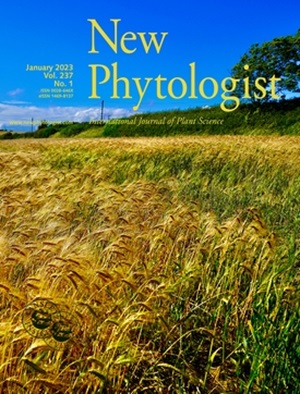
New Phytologist is an international electronic journal published 24 times a year. It is owned by the New Phytologist Foundation, a non-profit-making charitable organization dedicated to promoting plant science. The journal publishes excellent, novel, rigorous, and timely research and scholarship in plant science and its applications. The articles cover topics in five sections: Physiology & Development, Environment, Interaction, Evolution, and Transformative Plant Biotechnology. These sections encompass intracellular processes, global environmental change, and encourage cross-disciplinary approaches. The journal recognizes the use of techniques from molecular and cell biology, functional genomics, modeling, and system-based approaches in plant science. Abstracting and Indexing Information for New Phytologist includes Academic Search, AgBiotech News & Information, Agroforestry Abstracts, Biochemistry & Biophysics Citation Index, Botanical Pesticides, CAB Abstracts®, Environment Index, Global Health, and Plant Breeding Abstracts, and others.



 京公网安备 11010802042870号
京ICP备2023020795号-1
京公网安备 11010802042870号
京ICP备2023020795号-1

 分享
分享
 求助内容:
求助内容: 应助结果提醒方式:
 扫码关注我们
