Peixuan Han , Hongjun Yin , Xuhui Zhang, Ting Li, Jing Huang, Yang Wang, Bihua Xia, Shibo Wang, Weifu Dong
{"title":"Accelerating polycondensation efficiency through introducing aromatic monofunctional alcohol","authors":"Peixuan Han , Hongjun Yin , Xuhui Zhang, Ting Li, Jing Huang, Yang Wang, Bihua Xia, Shibo Wang, Weifu Dong","doi":"10.1016/j.polymer.2025.128329","DOIUrl":null,"url":null,"abstract":"<div><div>Increasing the polycondensation rate of polyester is crucial for energy conservation, cost control, product quality, and improving production efficiency, as the process typically occurs under high temperature and vacuum conditions. To increase the rate, this study proposes a novel approach to accelerate the polycondensation of polybutylene succinate (PBS) by introducing benzyl alcohol as a comonomer. Experimental results show that the addition of benzyl alcohol significantly speeds up the polycondensation reaction. Without benzyl alcohol, the polymerization reaction required 170 min under a high vacuum to reach an intrinsic viscosity of 0.85 dL/g. With benzyl alcohol, the polymer's intrinsic viscosity can reach 1.31 dL/g in just 85 min. The accelerated polycondensation rate was revealed to stem from the high ester exchange activity of the benzyl ester groups and the significantly accelerated chain growth rate. Furthermore, density functional theory calculations further confirmed that the energy required for the removal of benzyl alcohol from the polymer chain was lower than that for 1,4-butanediol. Importantly, this method did not alter the physical properties of the polymer, suggesting the potential for industrial preparation. We believe that this approach holds significant practical value for polyester industrial production, particularly in terms of reducing production costs and improving production efficiency.</div></div>","PeriodicalId":405,"journal":{"name":"Polymer","volume":"326 ","pages":"Article 128329"},"PeriodicalIF":4.5000,"publicationDate":"2025-05-09","publicationTypes":"Journal Article","fieldsOfStudy":null,"isOpenAccess":false,"openAccessPdf":"","citationCount":"0","resultStr":null,"platform":"Semanticscholar","paperid":null,"PeriodicalName":"Polymer","FirstCategoryId":"92","ListUrlMain":"https://www.sciencedirect.com/science/article/pii/S0032386125003155","RegionNum":2,"RegionCategory":"化学","ArticlePicture":[],"TitleCN":null,"AbstractTextCN":null,"PMCID":null,"EPubDate":"2025/3/28 0:00:00","PubModel":"Epub","JCR":"Q2","JCRName":"POLYMER SCIENCE","Score":null,"Total":0}
引用次数: 0
Abstract
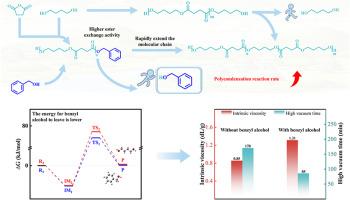
Increasing the polycondensation rate of polyester is crucial for energy conservation, cost control, product quality, and improving production efficiency, as the process typically occurs under high temperature and vacuum conditions. To increase the rate, this study proposes a novel approach to accelerate the polycondensation of polybutylene succinate (PBS) by introducing benzyl alcohol as a comonomer. Experimental results show that the addition of benzyl alcohol significantly speeds up the polycondensation reaction. Without benzyl alcohol, the polymerization reaction required 170 min under a high vacuum to reach an intrinsic viscosity of 0.85 dL/g. With benzyl alcohol, the polymer's intrinsic viscosity can reach 1.31 dL/g in just 85 min. The accelerated polycondensation rate was revealed to stem from the high ester exchange activity of the benzyl ester groups and the significantly accelerated chain growth rate. Furthermore, density functional theory calculations further confirmed that the energy required for the removal of benzyl alcohol from the polymer chain was lower than that for 1,4-butanediol. Importantly, this method did not alter the physical properties of the polymer, suggesting the potential for industrial preparation. We believe that this approach holds significant practical value for polyester industrial production, particularly in terms of reducing production costs and improving production efficiency.
期刊介绍:
Polymer is an interdisciplinary journal dedicated to publishing innovative and significant advances in Polymer Physics, Chemistry and Technology. We welcome submissions on polymer hybrids, nanocomposites, characterisation and self-assembly. Polymer also publishes work on the technological application of polymers in energy and optoelectronics.
The main scope is covered but not limited to the following core areas:
Polymer Materials
Nanocomposites and hybrid nanomaterials
Polymer blends, films, fibres, networks and porous materials
Physical Characterization
Characterisation, modelling and simulation* of molecular and materials properties in bulk, solution, and thin films
Polymer Engineering
Advanced multiscale processing methods
Polymer Synthesis, Modification and Self-assembly
Including designer polymer architectures, mechanisms and kinetics, and supramolecular polymerization
Technological Applications
Polymers for energy generation and storage
Polymer membranes for separation technology
Polymers for opto- and microelectronics.




 京公网安备 11010802042870号
京ICP备2023020795号-1
京公网安备 11010802042870号
京ICP备2023020795号-1

 分享
分享
 求助内容:
求助内容: 应助结果提醒方式:
 扫码关注我们
