Guang-Xuan Tang , Yu-Hong Huang , Li-Wan Feng , Yu-Chang Hu , Jia-Lu Wei , Huixiong Lü , Li-Hui Liu , Hai-Ming Zhao , Lei Xiang , Hui Li , Ce-Hui Mo , Yan-Wen Li , Quan-Ying Cai
{"title":"New insights into rhizosphere bacterial community shaped by lettuce genotypes for divergent degradation efficiencies of phthalates","authors":"Guang-Xuan Tang , Yu-Hong Huang , Li-Wan Feng , Yu-Chang Hu , Jia-Lu Wei , Huixiong Lü , Li-Hui Liu , Hai-Ming Zhao , Lei Xiang , Hui Li , Ce-Hui Mo , Yan-Wen Li , Quan-Ying Cai","doi":"10.1016/j.jhazmat.2025.138077","DOIUrl":null,"url":null,"abstract":"<div><div>Rhizosphere dissipation of organic pollutants benefits safe utilization of the polluted agricultural soil. Nevertheless, dissipation variation of phthalates (PAEs) in rhizosphere among different vegetable genotypes and the related microbial mechanisms remain unknown. Here, twelve lettuce cultivars with different genetic relationships identified by 18S rRNA gene sequencing were cultivated in soil spiked with di-(2-ethylhexyl) phthalate (DEHP). Bacterial communities and function genes in rhizosphere of lettuce were analyzed by 16S rRNA gene and metagenomic sequencing. Results showed significant variations in DEHP concentrations of roots (2.8–15.3 mg/kg) and shoots (0.70–1.8 mg/kg) among 12 cultivars. Notably, cultivars L11 and L12 showed the lowest DEHP accumulation in roots and shoots, being lower by 82 % and 58 % than the highest accumulators (cultivars L5 and L6), respectively. This accumulation variation was closely connected with their genetic relationships and exhibited genotype-dependent trait. The significantly different bacterial community diversities and structures were recorded in rhizosphere among 12 cultivars. Especially, bacterial communities in rhizosphere of cultivars L11 and L12 (low-DEHP accumulators with high DEHP dissipation) strengthened their adaptation by enriching pollutant-resistant taxa, increasing extracellular polymeric substance contents and biofilm formation, as well as constructing complex ecological networks under DEHP pollution. Moreover, PAE-degrading bacteria and genes (e.g., <em>hydrolase65</em>, <em>phtAb</em>, and <em>pcaI</em>) in rhizosphere were enriched by low-DEHP accumulators, which benefited DEHP removal and subsequently safe agricultural products. This study provides new insights into microbial mechanisms on rhizosphere DEHP degradation and its correlation with accumulation variation among different crop genotypes.</div></div>","PeriodicalId":361,"journal":{"name":"Journal of Hazardous Materials","volume":"492 ","pages":"Article 138077"},"PeriodicalIF":11.3000,"publicationDate":"2025-07-15","publicationTypes":"Journal Article","fieldsOfStudy":null,"isOpenAccess":false,"openAccessPdf":"","citationCount":"0","resultStr":null,"platform":"Semanticscholar","paperid":null,"PeriodicalName":"Journal of Hazardous Materials","FirstCategoryId":"93","ListUrlMain":"https://www.sciencedirect.com/science/article/pii/S0304389425009926","RegionNum":1,"RegionCategory":"环境科学与生态学","ArticlePicture":[],"TitleCN":null,"AbstractTextCN":null,"PMCID":null,"EPubDate":"2025/3/28 0:00:00","PubModel":"Epub","JCR":"Q1","JCRName":"ENGINEERING, ENVIRONMENTAL","Score":null,"Total":0}
引用次数: 0
Abstract
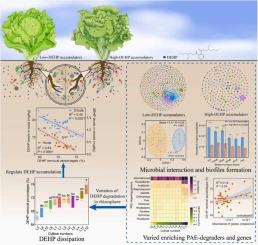
Rhizosphere dissipation of organic pollutants benefits safe utilization of the polluted agricultural soil. Nevertheless, dissipation variation of phthalates (PAEs) in rhizosphere among different vegetable genotypes and the related microbial mechanisms remain unknown. Here, twelve lettuce cultivars with different genetic relationships identified by 18S rRNA gene sequencing were cultivated in soil spiked with di-(2-ethylhexyl) phthalate (DEHP). Bacterial communities and function genes in rhizosphere of lettuce were analyzed by 16S rRNA gene and metagenomic sequencing. Results showed significant variations in DEHP concentrations of roots (2.8–15.3 mg/kg) and shoots (0.70–1.8 mg/kg) among 12 cultivars. Notably, cultivars L11 and L12 showed the lowest DEHP accumulation in roots and shoots, being lower by 82 % and 58 % than the highest accumulators (cultivars L5 and L6), respectively. This accumulation variation was closely connected with their genetic relationships and exhibited genotype-dependent trait. The significantly different bacterial community diversities and structures were recorded in rhizosphere among 12 cultivars. Especially, bacterial communities in rhizosphere of cultivars L11 and L12 (low-DEHP accumulators with high DEHP dissipation) strengthened their adaptation by enriching pollutant-resistant taxa, increasing extracellular polymeric substance contents and biofilm formation, as well as constructing complex ecological networks under DEHP pollution. Moreover, PAE-degrading bacteria and genes (e.g., hydrolase65, phtAb, and pcaI) in rhizosphere were enriched by low-DEHP accumulators, which benefited DEHP removal and subsequently safe agricultural products. This study provides new insights into microbial mechanisms on rhizosphere DEHP degradation and its correlation with accumulation variation among different crop genotypes.
期刊介绍:
The Journal of Hazardous Materials serves as a global platform for promoting cutting-edge research in the field of Environmental Science and Engineering. Our publication features a wide range of articles, including full-length research papers, review articles, and perspectives, with the aim of enhancing our understanding of the dangers and risks associated with various materials concerning public health and the environment. It is important to note that the term "environmental contaminants" refers specifically to substances that pose hazardous effects through contamination, while excluding those that do not have such impacts on the environment or human health. Moreover, we emphasize the distinction between wastes and hazardous materials in order to provide further clarity on the scope of the journal. We have a keen interest in exploring specific compounds and microbial agents that have adverse effects on the environment.



 京公网安备 11010802042870号
京ICP备2023020795号-1
京公网安备 11010802042870号
京ICP备2023020795号-1

 分享
分享
 求助内容:
求助内容: 应助结果提醒方式:
 扫码关注我们
