Ningning Xuan, Ningning Huang, Chunhui Song, Xinlei Du, Pengxu Chang, Junmeng Guo, Gang Cheng
{"title":"Dynamic Electrodes Enhanced Electrocatalytic Hydrogen Evolution Performance of Two-Dimensional Materials","authors":"Ningning Xuan, Ningning Huang, Chunhui Song, Xinlei Du, Pengxu Chang, Junmeng Guo, Gang Cheng","doi":"10.1021/acs.langmuir.4c05223","DOIUrl":null,"url":null,"abstract":"Hydrogen energy, known for its elevated combustion enthalpy and the generation of clean water upon combustion, represents a clean energy source with valuable potential applications. Water electrolysis for hydrogen production has emerged as an effective and environmentally friendly green hydrogen synthesis methodology. However, the conventional process of water electrolysis is typically performed under constant current or constant potential conditions, resulting in less-than-ideal hydrogen production rates due to limitations in mass transport. The adjustment of the catalyst interface and enhancement of mass transfer are achievable with dynamic electrodes. Herein, the electrocatalytic hydrogen evolution performance using MoS<sub>2</sub> as a model catalyst with dynamic electrodes was investigated. The electrocatalytic hydrogen evolution performance of MoS<sub>2</sub> can be enhanced by using dynamic electrodes, achieving a maximum increase of 240% in the hydrogen production rate. Improved electrocatalytic performance for hydrogen evolution can be observed when employing other two-dimensional materials as dynamic electrodes, including Pt-MoS<sub>2</sub> and Mo<sub>2</sub>C. Pt-MoS<sub>2</sub> demonstrates the most significant enhancement in the hydrogen evolution rate (400% enhancement). Through mechanistic analysis, the essence of enhancing electrocatalytic performance for hydrogen evolution lies in the bubbles effective separation and varied electrochemical double layer to facilitate mass transport. This work provides an effective method for enhancing the water electrolysis activity using the dynamic electrode.","PeriodicalId":50,"journal":{"name":"Langmuir","volume":"59 1","pages":""},"PeriodicalIF":3.9000,"publicationDate":"2025-03-28","publicationTypes":"Journal Article","fieldsOfStudy":null,"isOpenAccess":false,"openAccessPdf":"","citationCount":"0","resultStr":null,"platform":"Semanticscholar","paperid":null,"PeriodicalName":"Langmuir","FirstCategoryId":"92","ListUrlMain":"https://doi.org/10.1021/acs.langmuir.4c05223","RegionNum":2,"RegionCategory":"化学","ArticlePicture":[],"TitleCN":null,"AbstractTextCN":null,"PMCID":null,"EPubDate":"","PubModel":"","JCR":"Q2","JCRName":"CHEMISTRY, MULTIDISCIPLINARY","Score":null,"Total":0}
引用次数: 0
Abstract
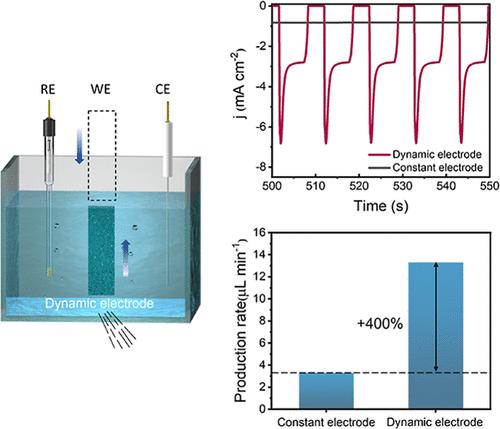
Hydrogen energy, known for its elevated combustion enthalpy and the generation of clean water upon combustion, represents a clean energy source with valuable potential applications. Water electrolysis for hydrogen production has emerged as an effective and environmentally friendly green hydrogen synthesis methodology. However, the conventional process of water electrolysis is typically performed under constant current or constant potential conditions, resulting in less-than-ideal hydrogen production rates due to limitations in mass transport. The adjustment of the catalyst interface and enhancement of mass transfer are achievable with dynamic electrodes. Herein, the electrocatalytic hydrogen evolution performance using MoS2 as a model catalyst with dynamic electrodes was investigated. The electrocatalytic hydrogen evolution performance of MoS2 can be enhanced by using dynamic electrodes, achieving a maximum increase of 240% in the hydrogen production rate. Improved electrocatalytic performance for hydrogen evolution can be observed when employing other two-dimensional materials as dynamic electrodes, including Pt-MoS2 and Mo2C. Pt-MoS2 demonstrates the most significant enhancement in the hydrogen evolution rate (400% enhancement). Through mechanistic analysis, the essence of enhancing electrocatalytic performance for hydrogen evolution lies in the bubbles effective separation and varied electrochemical double layer to facilitate mass transport. This work provides an effective method for enhancing the water electrolysis activity using the dynamic electrode.
期刊介绍:
Langmuir is an interdisciplinary journal publishing articles in the following subject categories:
Colloids: surfactants and self-assembly, dispersions, emulsions, foams
Interfaces: adsorption, reactions, films, forces
Biological Interfaces: biocolloids, biomolecular and biomimetic materials
Materials: nano- and mesostructured materials, polymers, gels, liquid crystals
Electrochemistry: interfacial charge transfer, charge transport, electrocatalysis, electrokinetic phenomena, bioelectrochemistry
Devices and Applications: sensors, fluidics, patterning, catalysis, photonic crystals
However, when high-impact, original work is submitted that does not fit within the above categories, decisions to accept or decline such papers will be based on one criteria: What Would Irving Do?
Langmuir ranks #2 in citations out of 136 journals in the category of Physical Chemistry with 113,157 total citations. The journal received an Impact Factor of 4.384*.
This journal is also indexed in the categories of Materials Science (ranked #1) and Multidisciplinary Chemistry (ranked #5).



 京公网安备 11010802042870号
京ICP备2023020795号-1
京公网安备 11010802042870号
京ICP备2023020795号-1

 分享
分享
 求助内容:
求助内容: 应助结果提醒方式:
 扫码关注我们
