Shuailing Hou , Jun Wang , Dan Feng , Dongming Wu , Shiquan Chen , Jinluo Fan , Mingguang Luo , Hui Deng , Xing Yang , Jiwei Luo , Yuanyuan Zhao , Chengjun Ge
{"title":"Colonization time of plastisphere drives the dynamics of organic carbon stability and microbial communities in seagrass bed sediments","authors":"Shuailing Hou , Jun Wang , Dan Feng , Dongming Wu , Shiquan Chen , Jinluo Fan , Mingguang Luo , Hui Deng , Xing Yang , Jiwei Luo , Yuanyuan Zhao , Chengjun Ge","doi":"10.1016/j.jhazmat.2025.138078","DOIUrl":null,"url":null,"abstract":"<div><div>Microplastic (MP) pollution in seagrass bed ecosystems has emerged as a significant global concern. However, the effects of plastisphere formation on organic carbon pools and microbial communities in these ecosystems remain unknown. We conducted a 56-day microcosm incubation experiment to study the dynamic changes in physicochemical characteristics, organic carbon fractions and stability, and bacterial community structure in seagrass bed sediments during the plastisphere formation process for polystyrene (PS) and polylactic acid (PLA). The results revealed significant weathering and biofilm formation on both PS and PLA. MPs altered the microbial community structure in seagrass bed sediments, leading to species turnover. Colonization time emerged as the key factor driving microbial community assembly, with ecological processes shifting from dispersal limitation to ecological drift in the plastisphere, while sediments maintained dispersal limitation as the dominant process. The formation of the plastisphere significantly influenced seagrass bed sediment microbial carbon (MBC) and organic carbon pool stability. MPs weathering negatively correlated with sediment properties but positively correlated with microbial communities, jointly modulating carbon pool stability. This study provided a new insight into the potential risks posed by MPs to carbon cycling and the ecological functioning of seagrass bed ecosystems.</div></div>","PeriodicalId":361,"journal":{"name":"Journal of Hazardous Materials","volume":"492 ","pages":"Article 138078"},"PeriodicalIF":11.3000,"publicationDate":"2025-03-28","publicationTypes":"Journal Article","fieldsOfStudy":null,"isOpenAccess":false,"openAccessPdf":"","citationCount":"0","resultStr":null,"platform":"Semanticscholar","paperid":null,"PeriodicalName":"Journal of Hazardous Materials","FirstCategoryId":"93","ListUrlMain":"https://www.sciencedirect.com/science/article/pii/S0304389425009938","RegionNum":1,"RegionCategory":"环境科学与生态学","ArticlePicture":[],"TitleCN":null,"AbstractTextCN":null,"PMCID":null,"EPubDate":"","PubModel":"","JCR":"Q1","JCRName":"ENGINEERING, ENVIRONMENTAL","Score":null,"Total":0}
引用次数: 0
Abstract
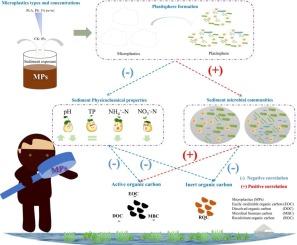
Microplastic (MP) pollution in seagrass bed ecosystems has emerged as a significant global concern. However, the effects of plastisphere formation on organic carbon pools and microbial communities in these ecosystems remain unknown. We conducted a 56-day microcosm incubation experiment to study the dynamic changes in physicochemical characteristics, organic carbon fractions and stability, and bacterial community structure in seagrass bed sediments during the plastisphere formation process for polystyrene (PS) and polylactic acid (PLA). The results revealed significant weathering and biofilm formation on both PS and PLA. MPs altered the microbial community structure in seagrass bed sediments, leading to species turnover. Colonization time emerged as the key factor driving microbial community assembly, with ecological processes shifting from dispersal limitation to ecological drift in the plastisphere, while sediments maintained dispersal limitation as the dominant process. The formation of the plastisphere significantly influenced seagrass bed sediment microbial carbon (MBC) and organic carbon pool stability. MPs weathering negatively correlated with sediment properties but positively correlated with microbial communities, jointly modulating carbon pool stability. This study provided a new insight into the potential risks posed by MPs to carbon cycling and the ecological functioning of seagrass bed ecosystems.
期刊介绍:
The Journal of Hazardous Materials serves as a global platform for promoting cutting-edge research in the field of Environmental Science and Engineering. Our publication features a wide range of articles, including full-length research papers, review articles, and perspectives, with the aim of enhancing our understanding of the dangers and risks associated with various materials concerning public health and the environment. It is important to note that the term "environmental contaminants" refers specifically to substances that pose hazardous effects through contamination, while excluding those that do not have such impacts on the environment or human health. Moreover, we emphasize the distinction between wastes and hazardous materials in order to provide further clarity on the scope of the journal. We have a keen interest in exploring specific compounds and microbial agents that have adverse effects on the environment.



 京公网安备 11010802042870号
京ICP备2023020795号-1
京公网安备 11010802042870号
京ICP备2023020795号-1

 分享
分享
 求助内容:
求助内容: 应助结果提醒方式:
 扫码关注我们
