Emily E. A. Robinson, Mahmoud Abdelwahab Fathy, Philippe Bühlmann
{"title":"Detection and Explanation of the Hidden Self-Discharge of Single-Walled Carbon-Nanotube Solid Contacts in Ion-Selective Electrodes","authors":"Emily E. A. Robinson, Mahmoud Abdelwahab Fathy, Philippe Bühlmann","doi":"10.1021/acssensors.4c03702","DOIUrl":null,"url":null,"abstract":"Solid contacts made of nonredox-active high-surface-area materials provide ion-selective electrodes comprising an ionophore-doped sensing membrane with a high capacitance. As emphasized in the literature, this minimizes changes in the measured potential that result from the minimal but unavoidable currents of real-life potentiometric measurements. However, as shown here for solid contacts made of single-walled carbon nanotubes (SWCNTs), solid contacts actively charged up over several minutes to voltages as small as ±100 mV do not hold this charge for longer than a few hours. Potential discharge occurs due to Faradaic processes and charge redistribution within the narrow confines of the SWCNT layer. The composition of the sensor membranes and atmospheric conditions have only a small impact on the kinetics of this spontaneous discharge, suggesting that redox reactions involving oxygen and the sensing membrane components do not play critical roles. Because both ion mobilities and the rate of redox reactions are expected to increase with temperature, the significant acceleration of discharge at higher temperature does not clarify whether charge redistribution or redox reactions dominate this discharge. However, contact angle measurements show that SWCNT-modified electrodes without an ion-selective membrane exhibit a substantial decrease in hydrophobicity after prolonged application of a bias potential as small as +100 mV, while application of a negative voltage had only a minor effect. This is consistent with very slow oxidation of the SWCNTs. These findings highlight the importance of optimizing the surface chemistry of high-surface-area solid contacts in view of high long-term stabilities. We propose quick charging of solid contacts to moderate potentials, followed by long-term potential monitoring under zero-current conditions, as a more thorough approach to characterize ISEs with high-surface-area solid contacts, offering insights not available with conventional chronopotentiometry measurements.","PeriodicalId":24,"journal":{"name":"ACS Sensors","volume":"13 1","pages":""},"PeriodicalIF":9.1000,"publicationDate":"2025-03-28","publicationTypes":"Journal Article","fieldsOfStudy":null,"isOpenAccess":false,"openAccessPdf":"","citationCount":"0","resultStr":null,"platform":"Semanticscholar","paperid":null,"PeriodicalName":"ACS Sensors","FirstCategoryId":"92","ListUrlMain":"https://doi.org/10.1021/acssensors.4c03702","RegionNum":1,"RegionCategory":"化学","ArticlePicture":[],"TitleCN":null,"AbstractTextCN":null,"PMCID":null,"EPubDate":"","PubModel":"","JCR":"Q1","JCRName":"CHEMISTRY, ANALYTICAL","Score":null,"Total":0}
引用次数: 0
Abstract
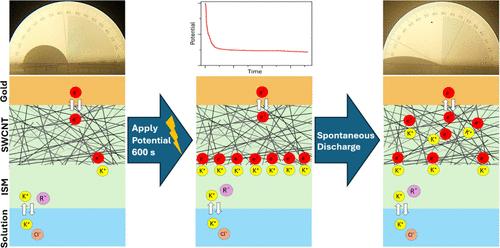
Solid contacts made of nonredox-active high-surface-area materials provide ion-selective electrodes comprising an ionophore-doped sensing membrane with a high capacitance. As emphasized in the literature, this minimizes changes in the measured potential that result from the minimal but unavoidable currents of real-life potentiometric measurements. However, as shown here for solid contacts made of single-walled carbon nanotubes (SWCNTs), solid contacts actively charged up over several minutes to voltages as small as ±100 mV do not hold this charge for longer than a few hours. Potential discharge occurs due to Faradaic processes and charge redistribution within the narrow confines of the SWCNT layer. The composition of the sensor membranes and atmospheric conditions have only a small impact on the kinetics of this spontaneous discharge, suggesting that redox reactions involving oxygen and the sensing membrane components do not play critical roles. Because both ion mobilities and the rate of redox reactions are expected to increase with temperature, the significant acceleration of discharge at higher temperature does not clarify whether charge redistribution or redox reactions dominate this discharge. However, contact angle measurements show that SWCNT-modified electrodes without an ion-selective membrane exhibit a substantial decrease in hydrophobicity after prolonged application of a bias potential as small as +100 mV, while application of a negative voltage had only a minor effect. This is consistent with very slow oxidation of the SWCNTs. These findings highlight the importance of optimizing the surface chemistry of high-surface-area solid contacts in view of high long-term stabilities. We propose quick charging of solid contacts to moderate potentials, followed by long-term potential monitoring under zero-current conditions, as a more thorough approach to characterize ISEs with high-surface-area solid contacts, offering insights not available with conventional chronopotentiometry measurements.
期刊介绍:
ACS Sensors is a peer-reviewed research journal that focuses on the dissemination of new and original knowledge in the field of sensor science, particularly those that selectively sense chemical or biological species or processes. The journal covers a broad range of topics, including but not limited to biosensors, chemical sensors, gas sensors, intracellular sensors, single molecule sensors, cell chips, and microfluidic devices. It aims to publish articles that address conceptual advances in sensing technology applicable to various types of analytes or application papers that report on the use of existing sensing concepts in new ways or for new analytes.



 京公网安备 11010802042870号
京ICP备2023020795号-1
京公网安备 11010802042870号
京ICP备2023020795号-1

 分享
分享
 求助内容:
求助内容: 应助结果提醒方式:
 扫码关注我们
