{"title":"Visual Counting of Influenza A Viruses with Magnetic T4 Phage SPR Probe","authors":"Le He, Li Liu, Xin Zhou, Zenglei Hu, Jiayin Shen","doi":"10.1021/acssensors.4c03670","DOIUrl":null,"url":null,"abstract":"Influenza A virus (IAV) represents a considerable threat to both animal and human health, while current detection methods encounter challenges related to the spectrum, rapidity, and sensitivity of viral identification. Herein, we describe the development of a magnetic T4 phage surface plasmon resonance probe for universal, rapid, highly sensitive, and visually detectable IAV detection under dark field microscopy (DFM). Briefly, we initially fused the Soc protein of the T4 phage with a single-chain variable fragment (scFv) antibody that exhibits broad-spectrum affinity toward the hemagglutinins of group 1 and group 2 influenza viruses, resulting in the generation of the recombinant Soc-scFv protein. Additionally, we generated another recombinant protein called AviTag-Hoc by fusing the Hoc capsid protein of T4 phage with biotin receptor peptides (AviTag). These two recombinant proteins were assembled on the head region of the T4 phage lacking both Soc and Hoc proteins. Subsequently, the resulting assembly was covalently modified with biotin using biotin-protein ligase, enabling conjugation with streptavidin-modified magnetic nanoparticles (SA@MNPs) to generate the magnetic T4 phage probe (T4@scFv@MNPs). Binding experiments demonstrated that this magnetic phage probe specifically binds to a wide range of IAVs of group 1 and group 2. Furthermore, in the presence of influenza viruses, the magnetic T4 phage probe and antibodies functionalized chip can form a sandwich complex that appears as a distinct bright golden yellow fluorescence spot visible to the naked eye under DFM. The number of viruses in samples can be automatically counted using artificial intelligence-assisted software. Assay results from both pure and real virus samples show that our magnetic phage-based DFM strategy is highly time efficient, taking approximately 30 min to complete. The method also showed excellent virus binding efficiency (>85%) in both high and low concentration samples and an extremely low detection limit (1 PFU/μL).","PeriodicalId":24,"journal":{"name":"ACS Sensors","volume":"72 1","pages":""},"PeriodicalIF":9.1000,"publicationDate":"2025-03-27","publicationTypes":"Journal Article","fieldsOfStudy":null,"isOpenAccess":false,"openAccessPdf":"","citationCount":"0","resultStr":null,"platform":"Semanticscholar","paperid":null,"PeriodicalName":"ACS Sensors","FirstCategoryId":"92","ListUrlMain":"https://doi.org/10.1021/acssensors.4c03670","RegionNum":1,"RegionCategory":"化学","ArticlePicture":[],"TitleCN":null,"AbstractTextCN":null,"PMCID":null,"EPubDate":"","PubModel":"","JCR":"Q1","JCRName":"CHEMISTRY, ANALYTICAL","Score":null,"Total":0}
引用次数: 0
Abstract
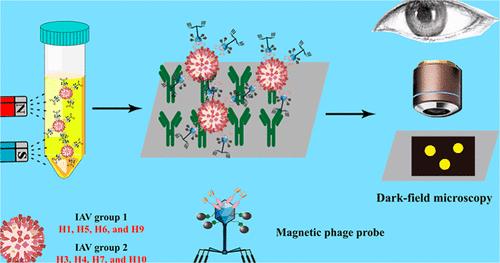
Influenza A virus (IAV) represents a considerable threat to both animal and human health, while current detection methods encounter challenges related to the spectrum, rapidity, and sensitivity of viral identification. Herein, we describe the development of a magnetic T4 phage surface plasmon resonance probe for universal, rapid, highly sensitive, and visually detectable IAV detection under dark field microscopy (DFM). Briefly, we initially fused the Soc protein of the T4 phage with a single-chain variable fragment (scFv) antibody that exhibits broad-spectrum affinity toward the hemagglutinins of group 1 and group 2 influenza viruses, resulting in the generation of the recombinant Soc-scFv protein. Additionally, we generated another recombinant protein called AviTag-Hoc by fusing the Hoc capsid protein of T4 phage with biotin receptor peptides (AviTag). These two recombinant proteins were assembled on the head region of the T4 phage lacking both Soc and Hoc proteins. Subsequently, the resulting assembly was covalently modified with biotin using biotin-protein ligase, enabling conjugation with streptavidin-modified magnetic nanoparticles (SA@MNPs) to generate the magnetic T4 phage probe (T4@scFv@MNPs). Binding experiments demonstrated that this magnetic phage probe specifically binds to a wide range of IAVs of group 1 and group 2. Furthermore, in the presence of influenza viruses, the magnetic T4 phage probe and antibodies functionalized chip can form a sandwich complex that appears as a distinct bright golden yellow fluorescence spot visible to the naked eye under DFM. The number of viruses in samples can be automatically counted using artificial intelligence-assisted software. Assay results from both pure and real virus samples show that our magnetic phage-based DFM strategy is highly time efficient, taking approximately 30 min to complete. The method also showed excellent virus binding efficiency (>85%) in both high and low concentration samples and an extremely low detection limit (1 PFU/μL).
期刊介绍:
ACS Sensors is a peer-reviewed research journal that focuses on the dissemination of new and original knowledge in the field of sensor science, particularly those that selectively sense chemical or biological species or processes. The journal covers a broad range of topics, including but not limited to biosensors, chemical sensors, gas sensors, intracellular sensors, single molecule sensors, cell chips, and microfluidic devices. It aims to publish articles that address conceptual advances in sensing technology applicable to various types of analytes or application papers that report on the use of existing sensing concepts in new ways or for new analytes.



 京公网安备 11010802042870号
京ICP备2023020795号-1
京公网安备 11010802042870号
京ICP备2023020795号-1

 分享
分享
 求助内容:
求助内容: 应助结果提醒方式:
 扫码关注我们
