Rui Jiang, Bowen Deng, Huijun Liu, Wen Lei, Liu Pi, Liangyou Hu, Xuhui Mao, Xinyu Li, Yaxu Wen, Dihua Wang
{"title":"Direct Synthesis of Dual Mo-Based Functional Materials Derived from Molybdenite by Molten Salt Paired Electrolysis","authors":"Rui Jiang, Bowen Deng, Huijun Liu, Wen Lei, Liu Pi, Liangyou Hu, Xuhui Mao, Xinyu Li, Yaxu Wen, Dihua Wang","doi":"10.1021/acsami.4c19822","DOIUrl":null,"url":null,"abstract":"A facile synthesis process that facilitates the industrial-scale production of catalysts is the prerequisite of the hydrogen evolution reaction (HER) industry. Molybdenum-based catalysts are ideal alternatives for precious-metal-based HER materials; however, they remain challenging in scale-up preparation due to the costly and complex Mo sources. Herein, we propose a molten salt paired electrolysis approach to synthesize transition-metal-doped Mo<sub>2</sub>C catalysts directly from molybdenite (mainly consisting of micrometer-scale MoS<sub>2</sub> bulks), an earth-abundant natural Mo ore. Unlike Fe-doped Mo<sub>2</sub>C in which those transition metal dopants are inclined to diffuse into inner planes of Mo<sub>2</sub>C, this unique synthesis approach leverages the differences in transition metal diffusion energy barriers, ultimately leading to the development of Ni-doped Mo<sub>2</sub>C catalytic materials with specific Ni-enriched interfaces. Owing to the unique design and structures of the catalyst, the interfacially Ni-enriched Ni-doped Mo<sub>2</sub>C exhibited promising HER performance and long-term stability. Very interestingly, MoS<sub>2</sub> nanoflakes, as side products, can be collected at the anode side while interfacially Ni-enriched Mo<sub>2</sub>C was concurrently obtained at the cathode side during the electrolytic synthesis process. This work not only deepens our knowledge on constructing active-site-enriched interfaces that are beneficial to HER but also gives clues to upcycling raw materials.","PeriodicalId":5,"journal":{"name":"ACS Applied Materials & Interfaces","volume":"35 1","pages":""},"PeriodicalIF":8.2000,"publicationDate":"2025-03-28","publicationTypes":"Journal Article","fieldsOfStudy":null,"isOpenAccess":false,"openAccessPdf":"","citationCount":"0","resultStr":null,"platform":"Semanticscholar","paperid":null,"PeriodicalName":"ACS Applied Materials & Interfaces","FirstCategoryId":"88","ListUrlMain":"https://doi.org/10.1021/acsami.4c19822","RegionNum":2,"RegionCategory":"材料科学","ArticlePicture":[],"TitleCN":null,"AbstractTextCN":null,"PMCID":null,"EPubDate":"","PubModel":"","JCR":"Q1","JCRName":"MATERIALS SCIENCE, MULTIDISCIPLINARY","Score":null,"Total":0}
引用次数: 0
Abstract
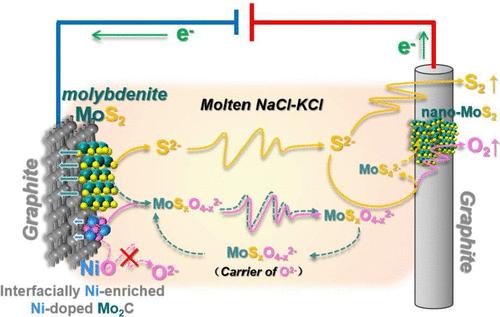
A facile synthesis process that facilitates the industrial-scale production of catalysts is the prerequisite of the hydrogen evolution reaction (HER) industry. Molybdenum-based catalysts are ideal alternatives for precious-metal-based HER materials; however, they remain challenging in scale-up preparation due to the costly and complex Mo sources. Herein, we propose a molten salt paired electrolysis approach to synthesize transition-metal-doped Mo2C catalysts directly from molybdenite (mainly consisting of micrometer-scale MoS2 bulks), an earth-abundant natural Mo ore. Unlike Fe-doped Mo2C in which those transition metal dopants are inclined to diffuse into inner planes of Mo2C, this unique synthesis approach leverages the differences in transition metal diffusion energy barriers, ultimately leading to the development of Ni-doped Mo2C catalytic materials with specific Ni-enriched interfaces. Owing to the unique design and structures of the catalyst, the interfacially Ni-enriched Ni-doped Mo2C exhibited promising HER performance and long-term stability. Very interestingly, MoS2 nanoflakes, as side products, can be collected at the anode side while interfacially Ni-enriched Mo2C was concurrently obtained at the cathode side during the electrolytic synthesis process. This work not only deepens our knowledge on constructing active-site-enriched interfaces that are beneficial to HER but also gives clues to upcycling raw materials.
期刊介绍:
ACS Applied Materials & Interfaces is a leading interdisciplinary journal that brings together chemists, engineers, physicists, and biologists to explore the development and utilization of newly-discovered materials and interfacial processes for specific applications. Our journal has experienced remarkable growth since its establishment in 2009, both in terms of the number of articles published and the impact of the research showcased. We are proud to foster a truly global community, with the majority of published articles originating from outside the United States, reflecting the rapid growth of applied research worldwide.




 京公网安备 11010802042870号
京ICP备2023020795号-1
京公网安备 11010802042870号
京ICP备2023020795号-1

 分享
分享
 求助内容:
求助内容: 应助结果提醒方式:
 扫码关注我们
