Suelen Delfino Souza, Hugo Fernando Meira dos Santos, Larissa Fernandes Bonfim, Iara Silva Squarisi, Tábata Esperandim, Liziane Marçal, Denise Crispim Tavares, Emerson Henrique de Faria
{"title":"Impact of Cationic and Neutral Clay Minerals’ Incorporation in Chitosan and Chitosan/PVA Microsphere Properties","authors":"Suelen Delfino Souza, Hugo Fernando Meira dos Santos, Larissa Fernandes Bonfim, Iara Silva Squarisi, Tábata Esperandim, Liziane Marçal, Denise Crispim Tavares, Emerson Henrique de Faria","doi":"10.1021/acsami.4c22323","DOIUrl":null,"url":null,"abstract":"This study investigates the synthesis of chitosan and chitosan/poly(vinyl alcohol) (PVA) microspheres incorporated with kaolinite and synthetic saponite clays. The microspheres were prepared using a two-step process: (i) reticulation of chitosan and chitosan/PVA with kaolinite or saponite to form a clay-biopolymer matrix and (ii) further reticulation of chitosan/PVA to produce double-layered microspheres. The resulting materials were characterized using FTIR, XRD, thermal analysis and SEM. Their properties were evaluated for water uptake, cation exchange capacity, specific surface area, acid stability, and methylene blue, Cr<sup>3+</sup>, Cr<sup>6+</sup>, and Ni<sup>2+</sup> adsorption. XRD analysis confirmed a successful polymer interaction with both clay structures. Cationic saponite clay favored clay dispersion, resulting in more homogeneous microspheres. Swelling tests revealed that chitosan-kaolinite microspheres exhibited 75% swelling, while chitosan-PVA-kaolinite microspheres showed 70% swelling, attributed to structural changes induced by PVA. Adsorption tests demonstrated that <i>KaolCSL</i> microspheres removed 53% of methylene blue (MB) and 82% of Ni<sup>2+</sup>, while <i>SapCPSL</i> microspheres exhibited superior removal of Cr<sup>3+</sup> (91%), Cr<sup>6+</sup> (19%), and silver nanoparticles (>90%). Biocompatibility assessments using zebrafish and HaCat cells showed no mortality or genotoxicity, with a 38% increase in cell viability for Cr-loaded microspheres. These results suggest that the use of modified clay-biopolymer microspheres can be an effective, low-cost solution for water purification and wastewater treatment.","PeriodicalId":5,"journal":{"name":"ACS Applied Materials & Interfaces","volume":"59 1","pages":""},"PeriodicalIF":8.2000,"publicationDate":"2025-03-28","publicationTypes":"Journal Article","fieldsOfStudy":null,"isOpenAccess":false,"openAccessPdf":"","citationCount":"0","resultStr":null,"platform":"Semanticscholar","paperid":null,"PeriodicalName":"ACS Applied Materials & Interfaces","FirstCategoryId":"88","ListUrlMain":"https://doi.org/10.1021/acsami.4c22323","RegionNum":2,"RegionCategory":"材料科学","ArticlePicture":[],"TitleCN":null,"AbstractTextCN":null,"PMCID":null,"EPubDate":"","PubModel":"","JCR":"Q1","JCRName":"MATERIALS SCIENCE, MULTIDISCIPLINARY","Score":null,"Total":0}
引用次数: 0
Abstract
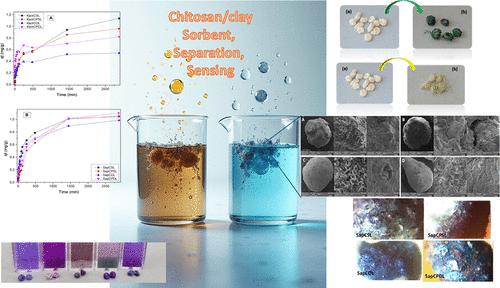
This study investigates the synthesis of chitosan and chitosan/poly(vinyl alcohol) (PVA) microspheres incorporated with kaolinite and synthetic saponite clays. The microspheres were prepared using a two-step process: (i) reticulation of chitosan and chitosan/PVA with kaolinite or saponite to form a clay-biopolymer matrix and (ii) further reticulation of chitosan/PVA to produce double-layered microspheres. The resulting materials were characterized using FTIR, XRD, thermal analysis and SEM. Their properties were evaluated for water uptake, cation exchange capacity, specific surface area, acid stability, and methylene blue, Cr3+, Cr6+, and Ni2+ adsorption. XRD analysis confirmed a successful polymer interaction with both clay structures. Cationic saponite clay favored clay dispersion, resulting in more homogeneous microspheres. Swelling tests revealed that chitosan-kaolinite microspheres exhibited 75% swelling, while chitosan-PVA-kaolinite microspheres showed 70% swelling, attributed to structural changes induced by PVA. Adsorption tests demonstrated that KaolCSL microspheres removed 53% of methylene blue (MB) and 82% of Ni2+, while SapCPSL microspheres exhibited superior removal of Cr3+ (91%), Cr6+ (19%), and silver nanoparticles (>90%). Biocompatibility assessments using zebrafish and HaCat cells showed no mortality or genotoxicity, with a 38% increase in cell viability for Cr-loaded microspheres. These results suggest that the use of modified clay-biopolymer microspheres can be an effective, low-cost solution for water purification and wastewater treatment.
期刊介绍:
ACS Applied Materials & Interfaces is a leading interdisciplinary journal that brings together chemists, engineers, physicists, and biologists to explore the development and utilization of newly-discovered materials and interfacial processes for specific applications. Our journal has experienced remarkable growth since its establishment in 2009, both in terms of the number of articles published and the impact of the research showcased. We are proud to foster a truly global community, with the majority of published articles originating from outside the United States, reflecting the rapid growth of applied research worldwide.



 京公网安备 11010802042870号
京ICP备2023020795号-1
京公网安备 11010802042870号
京ICP备2023020795号-1

 分享
分享
 求助内容:
求助内容: 应助结果提醒方式:
 扫码关注我们
