Jiamiao Yin, Qianwen Zhou, Yanzhong Li, Donghao Hu, Ming Xu, Mei Shi, Weigang Yan, Qingbing Wang, Xiufeng Hou, Fuyou Li
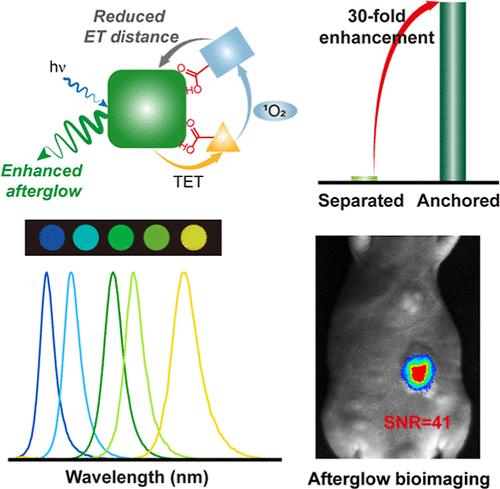
{"title":"“All-in-One” Photochemical Afterglow Nanoplatform Based on Perovskite Quantum Dots","authors":"Jiamiao Yin, Qianwen Zhou, Yanzhong Li, Donghao Hu, Ming Xu, Mei Shi, Weigang Yan, Qingbing Wang, Xiufeng Hou, Fuyou Li","doi":"10.1021/acsami.4c22254","DOIUrl":null,"url":null,"abstract":"Photochemical reaction-based afterglow materials offer a promising solution to the tissue autofluorescence issues associated with real-time excitation in traditional fluorescence probes. Conventional photochemical afterglow systems typically consist of three components: a photosensitizer, an energy cache unit (ECU), and an emitter. However, their physical separation leads to inefficient energy transfer. We present a strategy for constructing an “all-in-one” afterglow nanoplatform (AGNP) based on perovskite quantum dots (PQDs) to enhance the energy transfer efficiency by minimizing physical separation. Modified with 1-pyrenecarboxylic acid (PCA), CsPbBr<sub>3</sub> PQDs can serve as a photosensitizer, emitter, and ECU–phenylacetic acid (ECU–COOH) host simultaneously. The afterglow intensity of the AGNP shows a remarkable 30-fold enhancement compared with the separated ECU afterglow system, attributed to the decreased energy transfer distance. The AGNP also exhibits great versatility, enabling tunable afterglow emission across the visible region. The AGNP is further adopted for in vivo afterglow imaging with a signal-to-noise ratio of 41. This work provides an idea for constructing “all-in-one” afterglow systems and demonstrates their potential for background-free bioimaging.","PeriodicalId":5,"journal":{"name":"ACS Applied Materials & Interfaces","volume":"100 5 Pt 1 1","pages":""},"PeriodicalIF":8.2000,"publicationDate":"2025-03-28","publicationTypes":"Journal Article","fieldsOfStudy":null,"isOpenAccess":false,"openAccessPdf":"","citationCount":"0","resultStr":null,"platform":"Semanticscholar","paperid":null,"PeriodicalName":"ACS Applied Materials & Interfaces","FirstCategoryId":"88","ListUrlMain":"https://doi.org/10.1021/acsami.4c22254","RegionNum":2,"RegionCategory":"材料科学","ArticlePicture":[],"TitleCN":null,"AbstractTextCN":null,"PMCID":null,"EPubDate":"","PubModel":"","JCR":"Q1","JCRName":"MATERIALS SCIENCE, MULTIDISCIPLINARY","Score":null,"Total":0}
引用次数: 0
Abstract
Photochemical reaction-based afterglow materials offer a promising solution to the tissue autofluorescence issues associated with real-time excitation in traditional fluorescence probes. Conventional photochemical afterglow systems typically consist of three components: a photosensitizer, an energy cache unit (ECU), and an emitter. However, their physical separation leads to inefficient energy transfer. We present a strategy for constructing an “all-in-one” afterglow nanoplatform (AGNP) based on perovskite quantum dots (PQDs) to enhance the energy transfer efficiency by minimizing physical separation. Modified with 1-pyrenecarboxylic acid (PCA), CsPbBr3 PQDs can serve as a photosensitizer, emitter, and ECU–phenylacetic acid (ECU–COOH) host simultaneously. The afterglow intensity of the AGNP shows a remarkable 30-fold enhancement compared with the separated ECU afterglow system, attributed to the decreased energy transfer distance. The AGNP also exhibits great versatility, enabling tunable afterglow emission across the visible region. The AGNP is further adopted for in vivo afterglow imaging with a signal-to-noise ratio of 41. This work provides an idea for constructing “all-in-one” afterglow systems and demonstrates their potential for background-free bioimaging.
期刊介绍:
ACS Applied Materials & Interfaces is a leading interdisciplinary journal that brings together chemists, engineers, physicists, and biologists to explore the development and utilization of newly-discovered materials and interfacial processes for specific applications. Our journal has experienced remarkable growth since its establishment in 2009, both in terms of the number of articles published and the impact of the research showcased. We are proud to foster a truly global community, with the majority of published articles originating from outside the United States, reflecting the rapid growth of applied research worldwide.



 京公网安备 11010802042870号
京ICP备2023020795号-1
京公网安备 11010802042870号
京ICP备2023020795号-1

 分享
分享
 求助内容:
求助内容: 应助结果提醒方式:
 扫码关注我们
