Jing Guo , Haotong Ma , Huan Shang , Wenchao Wang , Ruiyi Yang , Shuo Wang , Yingchun Miao , David Lee Phillips , Guisheng Li , Shuning Xiao
{"title":"Dual-site Langmuir-Hinshelwood mechanism in ZnCr-LDH/NH2-UIO66 heterojunction for efficient photocatalytic NO oxidation","authors":"Jing Guo , Haotong Ma , Huan Shang , Wenchao Wang , Ruiyi Yang , Shuo Wang , Yingchun Miao , David Lee Phillips , Guisheng Li , Shuning Xiao","doi":"10.1016/j.jhazmat.2025.138060","DOIUrl":null,"url":null,"abstract":"<div><div>In this study, we developed a ZnCr-LDH/NH<sub>2</sub>-UIO66 heterojunction to enhance photocatalytic NO oxidation through a dual-site Langmuir-Hinshelwood (L-H) mechanism. Nitrogen oxides (NOₓ), including NO, are hazardous environmental contaminants linked to severe air pollution issues such as haze, acid rain, and photochemical smog. The composite catalyst addresses these challenges by synergistically activating NO and O<sub>2</sub> under environmentally relevant conditions, including simulated solar light, ambient temperature, and NO concentrations of 1000 ppb typical of polluted urban areas. The MOF component (NH<sub>2</sub>-UIO66) selectively adsorbs NO, while the LDH component (ZnCr-LDH) efficiently activates O<sub>2</sub> to generate reactive oxygen species (ROS). The built-in electric field (BIEF) optimizes charge separation, enabling 71.1 % NO removal efficiency with 97.8 % nitrate selectivity, effectively suppressing toxic NO<sub>2</sub> byproduct formation. This work provides a sustainable strategy for mitigating hazardous NO emissions in air pollution control, bridging material design with environmental remediation.</div></div>","PeriodicalId":361,"journal":{"name":"Journal of Hazardous Materials","volume":"492 ","pages":"Article 138060"},"PeriodicalIF":11.3000,"publicationDate":"2025-03-28","publicationTypes":"Journal Article","fieldsOfStudy":null,"isOpenAccess":false,"openAccessPdf":"","citationCount":"0","resultStr":null,"platform":"Semanticscholar","paperid":null,"PeriodicalName":"Journal of Hazardous Materials","FirstCategoryId":"93","ListUrlMain":"https://www.sciencedirect.com/science/article/pii/S0304389425009756","RegionNum":1,"RegionCategory":"环境科学与生态学","ArticlePicture":[],"TitleCN":null,"AbstractTextCN":null,"PMCID":null,"EPubDate":"","PubModel":"","JCR":"Q1","JCRName":"ENGINEERING, ENVIRONMENTAL","Score":null,"Total":0}
引用次数: 0
Abstract
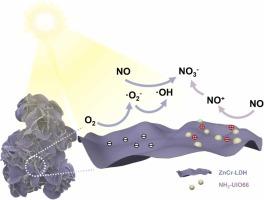
In this study, we developed a ZnCr-LDH/NH2-UIO66 heterojunction to enhance photocatalytic NO oxidation through a dual-site Langmuir-Hinshelwood (L-H) mechanism. Nitrogen oxides (NOₓ), including NO, are hazardous environmental contaminants linked to severe air pollution issues such as haze, acid rain, and photochemical smog. The composite catalyst addresses these challenges by synergistically activating NO and O2 under environmentally relevant conditions, including simulated solar light, ambient temperature, and NO concentrations of 1000 ppb typical of polluted urban areas. The MOF component (NH2-UIO66) selectively adsorbs NO, while the LDH component (ZnCr-LDH) efficiently activates O2 to generate reactive oxygen species (ROS). The built-in electric field (BIEF) optimizes charge separation, enabling 71.1 % NO removal efficiency with 97.8 % nitrate selectivity, effectively suppressing toxic NO2 byproduct formation. This work provides a sustainable strategy for mitigating hazardous NO emissions in air pollution control, bridging material design with environmental remediation.
期刊介绍:
The Journal of Hazardous Materials serves as a global platform for promoting cutting-edge research in the field of Environmental Science and Engineering. Our publication features a wide range of articles, including full-length research papers, review articles, and perspectives, with the aim of enhancing our understanding of the dangers and risks associated with various materials concerning public health and the environment. It is important to note that the term "environmental contaminants" refers specifically to substances that pose hazardous effects through contamination, while excluding those that do not have such impacts on the environment or human health. Moreover, we emphasize the distinction between wastes and hazardous materials in order to provide further clarity on the scope of the journal. We have a keen interest in exploring specific compounds and microbial agents that have adverse effects on the environment.



 京公网安备 11010802042870号
京ICP备2023020795号-1
京公网安备 11010802042870号
京ICP备2023020795号-1

 分享
分享
 求助内容:
求助内容: 应助结果提醒方式:
 扫码关注我们
