Shunrong Chen , Chunyue Zhao , Wei Wang , Songyuan Yang , Chengjiang Zhou
{"title":"Convolutional neural network-assisted design and validation of terahertz metamaterial sensor","authors":"Shunrong Chen , Chunyue Zhao , Wei Wang , Songyuan Yang , Chengjiang Zhou","doi":"10.1016/j.matdes.2025.113871","DOIUrl":null,"url":null,"abstract":"<div><div>This paper proposes a convolutional neural network (CNN)-assisted method for both forward optimization and inverse design of terahertz metamaterial sensors (TMSs), addressing the limitations imposed by reliance on manual trial-and-error processes. A hollow n-shaped TMS based on copper foil was developed, exhibiting two distinct resonance peaks between 0.3 and 1.4 THz. The formation mechanisms of resonance peaks were analyzed based on electric field and current distribution, while the sensing performance of the TMS was investigated. In the forward optimization stage, the n-shaped unit of TMS was converted into a data matrix, and the CNN was developed to predict the resonance frequency. In the inverse design stage, a predictive model for estimating the size of the TMS was developed by applying one-dimensional convolution to the transmission coefficients. The training dataset employed for forward optimization and inverse design achieved coefficients of determination (R<sup>2</sup>) of 0.99 and 0.99, respectively, with corresponding mean absolute error (MAE) values of 3.90 and 1.04. The efficacy of the proposed method was validated through terahertz time-domain spectroscopy (THz-TDS) measurements of TMS. Experimental assessments were conducted on glucose solutions of varying concentrations to ascertain the sensing capabilities. The proposed method contributes to the efficient design and optimization of TMS.</div></div>","PeriodicalId":383,"journal":{"name":"Materials & Design","volume":"253 ","pages":"Article 113871"},"PeriodicalIF":7.9000,"publicationDate":"2025-05-01","publicationTypes":"Journal Article","fieldsOfStudy":null,"isOpenAccess":false,"openAccessPdf":"","citationCount":"0","resultStr":null,"platform":"Semanticscholar","paperid":null,"PeriodicalName":"Materials & Design","FirstCategoryId":"88","ListUrlMain":"https://www.sciencedirect.com/science/article/pii/S0264127525002916","RegionNum":2,"RegionCategory":"材料科学","ArticlePicture":[],"TitleCN":null,"AbstractTextCN":null,"PMCID":null,"EPubDate":"2025/3/22 0:00:00","PubModel":"Epub","JCR":"Q1","JCRName":"MATERIALS SCIENCE, MULTIDISCIPLINARY","Score":null,"Total":0}
引用次数: 0
Abstract
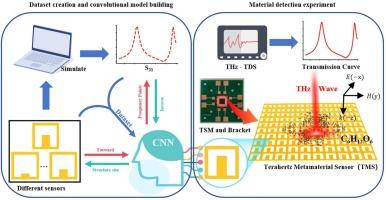
This paper proposes a convolutional neural network (CNN)-assisted method for both forward optimization and inverse design of terahertz metamaterial sensors (TMSs), addressing the limitations imposed by reliance on manual trial-and-error processes. A hollow n-shaped TMS based on copper foil was developed, exhibiting two distinct resonance peaks between 0.3 and 1.4 THz. The formation mechanisms of resonance peaks were analyzed based on electric field and current distribution, while the sensing performance of the TMS was investigated. In the forward optimization stage, the n-shaped unit of TMS was converted into a data matrix, and the CNN was developed to predict the resonance frequency. In the inverse design stage, a predictive model for estimating the size of the TMS was developed by applying one-dimensional convolution to the transmission coefficients. The training dataset employed for forward optimization and inverse design achieved coefficients of determination (R2) of 0.99 and 0.99, respectively, with corresponding mean absolute error (MAE) values of 3.90 and 1.04. The efficacy of the proposed method was validated through terahertz time-domain spectroscopy (THz-TDS) measurements of TMS. Experimental assessments were conducted on glucose solutions of varying concentrations to ascertain the sensing capabilities. The proposed method contributes to the efficient design and optimization of TMS.
期刊介绍:
Materials and Design is a multi-disciplinary journal that publishes original research reports, review articles, and express communications. The journal focuses on studying the structure and properties of inorganic and organic materials, advancements in synthesis, processing, characterization, and testing, the design of materials and engineering systems, and their applications in technology. It aims to bring together various aspects of materials science, engineering, physics, and chemistry.
The journal explores themes ranging from materials to design and aims to reveal the connections between natural and artificial materials, as well as experiment and modeling. Manuscripts submitted to Materials and Design should contain elements of discovery and surprise, as they often contribute new insights into the architecture and function of matter.



 京公网安备 11010802042870号
京ICP备2023020795号-1
京公网安备 11010802042870号
京ICP备2023020795号-1

 分享
分享
 求助内容:
求助内容: 应助结果提醒方式:
 扫码关注我们
