Viktor Wessely , Indranil Basu , Jeffrey M. Wheeler , Robin E. Schäublin , Ueli Töpfer , Stephan S.A. Gerstl , Stefan Pogatscher , Peter J. Uggowitzer , Jörg F. Löffler
{"title":"A multiscale investigation of hardening behavior in dispersoid-modified AlZnMg alloys","authors":"Viktor Wessely , Indranil Basu , Jeffrey M. Wheeler , Robin E. Schäublin , Ueli Töpfer , Stephan S.A. Gerstl , Stefan Pogatscher , Peter J. Uggowitzer , Jörg F. Löffler","doi":"10.1016/j.matdes.2025.113838","DOIUrl":null,"url":null,"abstract":"<div><div>While dispersoid-modified Al–Zn–Mg alloys have improved thermal stability compared to their unmodified variants, they generally exhibit a reduced age-hardening potential. In the current work, Al–Zn–Mg alloys with Hf and Zr additions below 1 wt% were systematically studied with respect to the influence of the induced Hf–Zr-rich Al<sub>3</sub>X dispersoids on the Mg–Zn precipitation hardening response. A multiscale analysis was applied using correlative instrumented indentation, electron microscopy and atom probe tomography to derive the microstructure-property relationships in these alloys, with a focus on the precipitation behavior during the aging process. The results are compared to a reference dispersoid-free Al–Zn–Mg alloy subjected to the same aging treatment. A heterogeneous microstructure consisting of dispersoid-rich dendritic regions surrounded by dispersoid-free interdendritic regions was identified, with coarser Mg–Zn precipitation in the former. Via indentation mapping, we show that these local composition gradients correlate with spatial fluctuations in hardness. Related quantitative analysis indicates that the observed reduced macroscopic hardening potential during a 140 °C aging treatment of the dispersoid-modified alloys results from the coarser precipitates in the dispersoid-rich regions.</div></div>","PeriodicalId":383,"journal":{"name":"Materials & Design","volume":"253 ","pages":"Article 113838"},"PeriodicalIF":7.9000,"publicationDate":"2025-05-01","publicationTypes":"Journal Article","fieldsOfStudy":null,"isOpenAccess":false,"openAccessPdf":"","citationCount":"0","resultStr":null,"platform":"Semanticscholar","paperid":null,"PeriodicalName":"Materials & Design","FirstCategoryId":"88","ListUrlMain":"https://www.sciencedirect.com/science/article/pii/S0264127525002588","RegionNum":2,"RegionCategory":"材料科学","ArticlePicture":[],"TitleCN":null,"AbstractTextCN":null,"PMCID":null,"EPubDate":"2025/3/15 0:00:00","PubModel":"Epub","JCR":"Q1","JCRName":"MATERIALS SCIENCE, MULTIDISCIPLINARY","Score":null,"Total":0}
引用次数: 0
Abstract
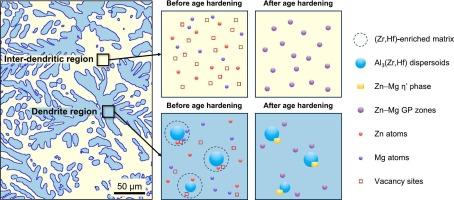
While dispersoid-modified Al–Zn–Mg alloys have improved thermal stability compared to their unmodified variants, they generally exhibit a reduced age-hardening potential. In the current work, Al–Zn–Mg alloys with Hf and Zr additions below 1 wt% were systematically studied with respect to the influence of the induced Hf–Zr-rich Al3X dispersoids on the Mg–Zn precipitation hardening response. A multiscale analysis was applied using correlative instrumented indentation, electron microscopy and atom probe tomography to derive the microstructure-property relationships in these alloys, with a focus on the precipitation behavior during the aging process. The results are compared to a reference dispersoid-free Al–Zn–Mg alloy subjected to the same aging treatment. A heterogeneous microstructure consisting of dispersoid-rich dendritic regions surrounded by dispersoid-free interdendritic regions was identified, with coarser Mg–Zn precipitation in the former. Via indentation mapping, we show that these local composition gradients correlate with spatial fluctuations in hardness. Related quantitative analysis indicates that the observed reduced macroscopic hardening potential during a 140 °C aging treatment of the dispersoid-modified alloys results from the coarser precipitates in the dispersoid-rich regions.
期刊介绍:
Materials and Design is a multi-disciplinary journal that publishes original research reports, review articles, and express communications. The journal focuses on studying the structure and properties of inorganic and organic materials, advancements in synthesis, processing, characterization, and testing, the design of materials and engineering systems, and their applications in technology. It aims to bring together various aspects of materials science, engineering, physics, and chemistry.
The journal explores themes ranging from materials to design and aims to reveal the connections between natural and artificial materials, as well as experiment and modeling. Manuscripts submitted to Materials and Design should contain elements of discovery and surprise, as they often contribute new insights into the architecture and function of matter.



 京公网安备 11010802042870号
京ICP备2023020795号-1
京公网安备 11010802042870号
京ICP备2023020795号-1

 分享
分享
 求助内容:
求助内容: 应助结果提醒方式:
 扫码关注我们
