Xiangbing Gong , Jintao Ma , Guoping Qian , Huanan Yu , Cheng Zhong
{"title":"Determination and quantitative representation of three-level dispersion system in asphalt mixture interface area","authors":"Xiangbing Gong , Jintao Ma , Guoping Qian , Huanan Yu , Cheng Zhong","doi":"10.1016/j.matdes.2025.113879","DOIUrl":null,"url":null,"abstract":"<div><div>To establish a theoretical foundation for the quantitative design of asphalt mixtures based on mastic theory, this study investigates the interfacial zone of OGFC-13 asphalt mixtures. A three-dimensional digital twin model of the interfacial zone in OGFC-13 was developed using X-ray computed tomography (CT) and an enhanced U-Net deep learning algorithm. The model delineated a three-level dispersion system (TDS) within the interfacial zone, outlining the distribution ranges of each system. Furthermore, the distribution of each zone within the interfacial zone’s three-level dispersion system was validated through micro-mechanical, morphological analyses, elemental analyses, and theoretical calculations. The reliability of the enhanced U-Net deep learning algorithm in processing mesoscopic images was confirmed by segmenting asphalt mixture images. The digital twin model reveals that within the three-level dispersion system of the interfacial zone in OGFC-13, the pure asphalt area spans 8–25 µm, the asphalt mastic area ranges from 30 to 108 µm, and the asphalt mortar area extends from 300 to 1360 µm. These distribution ranges agree with the results obtained from nanoindentation, energy-dispersive spectroscopy (EDS), and washing tests, thereby confirming the consistency of the digital twin model with experimental evidence.</div></div>","PeriodicalId":383,"journal":{"name":"Materials & Design","volume":"253 ","pages":"Article 113879"},"PeriodicalIF":7.9000,"publicationDate":"2025-03-26","publicationTypes":"Journal Article","fieldsOfStudy":null,"isOpenAccess":false,"openAccessPdf":"","citationCount":"0","resultStr":null,"platform":"Semanticscholar","paperid":null,"PeriodicalName":"Materials & Design","FirstCategoryId":"88","ListUrlMain":"https://www.sciencedirect.com/science/article/pii/S0264127525002990","RegionNum":2,"RegionCategory":"材料科学","ArticlePicture":[],"TitleCN":null,"AbstractTextCN":null,"PMCID":null,"EPubDate":"","PubModel":"","JCR":"Q1","JCRName":"MATERIALS SCIENCE, MULTIDISCIPLINARY","Score":null,"Total":0}
引用次数: 0
Abstract
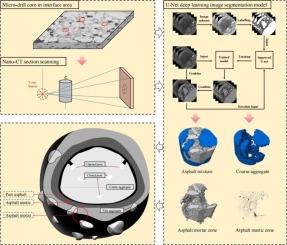
To establish a theoretical foundation for the quantitative design of asphalt mixtures based on mastic theory, this study investigates the interfacial zone of OGFC-13 asphalt mixtures. A three-dimensional digital twin model of the interfacial zone in OGFC-13 was developed using X-ray computed tomography (CT) and an enhanced U-Net deep learning algorithm. The model delineated a three-level dispersion system (TDS) within the interfacial zone, outlining the distribution ranges of each system. Furthermore, the distribution of each zone within the interfacial zone’s three-level dispersion system was validated through micro-mechanical, morphological analyses, elemental analyses, and theoretical calculations. The reliability of the enhanced U-Net deep learning algorithm in processing mesoscopic images was confirmed by segmenting asphalt mixture images. The digital twin model reveals that within the three-level dispersion system of the interfacial zone in OGFC-13, the pure asphalt area spans 8–25 µm, the asphalt mastic area ranges from 30 to 108 µm, and the asphalt mortar area extends from 300 to 1360 µm. These distribution ranges agree with the results obtained from nanoindentation, energy-dispersive spectroscopy (EDS), and washing tests, thereby confirming the consistency of the digital twin model with experimental evidence.
期刊介绍:
Materials and Design is a multi-disciplinary journal that publishes original research reports, review articles, and express communications. The journal focuses on studying the structure and properties of inorganic and organic materials, advancements in synthesis, processing, characterization, and testing, the design of materials and engineering systems, and their applications in technology. It aims to bring together various aspects of materials science, engineering, physics, and chemistry.
The journal explores themes ranging from materials to design and aims to reveal the connections between natural and artificial materials, as well as experiment and modeling. Manuscripts submitted to Materials and Design should contain elements of discovery and surprise, as they often contribute new insights into the architecture and function of matter.



 京公网安备 11010802042870号
京ICP备2023020795号-1
京公网安备 11010802042870号
京ICP备2023020795号-1

 分享
分享
 求助内容:
求助内容: 应助结果提醒方式:
 扫码关注我们
