Hui Niu , Xianwei Chen , Xiong Fu , Bin Zhang , Zuman Dou , Qiang Huang
{"title":"Pectin-stabilized emulsions: Structure-emulsification relationships, covalent and non-covalent modifications, and future trends","authors":"Hui Niu , Xianwei Chen , Xiong Fu , Bin Zhang , Zuman Dou , Qiang Huang","doi":"10.1016/j.tifs.2025.104986","DOIUrl":null,"url":null,"abstract":"<div><h3>Background</h3><div>Emulsions are thermodynamically unstable systems, and as storage time increases emulsions will undergo a series of destabilizing processes. The addition of emulsifiers can delay or even prevent these processes through steric hindrance and electrostatic repulsion effects. Compared with small molecule surfactants and proteins, polysaccharides (especially pectins) as emulsifiers have stronger steric hindrance effect and lower sensitivity to the changes in pH, temperature, and salt concentration in the environment.</div></div><div><h3>Scope and approach</h3><div>This review discusses the factors affecting emulsion stability, structure-emulsification relationships of pectin molecules, and covalent and non-covalent modifications of pectin molecules.</div></div><div><h3>Key findings and conclusions</h3><div>Large-sized pectin molecules have poor interfacial activity, and the interfacial mechanical properties and emulsification performances of pectin molecules can be improved through acid/alkali hydrolysis, enzyme modification, Maillard reaction, chemical cross-linking and electrostatic bonding, so as to obtain long-term stable emulsions.</div></div>","PeriodicalId":441,"journal":{"name":"Trends in Food Science & Technology","volume":"159 ","pages":"Article 104986"},"PeriodicalIF":15.4000,"publicationDate":"2025-05-01","publicationTypes":"Journal Article","fieldsOfStudy":null,"isOpenAccess":false,"openAccessPdf":"","citationCount":"0","resultStr":null,"platform":"Semanticscholar","paperid":null,"PeriodicalName":"Trends in Food Science & Technology","FirstCategoryId":"97","ListUrlMain":"https://www.sciencedirect.com/science/article/pii/S0924224425001220","RegionNum":1,"RegionCategory":"农林科学","ArticlePicture":[],"TitleCN":null,"AbstractTextCN":null,"PMCID":null,"EPubDate":"2025/3/25 0:00:00","PubModel":"Epub","JCR":"Q1","JCRName":"FOOD SCIENCE & TECHNOLOGY","Score":null,"Total":0}
引用次数: 0
Abstract
Background
Emulsions are thermodynamically unstable systems, and as storage time increases emulsions will undergo a series of destabilizing processes. The addition of emulsifiers can delay or even prevent these processes through steric hindrance and electrostatic repulsion effects. Compared with small molecule surfactants and proteins, polysaccharides (especially pectins) as emulsifiers have stronger steric hindrance effect and lower sensitivity to the changes in pH, temperature, and salt concentration in the environment.
Scope and approach
This review discusses the factors affecting emulsion stability, structure-emulsification relationships of pectin molecules, and covalent and non-covalent modifications of pectin molecules.
Key findings and conclusions
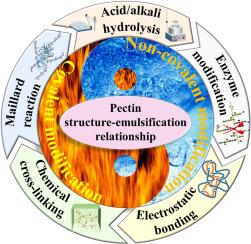
Large-sized pectin molecules have poor interfacial activity, and the interfacial mechanical properties and emulsification performances of pectin molecules can be improved through acid/alkali hydrolysis, enzyme modification, Maillard reaction, chemical cross-linking and electrostatic bonding, so as to obtain long-term stable emulsions.
期刊介绍:
Trends in Food Science & Technology is a prestigious international journal that specializes in peer-reviewed articles covering the latest advancements in technology, food science, and human nutrition. It serves as a bridge between specialized primary journals and general trade magazines, providing readable and scientifically rigorous reviews and commentaries on current research developments and their potential applications in the food industry.
Unlike traditional journals, Trends in Food Science & Technology does not publish original research papers. Instead, it focuses on critical and comprehensive reviews to offer valuable insights for professionals in the field. By bringing together cutting-edge research and industry applications, this journal plays a vital role in disseminating knowledge and facilitating advancements in the food science and technology sector.



 京公网安备 11010802042870号
京ICP备2023020795号-1
京公网安备 11010802042870号
京ICP备2023020795号-1

 分享
分享
 求助内容:
求助内容: 应助结果提醒方式:
 扫码关注我们
