Jackquline C. Eardley , Wei Sung Ng , Elizaveta Forbes , George V. Franks
{"title":"Flocculation-flotation of ultrafine hematite from quartz using anionic polyacrylamide as a selective flocculant","authors":"Jackquline C. Eardley , Wei Sung Ng , Elizaveta Forbes , George V. Franks","doi":"10.1016/j.mineng.2025.109254","DOIUrl":null,"url":null,"abstract":"<div><div>Conventional flotation cells are widely used for concentrating iron ores, yet one major challenge remains – the low recovery rate of ultrafine particles, particularly when processing low-grade deposits. This study explores the application of anionic polyacrylamide (APAM) in hematite and quartz mixtures (D<sub>50</sub>: 1 μm, feed grade: 27.2 % hematite) to selectively aggregate hematite for enhanced flotation recovery. The role of sodium hexametaphosphate (SHMP) was examined as a dispersant to prevent heterocoagulation and to enhance selective aggregation towards hematite, evaluating its effect on the combined flocculation-flotation performance. Detailed insights are provided into the interactions between each reagent combination with sodium oleate (NaOL) as collector, along with an analysis of the limitations of this approach.</div><div>Flotation with NaOL alone resulted in a hematite recovery of 44.5%. The addition of APAM increased hematite recovery to 82.7%. There was limited improvement in grade due to increased quartz entrainment and entrapment within the aggregates. When combined with SHMP, hematite grade improved by 11.4% as SHMP reduced heterocoagulation between hematite and quartz, and reduced entrainment by regulating the froth. Over 99% hematite recovery was achievable with optimised reagent doses. Since SHMP also functions as a depressant, the dose must be optimised to avoid excessive froth destabilisation. Overdosing APAM resulted in overly hydrophilic flocs which negatively impacts recovery. Balancing the dosage of all three reagents is crucial for optimum results. The highest grade achievable was 45.2% due to quartz entrapment and entrainment which is difficult to minimise in conventional lab scale mechanical flotation cells when handling ultrafine minerals.</div></div>","PeriodicalId":18594,"journal":{"name":"Minerals Engineering","volume":"227 ","pages":"Article 109254"},"PeriodicalIF":5.0000,"publicationDate":"2025-07-15","publicationTypes":"Journal Article","fieldsOfStudy":null,"isOpenAccess":false,"openAccessPdf":"","citationCount":"0","resultStr":null,"platform":"Semanticscholar","paperid":null,"PeriodicalName":"Minerals Engineering","FirstCategoryId":"5","ListUrlMain":"https://www.sciencedirect.com/science/article/pii/S0892687525000822","RegionNum":2,"RegionCategory":"工程技术","ArticlePicture":[],"TitleCN":null,"AbstractTextCN":null,"PMCID":null,"EPubDate":"2025/3/28 0:00:00","PubModel":"Epub","JCR":"Q1","JCRName":"ENGINEERING, CHEMICAL","Score":null,"Total":0}
引用次数: 0
Abstract
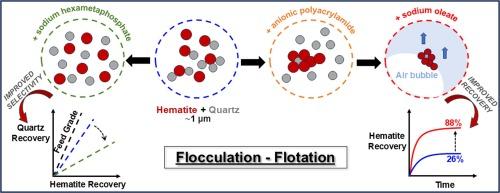
Conventional flotation cells are widely used for concentrating iron ores, yet one major challenge remains – the low recovery rate of ultrafine particles, particularly when processing low-grade deposits. This study explores the application of anionic polyacrylamide (APAM) in hematite and quartz mixtures (D50: 1 μm, feed grade: 27.2 % hematite) to selectively aggregate hematite for enhanced flotation recovery. The role of sodium hexametaphosphate (SHMP) was examined as a dispersant to prevent heterocoagulation and to enhance selective aggregation towards hematite, evaluating its effect on the combined flocculation-flotation performance. Detailed insights are provided into the interactions between each reagent combination with sodium oleate (NaOL) as collector, along with an analysis of the limitations of this approach.
Flotation with NaOL alone resulted in a hematite recovery of 44.5%. The addition of APAM increased hematite recovery to 82.7%. There was limited improvement in grade due to increased quartz entrainment and entrapment within the aggregates. When combined with SHMP, hematite grade improved by 11.4% as SHMP reduced heterocoagulation between hematite and quartz, and reduced entrainment by regulating the froth. Over 99% hematite recovery was achievable with optimised reagent doses. Since SHMP also functions as a depressant, the dose must be optimised to avoid excessive froth destabilisation. Overdosing APAM resulted in overly hydrophilic flocs which negatively impacts recovery. Balancing the dosage of all three reagents is crucial for optimum results. The highest grade achievable was 45.2% due to quartz entrapment and entrainment which is difficult to minimise in conventional lab scale mechanical flotation cells when handling ultrafine minerals.
期刊介绍:
The purpose of the journal is to provide for the rapid publication of topical papers featuring the latest developments in the allied fields of mineral processing and extractive metallurgy. Its wide ranging coverage of research and practical (operating) topics includes physical separation methods, such as comminution, flotation concentration and dewatering, chemical methods such as bio-, hydro-, and electro-metallurgy, analytical techniques, process control, simulation and instrumentation, and mineralogical aspects of processing. Environmental issues, particularly those pertaining to sustainable development, will also be strongly covered.



 京公网安备 11010802042870号
京ICP备2023020795号-1
京公网安备 11010802042870号
京ICP备2023020795号-1

 分享
分享
 求助内容:
求助内容: 应助结果提醒方式:
 扫码关注我们
