Weitao Wang , Chunfu Liu , Han Wang , Chenyu Zhu , Bao Ren , Lingyun Liu , Fanfei Min
{"title":"Experiment and simulation research on the effect of lattice defect-Fe3+ on the quartz surface wettability","authors":"Weitao Wang , Chunfu Liu , Han Wang , Chenyu Zhu , Bao Ren , Lingyun Liu , Fanfei Min","doi":"10.1016/j.mineng.2025.109282","DOIUrl":null,"url":null,"abstract":"<div><div>The hydration characteristic of quartz surface is the key of quartz deep flotation purification. In this study, molecular dynamics (MD) simulation and experimental methods were used to study the effect of lattice Fe<sup>3+</sup> impurities on quartz surface hydration properties. Quartz samples with different lattice Fe<sup>3+</sup> content were obtained by roasting H<sub>2</sub>SO<sub>4</sub>-HCl-HF mixed acid with NH<sub>4</sub>Cl. The changes in the lattice Fe<sup>3+</sup> content of the prepared quartz samples were characterized and validated using scanning electron microscopy (SEM), energy-dispersive spectroscopy (EDS), and X-ray photoelectron spectroscopy (XPS). The accuracy of the hydration simulation calculations was validated using contact angle measurements and wettability test results. The results indicate that as Fe<sup>3+</sup> doping increases, Na<sup>+</sup> ions diffuse into the water layer during adsorption on the Fe<sup>3+</sup>-doped quartz (0<!--> <!-->0<!--> <!-->1) surface and form hydrated complexes with H<sub>2</sub>O molecules, reaching an equilibrium state. As the doping concentration increases, the interaction between water molecules and the Fe<sup>3+</sup>-doped α-quartz (0<!--> <!-->0<!--> <!-->1) surface strengthens, accompanied by an increase in interfacial hydrogen bonds. In the contact angle simulation, the contact angle of the undoped quartz surface is about 4° higher than that of the Fe<sup>3+</sup> doped surface. When the Fe<sup>3+</sup> content in the quartz sample increased from 39.4 ppm to 80 ppm, the contact angle decreased by about 3.2°, consistent with the simulated trend. Wettability tests show that with increasing levels of Fe<sup>3+</sup> there is a further increase in surface hydrophilicity in the order: NH<sub>4</sub>Cl(0 %)-Q-H<sup>+</sup><NH<sub>4</sub>Cl(1 %)-Q-H<sup>+</sup><NH<sub>4</sub>Cl(5 %)-Q-H<sup>+</sup>. It can be concluded that higher Fe<sup>3+</sup> impurity levels in the quartz lattice significantly enhance the surface hydration characteristics. These results provide a theoretical basis for the selective separation and deep purification of quartz minerals.</div></div>","PeriodicalId":18594,"journal":{"name":"Minerals Engineering","volume":"227 ","pages":"Article 109282"},"PeriodicalIF":5.0000,"publicationDate":"2025-03-29","publicationTypes":"Journal Article","fieldsOfStudy":null,"isOpenAccess":false,"openAccessPdf":"","citationCount":"0","resultStr":null,"platform":"Semanticscholar","paperid":null,"PeriodicalName":"Minerals Engineering","FirstCategoryId":"5","ListUrlMain":"https://www.sciencedirect.com/science/article/pii/S0892687525001104","RegionNum":2,"RegionCategory":"工程技术","ArticlePicture":[],"TitleCN":null,"AbstractTextCN":null,"PMCID":null,"EPubDate":"","PubModel":"","JCR":"Q1","JCRName":"ENGINEERING, CHEMICAL","Score":null,"Total":0}
引用次数: 0
Abstract
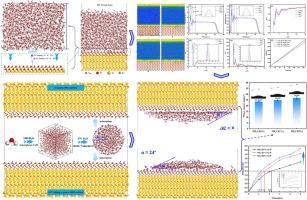
The hydration characteristic of quartz surface is the key of quartz deep flotation purification. In this study, molecular dynamics (MD) simulation and experimental methods were used to study the effect of lattice Fe3+ impurities on quartz surface hydration properties. Quartz samples with different lattice Fe3+ content were obtained by roasting H2SO4-HCl-HF mixed acid with NH4Cl. The changes in the lattice Fe3+ content of the prepared quartz samples were characterized and validated using scanning electron microscopy (SEM), energy-dispersive spectroscopy (EDS), and X-ray photoelectron spectroscopy (XPS). The accuracy of the hydration simulation calculations was validated using contact angle measurements and wettability test results. The results indicate that as Fe3+ doping increases, Na+ ions diffuse into the water layer during adsorption on the Fe3+-doped quartz (0 0 1) surface and form hydrated complexes with H2O molecules, reaching an equilibrium state. As the doping concentration increases, the interaction between water molecules and the Fe3+-doped α-quartz (0 0 1) surface strengthens, accompanied by an increase in interfacial hydrogen bonds. In the contact angle simulation, the contact angle of the undoped quartz surface is about 4° higher than that of the Fe3+ doped surface. When the Fe3+ content in the quartz sample increased from 39.4 ppm to 80 ppm, the contact angle decreased by about 3.2°, consistent with the simulated trend. Wettability tests show that with increasing levels of Fe3+ there is a further increase in surface hydrophilicity in the order: NH4Cl(0 %)-Q-H+<NH4Cl(1 %)-Q-H+<NH4Cl(5 %)-Q-H+. It can be concluded that higher Fe3+ impurity levels in the quartz lattice significantly enhance the surface hydration characteristics. These results provide a theoretical basis for the selective separation and deep purification of quartz minerals.
期刊介绍:
The purpose of the journal is to provide for the rapid publication of topical papers featuring the latest developments in the allied fields of mineral processing and extractive metallurgy. Its wide ranging coverage of research and practical (operating) topics includes physical separation methods, such as comminution, flotation concentration and dewatering, chemical methods such as bio-, hydro-, and electro-metallurgy, analytical techniques, process control, simulation and instrumentation, and mineralogical aspects of processing. Environmental issues, particularly those pertaining to sustainable development, will also be strongly covered.



 京公网安备 11010802042870号
京ICP备2023020795号-1
京公网安备 11010802042870号
京ICP备2023020795号-1

 分享
分享
 求助内容:
求助内容: 应助结果提醒方式:
 扫码关注我们
