{"title":"Allocating conservation resources between uncertain future states of nature","authors":"Neil Perry , Sriram Shankar","doi":"10.1016/j.ecolecon.2025.108610","DOIUrl":null,"url":null,"abstract":"<div><div>When uncertainty prevails, conservation decision makers allocate funds, inputs and resources between future states of nature to hedge their bets. Decision makers explicitly or implicitly substitute biodiversity in one future state of nature for biodiversity in another. However, the decision making frameworks common in conservation biology do not model, explain or justify such behavior. Frameworks such as information gap analysis, expected benefit, stochastic dominance and minimizing the maximum loss result in resources being dedicated to one state of nature. Portfolio theory applied to conservation under uncertainty leads to resource allocations across states of nature but the framework we propose in this paper is more general and a better (more realistic) representation of conservation decision making. Utilizing a standard hypothetical example of maximizing the population size of the endangered orange-bellied parrot (<em>Neophema chrysogaster</em>), we develop the state-contingent approach and contrast it with standard decision-making frameworks. We explain that the state-contingent approach is unique because it is explicit about the relationship between actions and the states of nature that could arise. The extent to which any one action or future state of nature receives funding depends on three variables – the subjective probability that the state of nature will arise, society's risk preferences, and the conservation technology, or the effectiveness of the conservation action under different states of nature. We focus on the conservation technology and introduce three different classes – state general technologies, state allocable technologies, and state specific technologies. Each type of conservation technology leads to different allocation solutions and we provide examples from the conservation literature where each technology applies. Using a framework grounded in economic theory, the state-contingent approach improves the justification of precautionary conservation action, and we discuss the applicability of the approach to the conservation of the Tasmanian devil (<em>Sarcophilus harrisii</em>).</div></div>","PeriodicalId":51021,"journal":{"name":"Ecological Economics","volume":"234 ","pages":"Article 108610"},"PeriodicalIF":6.3000,"publicationDate":"2025-03-28","publicationTypes":"Journal Article","fieldsOfStudy":null,"isOpenAccess":false,"openAccessPdf":"","citationCount":"0","resultStr":null,"platform":"Semanticscholar","paperid":null,"PeriodicalName":"Ecological Economics","FirstCategoryId":"96","ListUrlMain":"https://www.sciencedirect.com/science/article/pii/S092180092500093X","RegionNum":2,"RegionCategory":"经济学","ArticlePicture":[],"TitleCN":null,"AbstractTextCN":null,"PMCID":null,"EPubDate":"","PubModel":"","JCR":"Q1","JCRName":"ECOLOGY","Score":null,"Total":0}
引用次数: 0
Abstract
When uncertainty prevails, conservation decision makers allocate funds, inputs and resources between future states of nature to hedge their bets. Decision makers explicitly or implicitly substitute biodiversity in one future state of nature for biodiversity in another. However, the decision making frameworks common in conservation biology do not model, explain or justify such behavior. Frameworks such as information gap analysis, expected benefit, stochastic dominance and minimizing the maximum loss result in resources being dedicated to one state of nature. Portfolio theory applied to conservation under uncertainty leads to resource allocations across states of nature but the framework we propose in this paper is more general and a better (more realistic) representation of conservation decision making. Utilizing a standard hypothetical example of maximizing the population size of the endangered orange-bellied parrot (Neophema chrysogaster), we develop the state-contingent approach and contrast it with standard decision-making frameworks. We explain that the state-contingent approach is unique because it is explicit about the relationship between actions and the states of nature that could arise. The extent to which any one action or future state of nature receives funding depends on three variables – the subjective probability that the state of nature will arise, society's risk preferences, and the conservation technology, or the effectiveness of the conservation action under different states of nature. We focus on the conservation technology and introduce three different classes – state general technologies, state allocable technologies, and state specific technologies. Each type of conservation technology leads to different allocation solutions and we provide examples from the conservation literature where each technology applies. Using a framework grounded in economic theory, the state-contingent approach improves the justification of precautionary conservation action, and we discuss the applicability of the approach to the conservation of the Tasmanian devil (Sarcophilus harrisii).
期刊介绍:
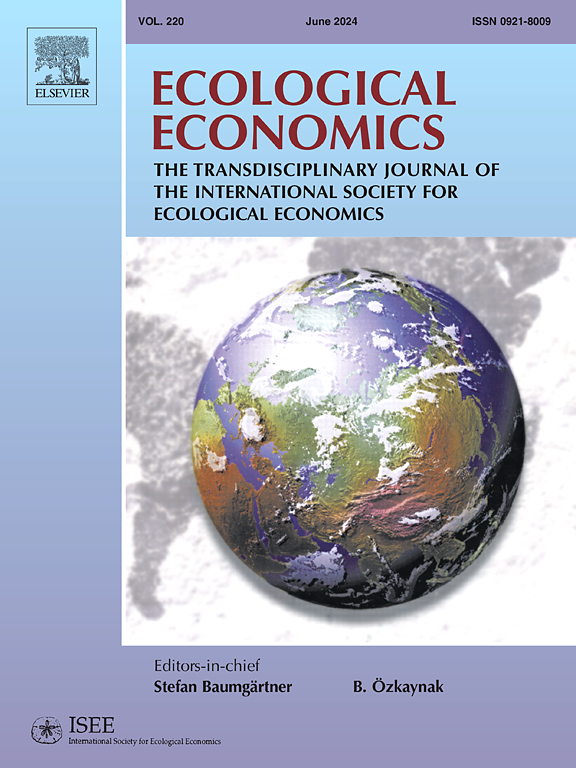
Ecological Economics is concerned with extending and integrating the understanding of the interfaces and interplay between "nature''s household" (ecosystems) and "humanity''s household" (the economy). Ecological economics is an interdisciplinary field defined by a set of concrete problems or challenges related to governing economic activity in a way that promotes human well-being, sustainability, and justice. The journal thus emphasizes critical work that draws on and integrates elements of ecological science, economics, and the analysis of values, behaviors, cultural practices, institutional structures, and societal dynamics. The journal is transdisciplinary in spirit and methodologically open, drawing on the insights offered by a variety of intellectual traditions, and appealing to a diverse readership.
Specific research areas covered include: valuation of natural resources, sustainable agriculture and development, ecologically integrated technology, integrated ecologic-economic modelling at scales from local to regional to global, implications of thermodynamics for economics and ecology, renewable resource management and conservation, critical assessments of the basic assumptions underlying current economic and ecological paradigms and the implications of alternative assumptions, economic and ecological consequences of genetically engineered organisms, and gene pool inventory and management, alternative principles for valuing natural wealth, integrating natural resources and environmental services into national income and wealth accounts, methods of implementing efficient environmental policies, case studies of economic-ecologic conflict or harmony, etc. New issues in this area are rapidly emerging and will find a ready forum in Ecological Economics.



 京公网安备 11010802042870号
京ICP备2023020795号-1
京公网安备 11010802042870号
京ICP备2023020795号-1

 分享
分享
 求助内容:
求助内容: 应助结果提醒方式:
 扫码关注我们
