{"title":"Unraveling an excited state intramolecular double proton transfer pathway in 2,5-bis(benzoxazole-2-yl)benzene-1,4-diol derivatives","authors":"Qiao Zhou , Bifa Cao , Peng Song , Wanjia Wen","doi":"10.1016/j.saa.2025.126109","DOIUrl":null,"url":null,"abstract":"<div><div>Organic molecules exhibiting excited-state intramolecular double proton transfer (ESIDPT) have garnered significant research interest, largely driven by their prevalence in nature and the unique luminescent properties associated with this phenomenon. This study presents a detailed theoretical investigation into the dynamic mechanism of both single and dual cooperative Proton transfer (PT) in the first excited singlet (S<sub>1</sub>) state of 2,5-bis(benzoxazole-2-yl)-1,4-dihydroxybenzene derivatives. The analysis meticulously incorporates solvent effects, specifically those of dichloromethane, to provide a comprehensive understanding of the PT processes. The occurrence of the ESIDPT process was confirmed by integrating infrared (IR) vibrational spectra, frontier molecular orbital analysis, and reduced density gradient (RDG) analysis. Additionally, the potential energy surfaces (PESs) for the ground (S<sub>0</sub>) and S<sub>1</sub> states revealed a synergistic interaction between single and dual ESIPT processes within the S<sub>1</sub> state. Furthermore, variation in the charge distribution, resulting from the coupling of photoinduced electron transfer with ESIPT involving the DPA group, led to distinct PT propensities for the O<sub>1</sub> and O<sub>4</sub> atoms. Consequently, these configurations are unable to undergo simultaneous proton transfer, as demonstrated by the construction of a potential energy surface. In addition, the corresponding PT PESs show that the ESIPT reaction for Zinhbo-9 is much easier for the Zinhbo-5 modified with a t-Bu group, which affect O4–H5···N6 hydrogen bond. These theoretical computations provide a robust explanation of the observed experimental phenomena and suggest potential pathways for future advancements and applications of ESIDPT molecules.</div></div>","PeriodicalId":433,"journal":{"name":"Spectrochimica Acta Part A: Molecular and Biomolecular Spectroscopy","volume":"337 ","pages":"Article 126109"},"PeriodicalIF":4.6000,"publicationDate":"2025-09-05","publicationTypes":"Journal Article","fieldsOfStudy":null,"isOpenAccess":false,"openAccessPdf":"","citationCount":"0","resultStr":null,"platform":"Semanticscholar","paperid":null,"PeriodicalName":"Spectrochimica Acta Part A: Molecular and Biomolecular Spectroscopy","FirstCategoryId":"92","ListUrlMain":"https://www.sciencedirect.com/science/article/pii/S1386142525004159","RegionNum":2,"RegionCategory":"化学","ArticlePicture":[],"TitleCN":null,"AbstractTextCN":null,"PMCID":null,"EPubDate":"2025/3/25 0:00:00","PubModel":"Epub","JCR":"Q1","JCRName":"SPECTROSCOPY","Score":null,"Total":0}
引用次数: 0
Abstract
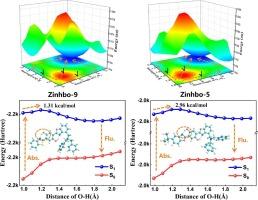
Organic molecules exhibiting excited-state intramolecular double proton transfer (ESIDPT) have garnered significant research interest, largely driven by their prevalence in nature and the unique luminescent properties associated with this phenomenon. This study presents a detailed theoretical investigation into the dynamic mechanism of both single and dual cooperative Proton transfer (PT) in the first excited singlet (S1) state of 2,5-bis(benzoxazole-2-yl)-1,4-dihydroxybenzene derivatives. The analysis meticulously incorporates solvent effects, specifically those of dichloromethane, to provide a comprehensive understanding of the PT processes. The occurrence of the ESIDPT process was confirmed by integrating infrared (IR) vibrational spectra, frontier molecular orbital analysis, and reduced density gradient (RDG) analysis. Additionally, the potential energy surfaces (PESs) for the ground (S0) and S1 states revealed a synergistic interaction between single and dual ESIPT processes within the S1 state. Furthermore, variation in the charge distribution, resulting from the coupling of photoinduced electron transfer with ESIPT involving the DPA group, led to distinct PT propensities for the O1 and O4 atoms. Consequently, these configurations are unable to undergo simultaneous proton transfer, as demonstrated by the construction of a potential energy surface. In addition, the corresponding PT PESs show that the ESIPT reaction for Zinhbo-9 is much easier for the Zinhbo-5 modified with a t-Bu group, which affect O4–H5···N6 hydrogen bond. These theoretical computations provide a robust explanation of the observed experimental phenomena and suggest potential pathways for future advancements and applications of ESIDPT molecules.
期刊介绍:
Spectrochimica Acta, Part A: Molecular and Biomolecular Spectroscopy (SAA) is an interdisciplinary journal which spans from basic to applied aspects of optical spectroscopy in chemistry, medicine, biology, and materials science.
The journal publishes original scientific papers that feature high-quality spectroscopic data and analysis. From the broad range of optical spectroscopies, the emphasis is on electronic, vibrational or rotational spectra of molecules, rather than on spectroscopy based on magnetic moments.
Criteria for publication in SAA are novelty, uniqueness, and outstanding quality. Routine applications of spectroscopic techniques and computational methods are not appropriate.
Topics of particular interest of Spectrochimica Acta Part A include, but are not limited to:
Spectroscopy and dynamics of bioanalytical, biomedical, environmental, and atmospheric sciences,
Novel experimental techniques or instrumentation for molecular spectroscopy,
Novel theoretical and computational methods,
Novel applications in photochemistry and photobiology,
Novel interpretational approaches as well as advances in data analysis based on electronic or vibrational spectroscopy.




 京公网安备 11010802042870号
京ICP备2023020795号-1
京公网安备 11010802042870号
京ICP备2023020795号-1

 分享
分享
 求助内容:
求助内容: 应助结果提醒方式:
 扫码关注我们
