Nicolas Argibay , Duane D. Johnson , Michael Chandross , Ryan T. Ott , Hailong Huang , Rameshwari Naorem , Gaoyuan Ouyang , Andrey V. Smirnov , Prashant Singh
{"title":"An energetic link between order and strength in metals: A nanocrystalline strength limit in high-entropy alloys and intermetallic compounds","authors":"Nicolas Argibay , Duane D. Johnson , Michael Chandross , Ryan T. Ott , Hailong Huang , Rameshwari Naorem , Gaoyuan Ouyang , Andrey V. Smirnov , Prashant Singh","doi":"10.1016/j.actamat.2025.120990","DOIUrl":null,"url":null,"abstract":"<div><div>The metallurgy and materials communities have long understood and exploited fundamental links between chemical and structural ordering in metallic solids to tailor their mechanical properties. We extend these ideas to include prediction of the nanocrystalline strength limit in high-entropy alloys and intermetallic compounds, where a breakdown occurs in the classical Hall-Petch strengthening behavior. The highest reported strength achievable through alloying has rapidly climbed and given rise to new classifications of materials with extraordinary properties, with a notable case being nanocrystalline metals. High-entropy alloys (chemically disordered, concentrated solid solutions) and intermetallic compounds are two boundary cases of how tailored order can be used to manipulate mechanical behavior. Here, we show that the complex electronic-structure mechanisms governing the peak strength of alloys and pure metals can be reduced to a few physically meaningful parameters based on their atomic arrangements and used – <em>with no fitting parameters</em> – to predict the maximum strength of these materials. This includes a generalized energy-based accounting for the degree of structural and chemical ordering that allows for rapid and reasonably accurate prediction of peak strength (validated in the nanocrystalline limit) as a function of temperature. Predictions of maximum strength based on the activation energy (with all materials properties derived from DFT calculations or experiments) for a stress-driven transition to an amorphous state is shown to accurately describe the breakdown in Hall-Petch behavior at the smallest crystallite sizes for pure metals, intermetallic compounds, high-entropy alloys, and metallic glasses. This activation energy is also shown to be directly proportional to interstitial electronic charge density, which is a good predictor of ductility, stiffness (moduli), and phase stability in high-entropy alloys and solid metals generally. The proposed framework suggests the possibility of coupling ordering and intrinsic strength to mechanisms like dislocation nucleation, hydrogen embrittlement, and transport properties, such as through correlations between the activation energies for amorphization with stacking-fault and grain boundary energies. It additionally opens the prospect for greatly accelerated structural materials design and development to address materials challenges limiting more sustainable and efficient use of energy.</div></div>","PeriodicalId":238,"journal":{"name":"Acta Materialia","volume":"290 ","pages":"Article 120990"},"PeriodicalIF":9.3000,"publicationDate":"2025-05-15","publicationTypes":"Journal Article","fieldsOfStudy":null,"isOpenAccess":false,"openAccessPdf":"","citationCount":"0","resultStr":null,"platform":"Semanticscholar","paperid":null,"PeriodicalName":"Acta Materialia","FirstCategoryId":"88","ListUrlMain":"https://www.sciencedirect.com/science/article/pii/S1359645425002812","RegionNum":1,"RegionCategory":"材料科学","ArticlePicture":[],"TitleCN":null,"AbstractTextCN":null,"PMCID":null,"EPubDate":"2025/3/28 0:00:00","PubModel":"Epub","JCR":"Q1","JCRName":"MATERIALS SCIENCE, MULTIDISCIPLINARY","Score":null,"Total":0}
引用次数: 0
Abstract
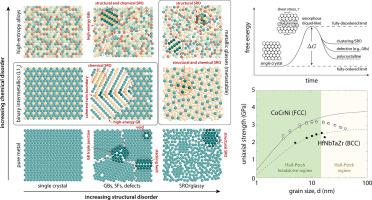
The metallurgy and materials communities have long understood and exploited fundamental links between chemical and structural ordering in metallic solids to tailor their mechanical properties. We extend these ideas to include prediction of the nanocrystalline strength limit in high-entropy alloys and intermetallic compounds, where a breakdown occurs in the classical Hall-Petch strengthening behavior. The highest reported strength achievable through alloying has rapidly climbed and given rise to new classifications of materials with extraordinary properties, with a notable case being nanocrystalline metals. High-entropy alloys (chemically disordered, concentrated solid solutions) and intermetallic compounds are two boundary cases of how tailored order can be used to manipulate mechanical behavior. Here, we show that the complex electronic-structure mechanisms governing the peak strength of alloys and pure metals can be reduced to a few physically meaningful parameters based on their atomic arrangements and used – with no fitting parameters – to predict the maximum strength of these materials. This includes a generalized energy-based accounting for the degree of structural and chemical ordering that allows for rapid and reasonably accurate prediction of peak strength (validated in the nanocrystalline limit) as a function of temperature. Predictions of maximum strength based on the activation energy (with all materials properties derived from DFT calculations or experiments) for a stress-driven transition to an amorphous state is shown to accurately describe the breakdown in Hall-Petch behavior at the smallest crystallite sizes for pure metals, intermetallic compounds, high-entropy alloys, and metallic glasses. This activation energy is also shown to be directly proportional to interstitial electronic charge density, which is a good predictor of ductility, stiffness (moduli), and phase stability in high-entropy alloys and solid metals generally. The proposed framework suggests the possibility of coupling ordering and intrinsic strength to mechanisms like dislocation nucleation, hydrogen embrittlement, and transport properties, such as through correlations between the activation energies for amorphization with stacking-fault and grain boundary energies. It additionally opens the prospect for greatly accelerated structural materials design and development to address materials challenges limiting more sustainable and efficient use of energy.
期刊介绍:
Acta Materialia serves as a platform for publishing full-length, original papers and commissioned overviews that contribute to a profound understanding of the correlation between the processing, structure, and properties of inorganic materials. The journal seeks papers with high impact potential or those that significantly propel the field forward. The scope includes the atomic and molecular arrangements, chemical and electronic structures, and microstructure of materials, focusing on their mechanical or functional behavior across all length scales, including nanostructures.



 京公网安备 11010802042870号
京ICP备2023020795号-1
京公网安备 11010802042870号
京ICP备2023020795号-1

 分享
分享
 求助内容:
求助内容: 应助结果提醒方式:
 扫码关注我们
