Magnus Moe Nygård , Marie Syre Wiig , Nathan Roosloot , Gaute Otnes , Mari B. Øgaard , Heine Nygard Riise , Erik Stensrud Marstein
{"title":"Elucidating uncertainty in bifacial photovoltaic gain estimation","authors":"Magnus Moe Nygård , Marie Syre Wiig , Nathan Roosloot , Gaute Otnes , Mari B. Øgaard , Heine Nygard Riise , Erik Stensrud Marstein","doi":"10.1016/j.solener.2025.113469","DOIUrl":null,"url":null,"abstract":"<div><div>The bifacial gain of fielded bifacial photovoltaic (PV) systems is commonly estimated by comparing the energy yield of the system with that of a monofacial reference. However, this approach is dependent on the selected reference, and can thus be associated with significant uncertainty, since the two technologies might have very different properties. This study investigates the significance of such differences when the bifacial gain is estimated from energy yield time series data. A series of corrections are applied to account for differences in installed capacity and responses with respect to temperature and irradiance. The analysis is carried out using data collected over two years from a 22.6 kW<sub>p</sub> ground-mounted fixed-tilt PV system in Norway using four different monofacial technologies as reference systems that all rely on Si as the active material but have different cell architectures. With no corrections applied, the estimated bifacial gain with the monofacial technology that most closely resembles the bifacial is determined to 12.6 % for the two-year period considered. The estimate increases to 13.1 % when correcting for irradiance and 14.4 % when also correcting for temperature. The results demonstrate that the applied corrections reduces the range between the smallest and largest estimate of the bifacial gain from 6.3 to 3.5 percentage points. Although it is possible that the range can be reduced further if differences in spectral response and degradation are accounted for, it should also be expected that some of the remaining variation reflects the measurement uncertainty inherent to this method of estimating the bifacial gain.</div></div>","PeriodicalId":428,"journal":{"name":"Solar Energy","volume":"292 ","pages":"Article 113469"},"PeriodicalIF":6.0000,"publicationDate":"2025-03-29","publicationTypes":"Journal Article","fieldsOfStudy":null,"isOpenAccess":false,"openAccessPdf":"","citationCount":"0","resultStr":null,"platform":"Semanticscholar","paperid":null,"PeriodicalName":"Solar Energy","FirstCategoryId":"5","ListUrlMain":"https://www.sciencedirect.com/science/article/pii/S0038092X25002324","RegionNum":2,"RegionCategory":"工程技术","ArticlePicture":[],"TitleCN":null,"AbstractTextCN":null,"PMCID":null,"EPubDate":"","PubModel":"","JCR":"Q2","JCRName":"ENERGY & FUELS","Score":null,"Total":0}
引用次数: 0
Abstract
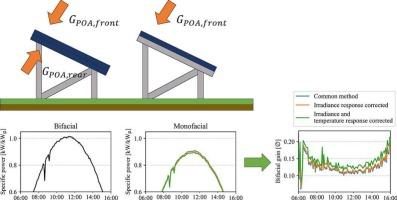
The bifacial gain of fielded bifacial photovoltaic (PV) systems is commonly estimated by comparing the energy yield of the system with that of a monofacial reference. However, this approach is dependent on the selected reference, and can thus be associated with significant uncertainty, since the two technologies might have very different properties. This study investigates the significance of such differences when the bifacial gain is estimated from energy yield time series data. A series of corrections are applied to account for differences in installed capacity and responses with respect to temperature and irradiance. The analysis is carried out using data collected over two years from a 22.6 kWp ground-mounted fixed-tilt PV system in Norway using four different monofacial technologies as reference systems that all rely on Si as the active material but have different cell architectures. With no corrections applied, the estimated bifacial gain with the monofacial technology that most closely resembles the bifacial is determined to 12.6 % for the two-year period considered. The estimate increases to 13.1 % when correcting for irradiance and 14.4 % when also correcting for temperature. The results demonstrate that the applied corrections reduces the range between the smallest and largest estimate of the bifacial gain from 6.3 to 3.5 percentage points. Although it is possible that the range can be reduced further if differences in spectral response and degradation are accounted for, it should also be expected that some of the remaining variation reflects the measurement uncertainty inherent to this method of estimating the bifacial gain.
期刊介绍:
Solar Energy welcomes manuscripts presenting information not previously published in journals on any aspect of solar energy research, development, application, measurement or policy. The term "solar energy" in this context includes the indirect uses such as wind energy and biomass



 京公网安备 11010802042870号
京ICP备2023020795号-1
京公网安备 11010802042870号
京ICP备2023020795号-1

 分享
分享
 求助内容:
求助内容: 应助结果提醒方式:
 扫码关注我们
