Sterre de Bruin , Jan A. van Franeker , André Meijboom , Jens-Kjeld Jensen , Bjarni Jacobsen , Susanne Kühn
{"title":"Plastics in stomachs of northern fulmars (Fulmarus glacialis) collected at Flemish Cap, Grand Banks of Newfoundland","authors":"Sterre de Bruin , Jan A. van Franeker , André Meijboom , Jens-Kjeld Jensen , Bjarni Jacobsen , Susanne Kühn","doi":"10.1016/j.marpolbul.2025.117894","DOIUrl":null,"url":null,"abstract":"<div><div>Incidental studies of plastic ingestion by the northern fulmar (<em>Fulmarus glacialis</em>) over a wide geographical range can improve our understanding of the distribution of marine litter in the global oceans and of the processes involved. A sample of 37 stomachs from northern fulmars (<em>Fulmarus glacialis</em>) collected in June 2021 near Flemish Cap at the eastern end of the Grand Banks of Newfoundland was analysed for the presence of plastic litter. Overall, 89 % of the birds contained plastic, with on average 6.6 particles, and a mass of 0.093 g per bird. No statistical differences were found in the quantity of plastic between males and females. A proportion of 27 % of all birds contained >0.1 g plastic, exceeding the Fulmar Threshold Value (FTV%) and international target of <10 %. Within an existing model that linked plastic abundance to latitude, the Newfoundland sample represented a clear outlier with a considerably lower FTV% compared to what would be expected. Flemish Cap is situated at the border between the southern tip of the cold and relatively clean Labrador Current coming from the north, and the warm and more polluted waters of the Gulf Stream further south. A logistic model using average annual sea surface temperatures representing North Atlantic current systems was applied and demonstrated a highly significant correlation, with the Newfoundland FTV% fitting much closer to the modelled prediction. This new model improves the understanding of geographical patterns in plastic uptake by fulmars.</div></div>","PeriodicalId":18215,"journal":{"name":"Marine pollution bulletin","volume":"215 ","pages":"Article 117894"},"PeriodicalIF":4.9000,"publicationDate":"2025-06-01","publicationTypes":"Journal Article","fieldsOfStudy":null,"isOpenAccess":false,"openAccessPdf":"","citationCount":"0","resultStr":null,"platform":"Semanticscholar","paperid":null,"PeriodicalName":"Marine pollution bulletin","FirstCategoryId":"93","ListUrlMain":"https://www.sciencedirect.com/science/article/pii/S0025326X25003698","RegionNum":3,"RegionCategory":"环境科学与生态学","ArticlePicture":[],"TitleCN":null,"AbstractTextCN":null,"PMCID":null,"EPubDate":"2025/3/29 0:00:00","PubModel":"Epub","JCR":"Q1","JCRName":"ENVIRONMENTAL SCIENCES","Score":null,"Total":0}
引用次数: 0
Abstract
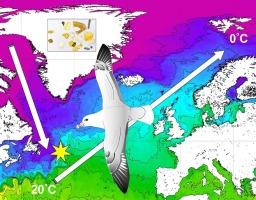
Incidental studies of plastic ingestion by the northern fulmar (Fulmarus glacialis) over a wide geographical range can improve our understanding of the distribution of marine litter in the global oceans and of the processes involved. A sample of 37 stomachs from northern fulmars (Fulmarus glacialis) collected in June 2021 near Flemish Cap at the eastern end of the Grand Banks of Newfoundland was analysed for the presence of plastic litter. Overall, 89 % of the birds contained plastic, with on average 6.6 particles, and a mass of 0.093 g per bird. No statistical differences were found in the quantity of plastic between males and females. A proportion of 27 % of all birds contained >0.1 g plastic, exceeding the Fulmar Threshold Value (FTV%) and international target of <10 %. Within an existing model that linked plastic abundance to latitude, the Newfoundland sample represented a clear outlier with a considerably lower FTV% compared to what would be expected. Flemish Cap is situated at the border between the southern tip of the cold and relatively clean Labrador Current coming from the north, and the warm and more polluted waters of the Gulf Stream further south. A logistic model using average annual sea surface temperatures representing North Atlantic current systems was applied and demonstrated a highly significant correlation, with the Newfoundland FTV% fitting much closer to the modelled prediction. This new model improves the understanding of geographical patterns in plastic uptake by fulmars.
期刊介绍:
Marine Pollution Bulletin is concerned with the rational use of maritime and marine resources in estuaries, the seas and oceans, as well as with documenting marine pollution and introducing new forms of measurement and analysis. A wide range of topics are discussed as news, comment, reviews and research reports, not only on effluent disposal and pollution control, but also on the management, economic aspects and protection of the marine environment in general.



 京公网安备 11010802042870号
京ICP备2023020795号-1
京公网安备 11010802042870号
京ICP备2023020795号-1

 分享
分享
 求助内容:
求助内容: 应助结果提醒方式:
 扫码关注我们
