Saleh Ba-swaimi , Renuga Verayiah , Vigna K. Ramachandaramurthy , Ahmad K. ALAhmad , Azzam Abu-Rayash
{"title":"Development and techno-economic assessment of an optimized and integrated solar/wind energy system for remote health applications","authors":"Saleh Ba-swaimi , Renuga Verayiah , Vigna K. Ramachandaramurthy , Ahmad K. ALAhmad , Azzam Abu-Rayash","doi":"10.1016/j.ecmx.2025.100985","DOIUrl":null,"url":null,"abstract":"<div><div>Healthcare facilities in developing regions face critical challenges owing to unreliable power supply, directly impacting their ability to provide essential medical services and save lives. The successful implementation of hybrid renewable energy systems (HRES) in healthcare facilities could revolutionize medical care delivery in remote and underserved areas. This study opens new pathways for sustainable healthcare infrastructure development that can be replicated across similar regions worldwide. The proposed system includes a solar photovoltaic (PV) system, wind turbine (WT), battery energy storage system (BESS), and diesel generator (DG). Four distinct system configurations were evaluated using HOMER Pro optimization software: DG only (base case), PV/BESS/DG, PV/WT/BESS, and PV/WT/BESS/DG. The analysis include technical, economic, and environmental parameters to determine the optimal configuration. The obtained results demonstrate that the PV/BESS/DG configuration achieves the most favorable economic outcomes, reducing the total net present cost (NPC) by 76.8% from $713,148.83 to $165,371.43 and decreasing the levelized cost of energy (LCOE) from $0.5742/kWh to $0.1332/kWh compared to the base case. While the fully renewable configuration (PV/WT/BESS) requires a significantly higher initial capital investment, 83.18 % more than the PV/BESS/DG setup, it eliminates fuel costs. It achieves zero emissions, making it well-aligned with environmental sustainability goals. Despite the theoretical advantages of wind power integration, site-specific low wind speeds render it less economically viable, with a capacity factor of only 7.04 %. The study concludes that integrating DG with renewable energy resources (RESs) optimizes system economics while maintaining reliability, offering a practical solution for healthcare facilities in regions with limited grid access. These findings provide valuable considerations for designing sustainable energy systems in healthcare settings, particularly in developing areas that face similar energy security challenges.</div></div>","PeriodicalId":37131,"journal":{"name":"Energy Conversion and Management-X","volume":"26 ","pages":"Article 100985"},"PeriodicalIF":7.6000,"publicationDate":"2025-04-01","publicationTypes":"Journal Article","fieldsOfStudy":null,"isOpenAccess":false,"openAccessPdf":"","citationCount":"0","resultStr":null,"platform":"Semanticscholar","paperid":null,"PeriodicalName":"Energy Conversion and Management-X","FirstCategoryId":"1085","ListUrlMain":"https://www.sciencedirect.com/science/article/pii/S2590174525001175","RegionNum":0,"RegionCategory":null,"ArticlePicture":[],"TitleCN":null,"AbstractTextCN":null,"PMCID":null,"EPubDate":"2025/3/25 0:00:00","PubModel":"Epub","JCR":"Q1","JCRName":"ENERGY & FUELS","Score":null,"Total":0}
引用次数: 0
Abstract
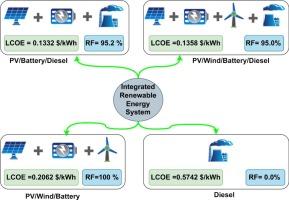
Healthcare facilities in developing regions face critical challenges owing to unreliable power supply, directly impacting their ability to provide essential medical services and save lives. The successful implementation of hybrid renewable energy systems (HRES) in healthcare facilities could revolutionize medical care delivery in remote and underserved areas. This study opens new pathways for sustainable healthcare infrastructure development that can be replicated across similar regions worldwide. The proposed system includes a solar photovoltaic (PV) system, wind turbine (WT), battery energy storage system (BESS), and diesel generator (DG). Four distinct system configurations were evaluated using HOMER Pro optimization software: DG only (base case), PV/BESS/DG, PV/WT/BESS, and PV/WT/BESS/DG. The analysis include technical, economic, and environmental parameters to determine the optimal configuration. The obtained results demonstrate that the PV/BESS/DG configuration achieves the most favorable economic outcomes, reducing the total net present cost (NPC) by 76.8% from $713,148.83 to $165,371.43 and decreasing the levelized cost of energy (LCOE) from $0.5742/kWh to $0.1332/kWh compared to the base case. While the fully renewable configuration (PV/WT/BESS) requires a significantly higher initial capital investment, 83.18 % more than the PV/BESS/DG setup, it eliminates fuel costs. It achieves zero emissions, making it well-aligned with environmental sustainability goals. Despite the theoretical advantages of wind power integration, site-specific low wind speeds render it less economically viable, with a capacity factor of only 7.04 %. The study concludes that integrating DG with renewable energy resources (RESs) optimizes system economics while maintaining reliability, offering a practical solution for healthcare facilities in regions with limited grid access. These findings provide valuable considerations for designing sustainable energy systems in healthcare settings, particularly in developing areas that face similar energy security challenges.
期刊介绍:
Energy Conversion and Management: X is the open access extension of the reputable journal Energy Conversion and Management, serving as a platform for interdisciplinary research on a wide array of critical energy subjects. The journal is dedicated to publishing original contributions and in-depth technical review articles that present groundbreaking research on topics spanning energy generation, utilization, conversion, storage, transmission, conservation, management, and sustainability.
The scope of Energy Conversion and Management: X encompasses various forms of energy, including mechanical, thermal, nuclear, chemical, electromagnetic, magnetic, and electric energy. It addresses all known energy resources, highlighting both conventional sources like fossil fuels and nuclear power, as well as renewable resources such as solar, biomass, hydro, wind, geothermal, and ocean energy.



 京公网安备 11010802042870号
京ICP备2023020795号-1
京公网安备 11010802042870号
京ICP备2023020795号-1

 分享
分享
 求助内容:
求助内容: 应助结果提醒方式:
 扫码关注我们
