Wei Liu , Ting Xue , Nawal Abdalla Adam , Ahola Jero , Hao Yang
{"title":"Hydrogen economy in China: Integrating biomass for renewable ernergy transition and economic growth","authors":"Wei Liu , Ting Xue , Nawal Abdalla Adam , Ahola Jero , Hao Yang","doi":"10.1016/j.ijhydene.2025.03.178","DOIUrl":null,"url":null,"abstract":"<div><div>China faces mounting pressure to transition from a fossil fuel-dependent economy to a low-carbon, sustainable energy system while maintaining robust economic growth. This study explores the integration of alkaline water electrolysis and biomass gasification as a dual-pathway strategy to advance China's hydrogen economy. The primary objective is to assess the technical feasibility, economic potential, and environmental impact of combining these two hydrogen production methods. Empirical analysis reveals that (1) China could utilize over 700 million tons of annual agricultural and organic waste for biomass gasification, producing up to 25 million tons of hydrogen per year; (2) integrating alkaline water electrolysis powered by renewable energy could further supply 20 million tons of green hydrogen annually; (3) the combined approach can reduce carbon emissions by over 200 million tons CO₂-equivalent each year; (4) lifecycle cost assessments show that hydrogen from biomass and electrolysis can become cost-competitive with grey hydrogen by 2035 under supportive policies; and (5) regional pilot projects in provinces like Sichuan and Inner Mongolia demonstrate the scalability of this integrated model. These findings suggest that a biomass-electrolysis hybrid approach could significantly enhance China’s energy security, support rural economic development, and accelerate its pathway toward carbon neutrality by 2060. Targeted policy interventions are urgently required to support R&D, scale infrastructure, and implement green hydrogen certification frameworks to realize this vision..</div></div>","PeriodicalId":337,"journal":{"name":"International Journal of Hydrogen Energy","volume":"121 ","pages":"Pages 171-188"},"PeriodicalIF":8.3000,"publicationDate":"2025-04-23","publicationTypes":"Journal Article","fieldsOfStudy":null,"isOpenAccess":false,"openAccessPdf":"","citationCount":"0","resultStr":null,"platform":"Semanticscholar","paperid":null,"PeriodicalName":"International Journal of Hydrogen Energy","FirstCategoryId":"5","ListUrlMain":"https://www.sciencedirect.com/science/article/pii/S0360319925012923","RegionNum":2,"RegionCategory":"工程技术","ArticlePicture":[],"TitleCN":null,"AbstractTextCN":null,"PMCID":null,"EPubDate":"2025/3/28 0:00:00","PubModel":"Epub","JCR":"Q1","JCRName":"CHEMISTRY, PHYSICAL","Score":null,"Total":0}
引用次数: 0
Abstract
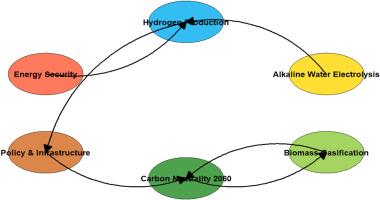
China faces mounting pressure to transition from a fossil fuel-dependent economy to a low-carbon, sustainable energy system while maintaining robust economic growth. This study explores the integration of alkaline water electrolysis and biomass gasification as a dual-pathway strategy to advance China's hydrogen economy. The primary objective is to assess the technical feasibility, economic potential, and environmental impact of combining these two hydrogen production methods. Empirical analysis reveals that (1) China could utilize over 700 million tons of annual agricultural and organic waste for biomass gasification, producing up to 25 million tons of hydrogen per year; (2) integrating alkaline water electrolysis powered by renewable energy could further supply 20 million tons of green hydrogen annually; (3) the combined approach can reduce carbon emissions by over 200 million tons CO₂-equivalent each year; (4) lifecycle cost assessments show that hydrogen from biomass and electrolysis can become cost-competitive with grey hydrogen by 2035 under supportive policies; and (5) regional pilot projects in provinces like Sichuan and Inner Mongolia demonstrate the scalability of this integrated model. These findings suggest that a biomass-electrolysis hybrid approach could significantly enhance China’s energy security, support rural economic development, and accelerate its pathway toward carbon neutrality by 2060. Targeted policy interventions are urgently required to support R&D, scale infrastructure, and implement green hydrogen certification frameworks to realize this vision..
期刊介绍:
The objective of the International Journal of Hydrogen Energy is to facilitate the exchange of new ideas, technological advancements, and research findings in the field of Hydrogen Energy among scientists and engineers worldwide. This journal showcases original research, both analytical and experimental, covering various aspects of Hydrogen Energy. These include production, storage, transmission, utilization, enabling technologies, environmental impact, economic considerations, and global perspectives on hydrogen and its carriers such as NH3, CH4, alcohols, etc.
The utilization aspect encompasses various methods such as thermochemical (combustion), photochemical, electrochemical (fuel cells), and nuclear conversion of hydrogen, hydrogen isotopes, and hydrogen carriers into thermal, mechanical, and electrical energies. The applications of these energies can be found in transportation (including aerospace), industrial, commercial, and residential sectors.



 京公网安备 11010802042870号
京ICP备2023020795号-1
京公网安备 11010802042870号
京ICP备2023020795号-1

 分享
分享
 求助内容:
求助内容: 应助结果提醒方式:
 扫码关注我们
