Jin-Ping Gu , Tian-Zi Qi , Dong-Rong Zhu , Xu-Jia He , Su-Peng Guo , Xin Lan , Hong Gu , Jia-Lie Luo , Min Yang , Yu-Cheng Gu , Wen-Li Wang , Guang-Tong Chen , Bo-Yi Fan
{"title":"Isolation of pentasaccharide resin glycosides from the whole plants of Ipomoea biflora and their cytotoxic activities","authors":"Jin-Ping Gu , Tian-Zi Qi , Dong-Rong Zhu , Xu-Jia He , Su-Peng Guo , Xin Lan , Hong Gu , Jia-Lie Luo , Min Yang , Yu-Cheng Gu , Wen-Li Wang , Guang-Tong Chen , Bo-Yi Fan","doi":"10.1016/j.phytochem.2025.114494","DOIUrl":null,"url":null,"abstract":"<div><div>A total of eight previously undescribed pentasaccharide resin glycosides, named ipomofins I-VIII (<strong>1</strong>–<strong>8</strong>), along with five known ones (<strong>9</strong>–<strong>13</strong>), were isolated from the whole plants of <em>Ipomoea biflora</em>. Their structural elucidation was achieved through a comprehensive application of spectroscopic and chemical techniques. All these resin glycosides were characterized as partially acylated pentasaccharides, originating from operculinic acids A or D, containing <span>l</span>-rhamnose, <span>d</span>-glucose, <span>d</span>-xylose or <span>d</span>-fucose units, and 11<em>S</em>-hydroxyhexadecanoic acid serving as the aglycone. Notably, compounds <strong>1</strong> and <strong>2</strong> represent the first resin glycosides with operculinic acid D as their core structure, while compounds <strong>3</strong> and <strong>4</strong> are the first derivatives of operculinic acid A featuring a 23-membered ring. Compounds <strong>1</strong>, <strong>2</strong>, and <strong>4–6</strong> exhibited apparent cytotoxic effects against certain cancer cell lines. Particularly, compound <strong>5</strong> demonstrated the ability to impair colony formation, reduce the proportion of EdU-positive cells, and enhance the expression of proteins related to endoplasmic reticulum stress (ERS) in HCT-15 cells, indicating that its cytotoxicity might be driven by the activation of ERS pathways. Collectively, this research identified 13 resin glycosides from <em>I. biflora</em>, including eight previously undescribed compounds, with compound <strong>5</strong> emerging as a potential anticancer agent due to its induction of ERS.</div></div>","PeriodicalId":20170,"journal":{"name":"Phytochemistry","volume":"236 ","pages":"Article 114494"},"PeriodicalIF":3.4000,"publicationDate":"2025-03-26","publicationTypes":"Journal Article","fieldsOfStudy":null,"isOpenAccess":false,"openAccessPdf":"","citationCount":"0","resultStr":null,"platform":"Semanticscholar","paperid":null,"PeriodicalName":"Phytochemistry","FirstCategoryId":"99","ListUrlMain":"https://www.sciencedirect.com/science/article/pii/S0031942225001177","RegionNum":2,"RegionCategory":"生物学","ArticlePicture":[],"TitleCN":null,"AbstractTextCN":null,"PMCID":null,"EPubDate":"","PubModel":"","JCR":"Q2","JCRName":"BIOCHEMISTRY & MOLECULAR BIOLOGY","Score":null,"Total":0}
引用次数: 0
Abstract
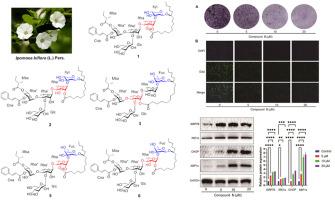
A total of eight previously undescribed pentasaccharide resin glycosides, named ipomofins I-VIII (1–8), along with five known ones (9–13), were isolated from the whole plants of Ipomoea biflora. Their structural elucidation was achieved through a comprehensive application of spectroscopic and chemical techniques. All these resin glycosides were characterized as partially acylated pentasaccharides, originating from operculinic acids A or D, containing l-rhamnose, d-glucose, d-xylose or d-fucose units, and 11S-hydroxyhexadecanoic acid serving as the aglycone. Notably, compounds 1 and 2 represent the first resin glycosides with operculinic acid D as their core structure, while compounds 3 and 4 are the first derivatives of operculinic acid A featuring a 23-membered ring. Compounds 1, 2, and 4–6 exhibited apparent cytotoxic effects against certain cancer cell lines. Particularly, compound 5 demonstrated the ability to impair colony formation, reduce the proportion of EdU-positive cells, and enhance the expression of proteins related to endoplasmic reticulum stress (ERS) in HCT-15 cells, indicating that its cytotoxicity might be driven by the activation of ERS pathways. Collectively, this research identified 13 resin glycosides from I. biflora, including eight previously undescribed compounds, with compound 5 emerging as a potential anticancer agent due to its induction of ERS.
期刊介绍:
Phytochemistry is a leading international journal publishing studies of plant chemistry, biochemistry, molecular biology and genetics, structure and bioactivities of phytochemicals, including ''-omics'' and bioinformatics/computational biology approaches. Phytochemistry is a primary source for papers dealing with phytochemicals, especially reports concerning their biosynthesis, regulation, and biological properties both in planta and as bioactive principles. Articles are published online as soon as possible as Articles-in-Press and in 12 volumes per year. Occasional topic-focussed special issues are published composed of papers from invited authors.



 京公网安备 11010802042870号
京ICP备2023020795号-1
京公网安备 11010802042870号
京ICP备2023020795号-1

 分享
分享
 求助内容:
求助内容: 应助结果提醒方式:
 扫码关注我们
