Photocatalytic remediation of organic pollutants in contaminated water using trimetallic zeolitic imidazole framework: From methylene blue to wastewater
{"title":"Photocatalytic remediation of organic pollutants in contaminated water using trimetallic zeolitic imidazole framework: From methylene blue to wastewater","authors":"Joohyun Kim, Jung Hyeun Kim","doi":"10.1016/j.chemosphere.2025.144362","DOIUrl":null,"url":null,"abstract":"<div><div>Photocatalysts have recently attracted significant attention for their ability to efficiently degrade organic contaminants in wastewater under sunlight irradiation conditions. In this study, trimetallic Zn–ZIF photocatalyst is synthesized by incorporating Ni– and Cd–dopant atoms to enhance photocatalytic performance. Morphological and crystallographic analyses confirm the formation of the ZIF−L structure. Compared to monometallic and bimetallic variants, the trimetallic ZIF exhibits enhanced optical absorbance. PL analysis indicates that additional impurities introduce more active sites, resulting in improved photocatalytic performance. Trimetallic N2C4 ZIF photocatalyst shows the highest organic degradability with 95.1 % MB degradation, with stable second-order kinetics derived primarily from superoxide radicals. The catalyst also effectively degrades melanoidin chromophore in coffee and wastewater. This work demonstrates a promising approach to developing broadly applicable ZIF photocatalysts to photodegrade various polluted environmental systems.</div></div>","PeriodicalId":276,"journal":{"name":"Chemosphere","volume":"377 ","pages":"Article 144362"},"PeriodicalIF":8.1000,"publicationDate":"2025-05-01","publicationTypes":"Journal Article","fieldsOfStudy":null,"isOpenAccess":false,"openAccessPdf":"","citationCount":"0","resultStr":null,"platform":"Semanticscholar","paperid":null,"PeriodicalName":"Chemosphere","FirstCategoryId":"93","ListUrlMain":"https://www.sciencedirect.com/science/article/pii/S0045653525003042","RegionNum":2,"RegionCategory":"环境科学与生态学","ArticlePicture":[],"TitleCN":null,"AbstractTextCN":null,"PMCID":null,"EPubDate":"2025/3/29 0:00:00","PubModel":"Epub","JCR":"Q1","JCRName":"ENVIRONMENTAL SCIENCES","Score":null,"Total":0}
引用次数: 0
Abstract
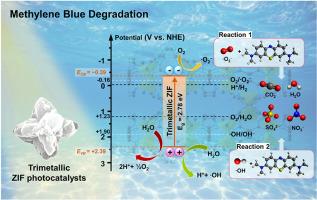
Photocatalysts have recently attracted significant attention for their ability to efficiently degrade organic contaminants in wastewater under sunlight irradiation conditions. In this study, trimetallic Zn–ZIF photocatalyst is synthesized by incorporating Ni– and Cd–dopant atoms to enhance photocatalytic performance. Morphological and crystallographic analyses confirm the formation of the ZIF−L structure. Compared to monometallic and bimetallic variants, the trimetallic ZIF exhibits enhanced optical absorbance. PL analysis indicates that additional impurities introduce more active sites, resulting in improved photocatalytic performance. Trimetallic N2C4 ZIF photocatalyst shows the highest organic degradability with 95.1 % MB degradation, with stable second-order kinetics derived primarily from superoxide radicals. The catalyst also effectively degrades melanoidin chromophore in coffee and wastewater. This work demonstrates a promising approach to developing broadly applicable ZIF photocatalysts to photodegrade various polluted environmental systems.
期刊介绍:
Chemosphere, being an international multidisciplinary journal, is dedicated to publishing original communications and review articles on chemicals in the environment. The scope covers a wide range of topics, including the identification, quantification, behavior, fate, toxicology, treatment, and remediation of chemicals in the bio-, hydro-, litho-, and atmosphere, ensuring the broad dissemination of research in this field.




 京公网安备 11010802042870号
京ICP备2023020795号-1
京公网安备 11010802042870号
京ICP备2023020795号-1

 分享
分享
 求助内容:
求助内容: 应助结果提醒方式:
 扫码关注我们
