Rakhi Rani Datta , Rimana Islam Papry , Yusuke Asakura , Ryo Kagaya , Kuo Hong Wong , Asami Suzuki Mashio , Hiroshi Hasegawa
{"title":"Arsenic biotransformation by macroalgae Srgassum thunbergii: Influence of growth stages and phosphate availability on uptake and reductive methylation","authors":"Rakhi Rani Datta , Rimana Islam Papry , Yusuke Asakura , Ryo Kagaya , Kuo Hong Wong , Asami Suzuki Mashio , Hiroshi Hasegawa","doi":"10.1016/j.chemosphere.2025.144333","DOIUrl":null,"url":null,"abstract":"<div><div>Investigations into arsenic (As) biotransformation in marine macroalgae are crucial for understanding environmental and human health impacts. However, the biomethylation of As at different growth stages of macroalgae remains unclear. This study investigated arsenate [As(V)] uptake and reductive methylation at four different growth stages (young, pre-juvenile, juvenile and adult) of marine macroalgae species. The frond of varied growth stages of <em>Sargassum thunbergii</em> were exposed to 1.0 μmol L<sup>−1</sup> As(V) and varying phosphate (P) concentrations (0.8, 10, and 20 μmol L<sup>−1</sup>) in filtered seawater for 14 days. The P concentration 0.8 μmol L<sup>−1</sup> indicate nutrient poor condition, whereas P10 and 20 represents environmental or intermediate level and eutrophic P level in seawater respectively. The results showed a significant variations in As(V) uptake at different growth stages, with lower uptake in young sporophyte and higher uptake in pre-juvenile and juvenile sporophytes at P10 and 20 μmol L<sup>−1</sup> concentrations. Biotransformation of internalized As(V) to dimethylarsinic acid (DMAA) occurred earlier in young sporophyte compared to juvenile sporophyte. The biotransformation of As(V) and release capacity across the growth stages follows the order of young sporophyte > pre-juvenile sporophyte > adult sporophyte > juvenile sporophyte. A significant difference in As bioaccumulation pattern was also observed at low (P0 and P10) and high (P20) P conditions, underscoring the competitive uptake mechanism of As(V) over the P concentration. Meanwhile total As content increased in the order of adult sporophyte > pre-juvenile sporophyte > juvenile sporophyte > young sporophyte indicating growth stage-specific As(V) uptake and metabolism. These findings deepen our understanding of As(V) biotransformation processes in macroalgae and contribute to elucidating complex interactions between macroalgal growth stages and As(V).</div></div>","PeriodicalId":276,"journal":{"name":"Chemosphere","volume":"377 ","pages":"Article 144333"},"PeriodicalIF":8.1000,"publicationDate":"2025-05-01","publicationTypes":"Journal Article","fieldsOfStudy":null,"isOpenAccess":false,"openAccessPdf":"","citationCount":"0","resultStr":null,"platform":"Semanticscholar","paperid":null,"PeriodicalName":"Chemosphere","FirstCategoryId":"93","ListUrlMain":"https://www.sciencedirect.com/science/article/pii/S0045653525002759","RegionNum":2,"RegionCategory":"环境科学与生态学","ArticlePicture":[],"TitleCN":null,"AbstractTextCN":null,"PMCID":null,"EPubDate":"2025/3/29 0:00:00","PubModel":"Epub","JCR":"Q1","JCRName":"ENVIRONMENTAL SCIENCES","Score":null,"Total":0}
引用次数: 0
Abstract
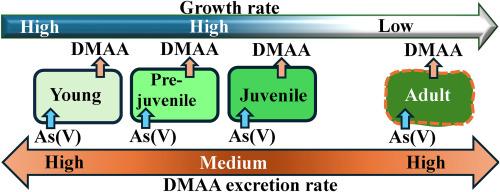
Investigations into arsenic (As) biotransformation in marine macroalgae are crucial for understanding environmental and human health impacts. However, the biomethylation of As at different growth stages of macroalgae remains unclear. This study investigated arsenate [As(V)] uptake and reductive methylation at four different growth stages (young, pre-juvenile, juvenile and adult) of marine macroalgae species. The frond of varied growth stages of Sargassum thunbergii were exposed to 1.0 μmol L−1 As(V) and varying phosphate (P) concentrations (0.8, 10, and 20 μmol L−1) in filtered seawater for 14 days. The P concentration 0.8 μmol L−1 indicate nutrient poor condition, whereas P10 and 20 represents environmental or intermediate level and eutrophic P level in seawater respectively. The results showed a significant variations in As(V) uptake at different growth stages, with lower uptake in young sporophyte and higher uptake in pre-juvenile and juvenile sporophytes at P10 and 20 μmol L−1 concentrations. Biotransformation of internalized As(V) to dimethylarsinic acid (DMAA) occurred earlier in young sporophyte compared to juvenile sporophyte. The biotransformation of As(V) and release capacity across the growth stages follows the order of young sporophyte > pre-juvenile sporophyte > adult sporophyte > juvenile sporophyte. A significant difference in As bioaccumulation pattern was also observed at low (P0 and P10) and high (P20) P conditions, underscoring the competitive uptake mechanism of As(V) over the P concentration. Meanwhile total As content increased in the order of adult sporophyte > pre-juvenile sporophyte > juvenile sporophyte > young sporophyte indicating growth stage-specific As(V) uptake and metabolism. These findings deepen our understanding of As(V) biotransformation processes in macroalgae and contribute to elucidating complex interactions between macroalgal growth stages and As(V).
期刊介绍:
Chemosphere, being an international multidisciplinary journal, is dedicated to publishing original communications and review articles on chemicals in the environment. The scope covers a wide range of topics, including the identification, quantification, behavior, fate, toxicology, treatment, and remediation of chemicals in the bio-, hydro-, litho-, and atmosphere, ensuring the broad dissemination of research in this field.



 京公网安备 11010802042870号
京ICP备2023020795号-1
京公网安备 11010802042870号
京ICP备2023020795号-1

 分享
分享
 求助内容:
求助内容: 应助结果提醒方式:
 扫码关注我们
