Daouda Koffi Kouassi , Aurélie Daval , Vincent Le Guen , André Clément-Demange , David Lopez , Pierre Mournet , Florelle Bonal , Jean-Luc Hofs , Mouman Soumahoro , Doffou Sélastique Akaffou , David Cros
{"title":"Enhancing genomic selection in rubber tree (Hevea brasiliensis): Exploring the impact of genetic relatedness and QTL integration","authors":"Daouda Koffi Kouassi , Aurélie Daval , Vincent Le Guen , André Clément-Demange , David Lopez , Pierre Mournet , Florelle Bonal , Jean-Luc Hofs , Mouman Soumahoro , Doffou Sélastique Akaffou , David Cros","doi":"10.1016/j.indcrop.2025.120908","DOIUrl":null,"url":null,"abstract":"<div><div>Rubber tree breeding faces significant challenges, mainly due to the low female fertility of the plant, the long breeding cycles and the complex trait architecture. The advent of genomic selection offers a significant opportunity to explore more effective breeding strategies and accelerate genetic gains. This study investigates genomic prediction strategies for <em>Hevea brasiliensis</em> breeding, focusing on two biparental families connected by a common parent and evaluated among four different sites. The objective was to assess the impact of using full-sib and half-sib populations on prediction accuracy for key traits, rubber production and sucrose content. Results confirmed that prediction accuracies are higher when the training and validation populations consist of full-sibs (0.54 for rubber production and 0.36 for sucrose), as compared to half-sibs (0.17 for rubber production and 0.21 for sucrose). Combining full-sibs and half-sibs in the training population yielded prediction performance comparable to intra-family models (0.52 for rubber production and 0.37 for sucrose), providing a more practical option for breeding programs. Additionally, the integration of QTL information into prediction models for rubber production did not improved accuracy in full-sib (0.53) or half-sib (0.16) validation approaches and reduced accuracy in cross-validation, likely due to the polygenic nature of the trait and genotype-by-environment interactions. Rubber tree breeding programs could benefit from constructing training populations composed of multiple related families, simplifying logistics while maintaining prediction accuracy across more diverse populations than single biparental families. This approach offers a promising pathway to enhance the efficiency and genetic gains in rubber tree genomic selection.</div></div>","PeriodicalId":13581,"journal":{"name":"Industrial Crops and Products","volume":"228 ","pages":"Article 120908"},"PeriodicalIF":6.2000,"publicationDate":"2025-06-01","publicationTypes":"Journal Article","fieldsOfStudy":null,"isOpenAccess":false,"openAccessPdf":"","citationCount":"0","resultStr":null,"platform":"Semanticscholar","paperid":null,"PeriodicalName":"Industrial Crops and Products","FirstCategoryId":"97","ListUrlMain":"https://www.sciencedirect.com/science/article/pii/S0926669025004546","RegionNum":1,"RegionCategory":"农林科学","ArticlePicture":[],"TitleCN":null,"AbstractTextCN":null,"PMCID":null,"EPubDate":"2025/3/29 0:00:00","PubModel":"Epub","JCR":"Q1","JCRName":"AGRICULTURAL ENGINEERING","Score":null,"Total":0}
引用次数: 0
Abstract
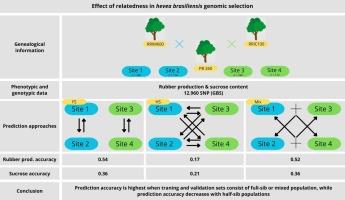
Rubber tree breeding faces significant challenges, mainly due to the low female fertility of the plant, the long breeding cycles and the complex trait architecture. The advent of genomic selection offers a significant opportunity to explore more effective breeding strategies and accelerate genetic gains. This study investigates genomic prediction strategies for Hevea brasiliensis breeding, focusing on two biparental families connected by a common parent and evaluated among four different sites. The objective was to assess the impact of using full-sib and half-sib populations on prediction accuracy for key traits, rubber production and sucrose content. Results confirmed that prediction accuracies are higher when the training and validation populations consist of full-sibs (0.54 for rubber production and 0.36 for sucrose), as compared to half-sibs (0.17 for rubber production and 0.21 for sucrose). Combining full-sibs and half-sibs in the training population yielded prediction performance comparable to intra-family models (0.52 for rubber production and 0.37 for sucrose), providing a more practical option for breeding programs. Additionally, the integration of QTL information into prediction models for rubber production did not improved accuracy in full-sib (0.53) or half-sib (0.16) validation approaches and reduced accuracy in cross-validation, likely due to the polygenic nature of the trait and genotype-by-environment interactions. Rubber tree breeding programs could benefit from constructing training populations composed of multiple related families, simplifying logistics while maintaining prediction accuracy across more diverse populations than single biparental families. This approach offers a promising pathway to enhance the efficiency and genetic gains in rubber tree genomic selection.
期刊介绍:
Industrial Crops and Products is an International Journal publishing academic and industrial research on industrial (defined as non-food/non-feed) crops and products. Papers concern both crop-oriented and bio-based materials from crops-oriented research, and should be of interest to an international audience, hypothesis driven, and where comparisons are made statistics performed.



 京公网安备 11010802042870号
京ICP备2023020795号-1
京公网安备 11010802042870号
京ICP备2023020795号-1

 分享
分享
 求助内容:
求助内容: 应助结果提醒方式:
 扫码关注我们
