{"title":"Reproductive toxicity and parental transmission effects of 4-methylbenzylidene camphor (4-MBC) exposure in adult zebrafish","authors":"Xiaofeng Wu, Chenyu Zhou, Jing Wang, Mengxi Cao, Ling Wang, Yong Liang","doi":"10.1016/j.aquatox.2025.107334","DOIUrl":null,"url":null,"abstract":"<div><div>4-methylbenzylidene camphor (4-MBC), a commonly used UV absorber, is frequently detected in aquatic environment. So far the reproductive toxicity of parental 4-MBC exposure and its effects on gonadal development in offsprings are not clear. In the present study, male and female adult F0 zebrafish were exposed to 100 nM 4-MBC for 14 consecutive days. Our data showed that 4-MBC exposure resulted in gonadal damage in the parental gonads and decreased egg production in females and sperm viability in males. In addition, exposure to 4-MBC resulted in increased levels of estradiol (E2), follicle stimulating hormone (FSH), and luteinizing hormone (LH) in females and decreased testosterone (T) in males, suggesting the estrogenic and antiandrogenic effects of 4-MBC. Parental 4-MBC exposure did not change the hatchability and mortality of the F1 generation, but caused significantly decreased heart rate and gonadal developmental retardation in 60 dpf fish by interfering with the HPG axis. Therefore, 4-MBC exposure to adult zebrafish caused gonadal damage and reduced reproductive performance in the parental generation, which was sex-dependent and caused intergenerational toxicity to the F1 generation. The present study provides new insights into the ecological risks of 4-MBC and its potential contribution to adverse reproductive outcomes in humans.</div></div>","PeriodicalId":248,"journal":{"name":"Aquatic Toxicology","volume":"283 ","pages":"Article 107334"},"PeriodicalIF":4.3000,"publicationDate":"2025-06-01","publicationTypes":"Journal Article","fieldsOfStudy":null,"isOpenAccess":false,"openAccessPdf":"","citationCount":"0","resultStr":null,"platform":"Semanticscholar","paperid":null,"PeriodicalName":"Aquatic Toxicology","FirstCategoryId":"93","ListUrlMain":"https://www.sciencedirect.com/science/article/pii/S0166445X25000992","RegionNum":2,"RegionCategory":"环境科学与生态学","ArticlePicture":[],"TitleCN":null,"AbstractTextCN":null,"PMCID":null,"EPubDate":"2025/3/21 0:00:00","PubModel":"Epub","JCR":"Q1","JCRName":"MARINE & FRESHWATER BIOLOGY","Score":null,"Total":0}
引用次数: 0
Abstract
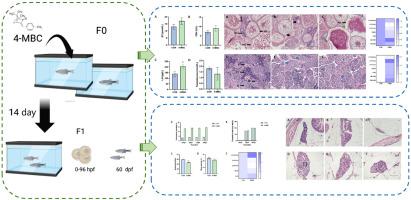
4-methylbenzylidene camphor (4-MBC), a commonly used UV absorber, is frequently detected in aquatic environment. So far the reproductive toxicity of parental 4-MBC exposure and its effects on gonadal development in offsprings are not clear. In the present study, male and female adult F0 zebrafish were exposed to 100 nM 4-MBC for 14 consecutive days. Our data showed that 4-MBC exposure resulted in gonadal damage in the parental gonads and decreased egg production in females and sperm viability in males. In addition, exposure to 4-MBC resulted in increased levels of estradiol (E2), follicle stimulating hormone (FSH), and luteinizing hormone (LH) in females and decreased testosterone (T) in males, suggesting the estrogenic and antiandrogenic effects of 4-MBC. Parental 4-MBC exposure did not change the hatchability and mortality of the F1 generation, but caused significantly decreased heart rate and gonadal developmental retardation in 60 dpf fish by interfering with the HPG axis. Therefore, 4-MBC exposure to adult zebrafish caused gonadal damage and reduced reproductive performance in the parental generation, which was sex-dependent and caused intergenerational toxicity to the F1 generation. The present study provides new insights into the ecological risks of 4-MBC and its potential contribution to adverse reproductive outcomes in humans.
期刊介绍:
Aquatic Toxicology publishes significant contributions that increase the understanding of the impact of harmful substances (including natural and synthetic chemicals) on aquatic organisms and ecosystems.
Aquatic Toxicology considers both laboratory and field studies with a focus on marine/ freshwater environments. We strive to attract high quality original scientific papers, critical reviews and expert opinion papers in the following areas: Effects of harmful substances on molecular, cellular, sub-organismal, organismal, population, community, and ecosystem level; Toxic Mechanisms; Genetic disturbances, transgenerational effects, behavioral and adaptive responses; Impacts of harmful substances on structure, function of and services provided by aquatic ecosystems; Mixture toxicity assessment; Statistical approaches to predict exposure to and hazards of contaminants
The journal also considers manuscripts in other areas, such as the development of innovative concepts, approaches, and methodologies, which promote the wider application of toxicological datasets to the protection of aquatic environments and inform ecological risk assessments and decision making by relevant authorities.




 京公网安备 11010802042870号
京ICP备2023020795号-1
京公网安备 11010802042870号
京ICP备2023020795号-1

 分享
分享
 求助内容:
求助内容: 应助结果提醒方式:
 扫码关注我们
