Ja Hyun Lee , Doyeon Kim , Yoonjoo Kim , Dong Hyun Kim , Yong-Cheol Park , Kyoung Heon Kim
{"title":"Enzyme cascades for high-yield conversion of d-xylose into d-ribose by overcoming equilibrium constraints and enhancing selectivity","authors":"Ja Hyun Lee , Doyeon Kim , Yoonjoo Kim , Dong Hyun Kim , Yong-Cheol Park , Kyoung Heon Kim","doi":"10.1016/j.biortech.2025.132435","DOIUrl":null,"url":null,"abstract":"<div><div><span>d</span>-Ribose is essential for critical cellular functions and the synthesis of antiviral nucleosides. However, traditional chemical synthesis and fermentation methods of <span>d</span>-ribose production suffer from low yields and inefficient resource utilization. Here, we present a highly efficient enzymatic cascade strategy that utilizes selective phosphorylation and dephosphorylation processes, coupled with ATP regeneration to convert <span>d</span>-xylose into <span>d</span>-ribose with high yield. By optimizing this enzyme cascade, we achieved a substantial increase in <span>d</span>-ribose yield from 23.4 % to 93.5 % mol/mol, effectively overcoming the equilibrium limitations of sugar conversion processes. Notably, our approach allows for the selective conversion of <span>d</span>-xylose to <span>d</span>-ribose in lignocellulosic hydrolysates, even in the presence of <span>d</span>-glucose. This work demonstrates the highly efficient enzymatic conversion of <span>d</span>-xylose into <span>d</span>-ribose offering a competitive alternative to existing chemical synthesis methods. Our findings provide a novel approach to cellulosic biomass valorization and represent a significant contribution to the field of biorefinery.</div></div>","PeriodicalId":258,"journal":{"name":"Bioresource Technology","volume":"428 ","pages":"Article 132435"},"PeriodicalIF":9.0000,"publicationDate":"2025-03-25","publicationTypes":"Journal Article","fieldsOfStudy":null,"isOpenAccess":false,"openAccessPdf":"","citationCount":"0","resultStr":null,"platform":"Semanticscholar","paperid":null,"PeriodicalName":"Bioresource Technology","FirstCategoryId":"5","ListUrlMain":"https://www.sciencedirect.com/science/article/pii/S0960852425004018","RegionNum":1,"RegionCategory":"环境科学与生态学","ArticlePicture":[],"TitleCN":null,"AbstractTextCN":null,"PMCID":null,"EPubDate":"","PubModel":"","JCR":"Q1","JCRName":"AGRICULTURAL ENGINEERING","Score":null,"Total":0}
引用次数: 0
Abstract
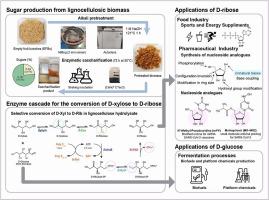
d-Ribose is essential for critical cellular functions and the synthesis of antiviral nucleosides. However, traditional chemical synthesis and fermentation methods of d-ribose production suffer from low yields and inefficient resource utilization. Here, we present a highly efficient enzymatic cascade strategy that utilizes selective phosphorylation and dephosphorylation processes, coupled with ATP regeneration to convert d-xylose into d-ribose with high yield. By optimizing this enzyme cascade, we achieved a substantial increase in d-ribose yield from 23.4 % to 93.5 % mol/mol, effectively overcoming the equilibrium limitations of sugar conversion processes. Notably, our approach allows for the selective conversion of d-xylose to d-ribose in lignocellulosic hydrolysates, even in the presence of d-glucose. This work demonstrates the highly efficient enzymatic conversion of d-xylose into d-ribose offering a competitive alternative to existing chemical synthesis methods. Our findings provide a novel approach to cellulosic biomass valorization and represent a significant contribution to the field of biorefinery.
期刊介绍:
Bioresource Technology publishes original articles, review articles, case studies, and short communications covering the fundamentals, applications, and management of bioresource technology. The journal seeks to advance and disseminate knowledge across various areas related to biomass, biological waste treatment, bioenergy, biotransformations, bioresource systems analysis, and associated conversion or production technologies.
Topics include:
• Biofuels: liquid and gaseous biofuels production, modeling and economics
• Bioprocesses and bioproducts: biocatalysis and fermentations
• Biomass and feedstocks utilization: bioconversion of agro-industrial residues
• Environmental protection: biological waste treatment
• Thermochemical conversion of biomass: combustion, pyrolysis, gasification, catalysis.



 京公网安备 11010802042870号
京ICP备2023020795号-1
京公网安备 11010802042870号
京ICP备2023020795号-1

 分享
分享
 求助内容:
求助内容: 应助结果提醒方式:
 扫码关注我们
