{"title":"An introduction to Sequential Monte Carlo for Bayesian inference and model comparison-with examples for psychology and behavioral science.","authors":"Max Hinne","doi":"10.3758/s13428-025-02642-1","DOIUrl":null,"url":null,"abstract":"<p><p>Bayesian inference is becoming an increasingly popular framework for statistics in the behavioral sciences. However, its application is hampered by its computational intractability - almost all Bayesian analyses require a form of approximation. While some of these approximate inference algorithms, such as Markov chain Monte Carlo (MCMC), have become well known throughout the literature, other approaches exist that are not as widespread. Here, we provide an introduction to another family of approximate inference techniques known as Sequential Monte Carlo (SMC). We show that SMC brings a number of benefits, which we illustrate in three different examples: linear regression and variable selection for depression, growth curve mixture modeling of grade point averages, and in computational modeling of the Iowa Gambling Task. These use cases demonstrate that SMC is efficient in exploring posterior distributions, reaching similar predictive performance as state-of-the-art MCMC approaches in less wall-clock time. Moreover, they show that SMC is effective in dealing with multi-modal distributions, and that SMC not only approximates the posterior distribution but simultaneously provides a useful estimate of the marginal likelihood, which is the essential quantity in Bayesian model comparison. All of this comes at no additional effort from the end user.</p>","PeriodicalId":8717,"journal":{"name":"Behavior Research Methods","volume":"57 5","pages":"125"},"PeriodicalIF":3.9000,"publicationDate":"2025-03-26","publicationTypes":"Journal Article","fieldsOfStudy":null,"isOpenAccess":false,"openAccessPdf":"https://www.ncbi.nlm.nih.gov/pmc/articles/PMC11946982/pdf/","citationCount":"0","resultStr":null,"platform":"Semanticscholar","paperid":null,"PeriodicalName":"Behavior Research Methods","FirstCategoryId":"102","ListUrlMain":"https://doi.org/10.3758/s13428-025-02642-1","RegionNum":2,"RegionCategory":"心理学","ArticlePicture":[],"TitleCN":null,"AbstractTextCN":null,"PMCID":null,"EPubDate":"","PubModel":"","JCR":"Q1","JCRName":"PSYCHOLOGY, EXPERIMENTAL","Score":null,"Total":0}
引用次数: 0
Abstract
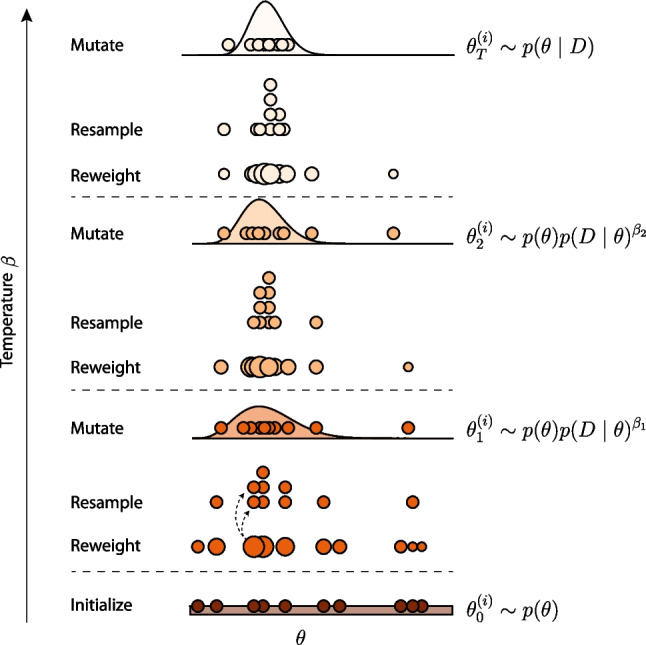
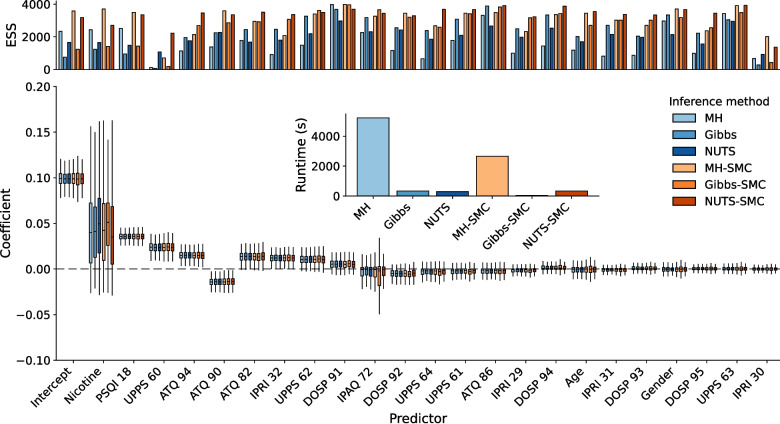
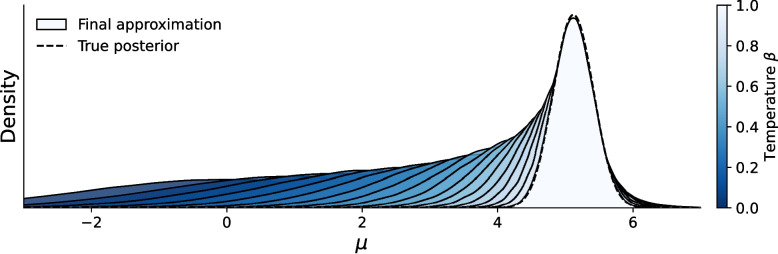
Bayesian inference is becoming an increasingly popular framework for statistics in the behavioral sciences. However, its application is hampered by its computational intractability - almost all Bayesian analyses require a form of approximation. While some of these approximate inference algorithms, such as Markov chain Monte Carlo (MCMC), have become well known throughout the literature, other approaches exist that are not as widespread. Here, we provide an introduction to another family of approximate inference techniques known as Sequential Monte Carlo (SMC). We show that SMC brings a number of benefits, which we illustrate in three different examples: linear regression and variable selection for depression, growth curve mixture modeling of grade point averages, and in computational modeling of the Iowa Gambling Task. These use cases demonstrate that SMC is efficient in exploring posterior distributions, reaching similar predictive performance as state-of-the-art MCMC approaches in less wall-clock time. Moreover, they show that SMC is effective in dealing with multi-modal distributions, and that SMC not only approximates the posterior distribution but simultaneously provides a useful estimate of the marginal likelihood, which is the essential quantity in Bayesian model comparison. All of this comes at no additional effort from the end user.
期刊介绍:
Behavior Research Methods publishes articles concerned with the methods, techniques, and instrumentation of research in experimental psychology. The journal focuses particularly on the use of computer technology in psychological research. An annual special issue is devoted to this field.



 京公网安备 11010802042870号
京ICP备2023020795号-1
京公网安备 11010802042870号
京ICP备2023020795号-1

 分享
分享
 求助内容:
求助内容: 应助结果提醒方式:
 扫码关注我们
