{"title":"Predictors of Expectations for the Future Among Young Korean Adults.","authors":"Jae-Sun An, Kyung-Hyun Suh","doi":"10.3390/bs15030391","DOIUrl":null,"url":null,"abstract":"<p><p>This study explored psychosocial factors related to young adults' expectations for the future and verified a model that can predict these expectations using psychosocial factors and demographic profiles to provide useful information for further studies and interventions. The participants were 371 Korean adults aged 20-39 years. The predictive models were examined using stepwise regression and decision tree analyses. The results revealed that stress, depression, gratitude, hardiness, interpersonal competence, and social support were significantly correlated with expectations for the future among young adults. Stepwise regression analysis revealed that commitment, reflecting a sense of purpose, and engagement in life accounted for the greatest variance in expectations for the future. Commitment, gratitude, self-directedness, depression, and the presence of disease accounted for approximately 66.7% of the variance in expectations for the future in young adulthood. The decision tree analysis identified commitment as the most important predictor, followed by gratitude, stress, self-directedness, empathy, perceived health, and marital status, showing how these factors are associated with shaping future expectations. These findings suggest that psychological variables such as commitment and gratitude may play a more important role in young adults' expectations of their future than health or marital status.</p>","PeriodicalId":8742,"journal":{"name":"Behavioral Sciences","volume":"15 3","pages":""},"PeriodicalIF":2.5000,"publicationDate":"2025-03-19","publicationTypes":"Journal Article","fieldsOfStudy":null,"isOpenAccess":false,"openAccessPdf":"https://www.ncbi.nlm.nih.gov/pmc/articles/PMC11939509/pdf/","citationCount":"0","resultStr":null,"platform":"Semanticscholar","paperid":null,"PeriodicalName":"Behavioral Sciences","FirstCategoryId":"102","ListUrlMain":"https://doi.org/10.3390/bs15030391","RegionNum":3,"RegionCategory":"心理学","ArticlePicture":[],"TitleCN":null,"AbstractTextCN":null,"PMCID":null,"EPubDate":"","PubModel":"","JCR":"Q2","JCRName":"PSYCHOLOGY, MULTIDISCIPLINARY","Score":null,"Total":0}
引用次数: 0
Abstract
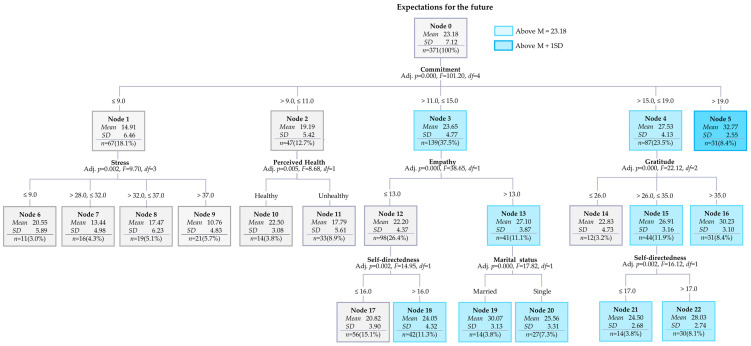
This study explored psychosocial factors related to young adults' expectations for the future and verified a model that can predict these expectations using psychosocial factors and demographic profiles to provide useful information for further studies and interventions. The participants were 371 Korean adults aged 20-39 years. The predictive models were examined using stepwise regression and decision tree analyses. The results revealed that stress, depression, gratitude, hardiness, interpersonal competence, and social support were significantly correlated with expectations for the future among young adults. Stepwise regression analysis revealed that commitment, reflecting a sense of purpose, and engagement in life accounted for the greatest variance in expectations for the future. Commitment, gratitude, self-directedness, depression, and the presence of disease accounted for approximately 66.7% of the variance in expectations for the future in young adulthood. The decision tree analysis identified commitment as the most important predictor, followed by gratitude, stress, self-directedness, empathy, perceived health, and marital status, showing how these factors are associated with shaping future expectations. These findings suggest that psychological variables such as commitment and gratitude may play a more important role in young adults' expectations of their future than health or marital status.




 京公网安备 11010802042870号
京ICP备2023020795号-1
京公网安备 11010802042870号
京ICP备2023020795号-1

 分享
分享
 求助内容:
求助内容: 应助结果提醒方式:
 扫码关注我们
