Yeseul Kang, Sang-Young Kim, Jun Hwee Kim, Nak-Hoon Son, Chae Jung Park
{"title":"Deep learning-based reconstruction for three-dimensional volumetric brain MRI: a qualitative and quantitative assessment.","authors":"Yeseul Kang, Sang-Young Kim, Jun Hwee Kim, Nak-Hoon Son, Chae Jung Park","doi":"10.1186/s12880-025-01647-8","DOIUrl":null,"url":null,"abstract":"<p><strong>Background: </strong>To evaluate the performance of a deep learning reconstruction (DLR) based on Adaptive-Compressed sensing (CS)-Network for brain MRI and validate it in a clinical setting.</p><p><strong>Methods: </strong>Ten healthy volunteers and 22 consecutive patients were prospectively enrolled. Volunteers underwent 3D brain MRI including T1 without CS factor (9:16 min, reference standard); with CS factor of 2 without DLR (CS2, 4:6 min); with CS factor of 2 with DLR (DLR-CS2); with CS factor of 4 without DLR (CS4, 2:6 min); and with CS factor of 4 with DLR (DLR-CS4). The patients' MRI included the CS2 and DLR-CS4. The volumes of lateral ventricles, hippocampus, choroid plexus, and white matter hypointensity were calculated and compared among the sequences. Three radiologists independently assessed anatomical conspicuity, overall image quality, artifacts, signal-to-noise ratio (SNR), and sharpness using a 5-point scale for each sequence.</p><p><strong>Results: </strong>Applying acceleration factors of 2 and 4 reduced the scan time to 65.4% and 33.5%, respectively, of that of the reference standard. Volumes of all the measured subregions showed no significant differences among different sequences in all participants. In qualitative analysis, the interrater agreement was excellent (κ = 0.844-0.926). In volunteers, quality of DLR-CS4 were comparable to those of CS2 for all metrics except for the overall image quality and SNR despite a 51.2% scan time reduction. In patients, DLR-CS4 showed quality comparable to that of CS2 for all metrics.</p><p><strong>Conclusions: </strong>DLR allowed the scan time reduction by at least half without sacrificing image quality and volumetric quantification accuracy, supporting its reliability and efficiency.</p>","PeriodicalId":9020,"journal":{"name":"BMC Medical Imaging","volume":"25 1","pages":"102"},"PeriodicalIF":3.2000,"publicationDate":"2025-03-27","publicationTypes":"Journal Article","fieldsOfStudy":null,"isOpenAccess":false,"openAccessPdf":"https://www.ncbi.nlm.nih.gov/pmc/articles/PMC11951731/pdf/","citationCount":"0","resultStr":null,"platform":"Semanticscholar","paperid":null,"PeriodicalName":"BMC Medical Imaging","FirstCategoryId":"3","ListUrlMain":"https://doi.org/10.1186/s12880-025-01647-8","RegionNum":3,"RegionCategory":"医学","ArticlePicture":[],"TitleCN":null,"AbstractTextCN":null,"PMCID":null,"EPubDate":"","PubModel":"","JCR":"Q2","JCRName":"RADIOLOGY, NUCLEAR MEDICINE & MEDICAL IMAGING","Score":null,"Total":0}
引用次数: 0
Abstract
Background: To evaluate the performance of a deep learning reconstruction (DLR) based on Adaptive-Compressed sensing (CS)-Network for brain MRI and validate it in a clinical setting.
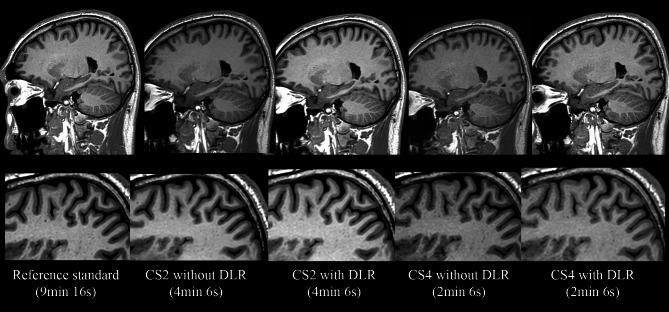
Methods: Ten healthy volunteers and 22 consecutive patients were prospectively enrolled. Volunteers underwent 3D brain MRI including T1 without CS factor (9:16 min, reference standard); with CS factor of 2 without DLR (CS2, 4:6 min); with CS factor of 2 with DLR (DLR-CS2); with CS factor of 4 without DLR (CS4, 2:6 min); and with CS factor of 4 with DLR (DLR-CS4). The patients' MRI included the CS2 and DLR-CS4. The volumes of lateral ventricles, hippocampus, choroid plexus, and white matter hypointensity were calculated and compared among the sequences. Three radiologists independently assessed anatomical conspicuity, overall image quality, artifacts, signal-to-noise ratio (SNR), and sharpness using a 5-point scale for each sequence.
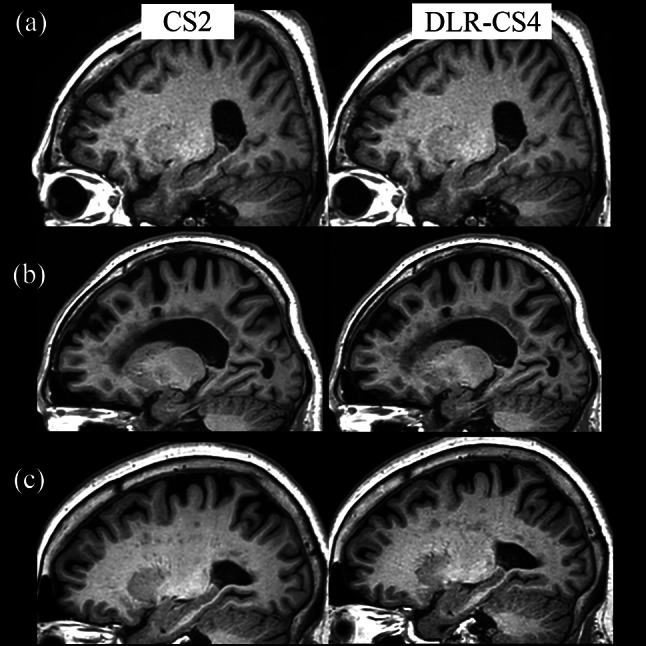
Results: Applying acceleration factors of 2 and 4 reduced the scan time to 65.4% and 33.5%, respectively, of that of the reference standard. Volumes of all the measured subregions showed no significant differences among different sequences in all participants. In qualitative analysis, the interrater agreement was excellent (κ = 0.844-0.926). In volunteers, quality of DLR-CS4 were comparable to those of CS2 for all metrics except for the overall image quality and SNR despite a 51.2% scan time reduction. In patients, DLR-CS4 showed quality comparable to that of CS2 for all metrics.
Conclusions: DLR allowed the scan time reduction by at least half without sacrificing image quality and volumetric quantification accuracy, supporting its reliability and efficiency.
期刊介绍:
BMC Medical Imaging is an open access journal publishing original peer-reviewed research articles in the development, evaluation, and use of imaging techniques and image processing tools to diagnose and manage disease.




 京公网安备 11010802042870号
京ICP备2023020795号-1
京公网安备 11010802042870号
京ICP备2023020795号-1

 分享
分享
 求助内容:
求助内容: 应助结果提醒方式:
 扫码关注我们
