{"title":"Therapeutic immersion: a single-subject study on virtual reality multisensory experiences for mitigating body disturbance in anorexia nervosa.","authors":"Giulia Brizzi, Margherita Boltri, Rebecca Guglielmini, Gianluca Castelnuovo, Leonardo Mendolicchio, Giuseppe Riva","doi":"10.1007/s40519-025-01740-5","DOIUrl":null,"url":null,"abstract":"<p><p>Anorexia Nervosa (AN) is a mental health condition marked by reduced food consumption, intense fear of weight gain, and distorted body experience. Virtual Reality (VR)-based techniques-i.e., Body-Swapping and Mirror Exposure techniques-offer promising avenues for addressing body disturbance in AN, allowing patients to embody virtual bodies varying in size and shape. We used a single-subject experimental design to explore the potential of virtual reality multisensory experiences for mitigating body disturbance in AN. We examine the case of a 24-year-old female hospitalized with restrictive Anorexia Nervosa who underwent a novel body-focused VR intervention alongside the hospital's standard care. The intervention included six bi-weekly sessions, wherein the patient was immersed in a VR environment that allowed her to embody a virtual body that matched a healthy weight range. Through interactions with a virtual mirror, the patient was encouraged to concentrate on the body's positive aspects and functional abilities, thinking about its significance in her past, current, and anticipated future activities (Functional Mirror Exposure). The patient reported reduced body dissatisfaction, negative beliefs, and body misperception. These changes endorse using immersive, multisensory, and embodied experiences to alter body consciousness and body-self relationship. Results preliminary support the transformative potential of VR in improving traditional approaches to assess and alter body disturbance.Level of evidence Level IV.</p>","PeriodicalId":11391,"journal":{"name":"Eating and Weight Disorders - Studies on Anorexia, Bulimia and Obesity","volume":"30 1","pages":"32"},"PeriodicalIF":2.8000,"publicationDate":"2025-03-26","publicationTypes":"Journal Article","fieldsOfStudy":null,"isOpenAccess":false,"openAccessPdf":"https://www.ncbi.nlm.nih.gov/pmc/articles/PMC11946939/pdf/","citationCount":"0","resultStr":null,"platform":"Semanticscholar","paperid":null,"PeriodicalName":"Eating and Weight Disorders - Studies on Anorexia, Bulimia and Obesity","FirstCategoryId":"3","ListUrlMain":"https://doi.org/10.1007/s40519-025-01740-5","RegionNum":3,"RegionCategory":"医学","ArticlePicture":[],"TitleCN":null,"AbstractTextCN":null,"PMCID":null,"EPubDate":"","PubModel":"","JCR":"Q2","JCRName":"PSYCHIATRY","Score":null,"Total":0}
引用次数: 0
Abstract
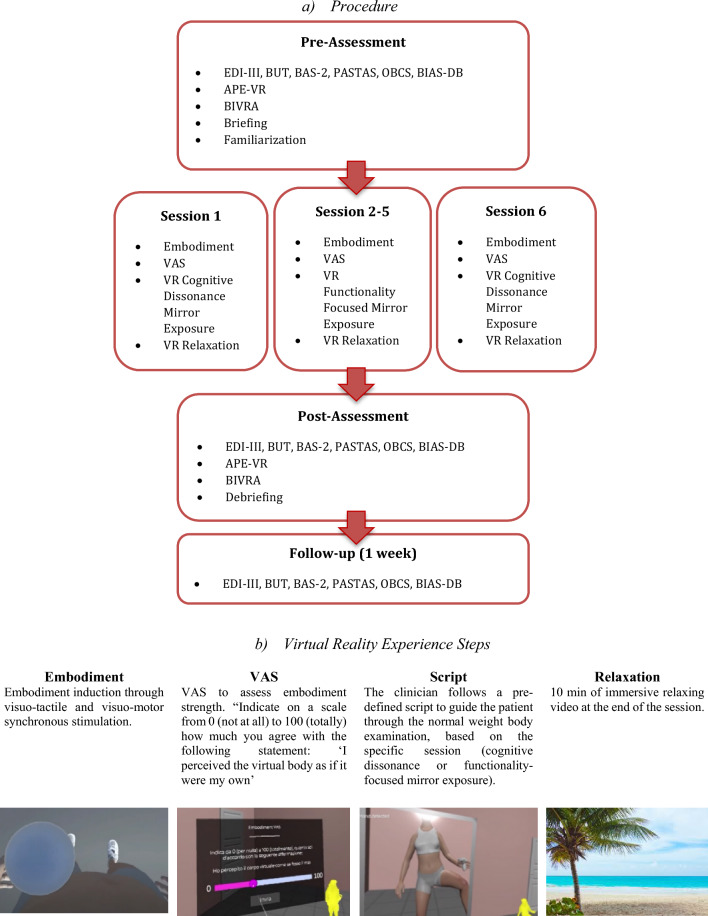
Anorexia Nervosa (AN) is a mental health condition marked by reduced food consumption, intense fear of weight gain, and distorted body experience. Virtual Reality (VR)-based techniques-i.e., Body-Swapping and Mirror Exposure techniques-offer promising avenues for addressing body disturbance in AN, allowing patients to embody virtual bodies varying in size and shape. We used a single-subject experimental design to explore the potential of virtual reality multisensory experiences for mitigating body disturbance in AN. We examine the case of a 24-year-old female hospitalized with restrictive Anorexia Nervosa who underwent a novel body-focused VR intervention alongside the hospital's standard care. The intervention included six bi-weekly sessions, wherein the patient was immersed in a VR environment that allowed her to embody a virtual body that matched a healthy weight range. Through interactions with a virtual mirror, the patient was encouraged to concentrate on the body's positive aspects and functional abilities, thinking about its significance in her past, current, and anticipated future activities (Functional Mirror Exposure). The patient reported reduced body dissatisfaction, negative beliefs, and body misperception. These changes endorse using immersive, multisensory, and embodied experiences to alter body consciousness and body-self relationship. Results preliminary support the transformative potential of VR in improving traditional approaches to assess and alter body disturbance.Level of evidence Level IV.
期刊介绍:
Eating and Weight Disorders - Studies on Anorexia, Bulimia and Obesity is a scientific journal whose main purpose is to create an international forum devoted to the several sectors of eating disorders and obesity and the significant relations between them. The journal publishes basic research, clinical and theoretical articles on eating disorders and weight-related problems: anorexia nervosa, bulimia nervosa, subthreshold eating disorders, obesity, atypical patterns of eating behaviour and body weight regulation in clinical and non-clinical populations.



 京公网安备 11010802042870号
京ICP备2023020795号-1
京公网安备 11010802042870号
京ICP备2023020795号-1

 分享
分享
 求助内容:
求助内容: 应助结果提醒方式:
 扫码关注我们
