Liang Yan, Jinhang Su, Chuanyi Liu, Shaoming Duan, Yuhao Zhang, Jianhang Li, Peiyi Han, Ye Liu
{"title":"ExSPIN: Explicit Feedback-Based Self-Play Fine-Tuning for Text-to-SQL Parsing.","authors":"Liang Yan, Jinhang Su, Chuanyi Liu, Shaoming Duan, Yuhao Zhang, Jianhang Li, Peiyi Han, Ye Liu","doi":"10.3390/e27030235","DOIUrl":null,"url":null,"abstract":"<p><p>Recently, self-play fine-tuning (SPIN) has garnered widespread attention as it enables large language models (LLMs) to iteratively enhance their capabilities through simulated interactions with themselves, transforming a weak LLM into a strong one. However, applying SPIN to fine-tune text-to-SQL models presents substantial challenges. Notably, existing frameworks lack clear signal feedback during the training process and fail to adequately capture the implicit schema-linking characteristics between natural language questions and databases. To address these issues, we propose a novel self-play fine-tuning method for text-to-SQL models, termed ExSPIN, which incorporates explicit feedback. Specifically, during fine-tuning, the SQL query execution results predicted by the LLM are fed back into the model's parameter update process. This feedback allows both the main player and the opponent to more accurately distinguish between negative and positive samples, thereby improving the fine-tuning outcomes. Additionally, we employ in-context learning techniques to provide explicit schema hints, enabling the LLM to better understand the schema-linking between the database and natural language queries during the self-play process. Evaluations on two real-world datasets show that our method significantly outperforms the state-of-the-art approaches.</p>","PeriodicalId":11694,"journal":{"name":"Entropy","volume":"27 3","pages":""},"PeriodicalIF":2.0000,"publicationDate":"2025-02-25","publicationTypes":"Journal Article","fieldsOfStudy":null,"isOpenAccess":false,"openAccessPdf":"https://www.ncbi.nlm.nih.gov/pmc/articles/PMC11940967/pdf/","citationCount":"0","resultStr":null,"platform":"Semanticscholar","paperid":null,"PeriodicalName":"Entropy","FirstCategoryId":"101","ListUrlMain":"https://doi.org/10.3390/e27030235","RegionNum":3,"RegionCategory":"物理与天体物理","ArticlePicture":[],"TitleCN":null,"AbstractTextCN":null,"PMCID":null,"EPubDate":"","PubModel":"","JCR":"Q2","JCRName":"PHYSICS, MULTIDISCIPLINARY","Score":null,"Total":0}
引用次数: 0
Abstract
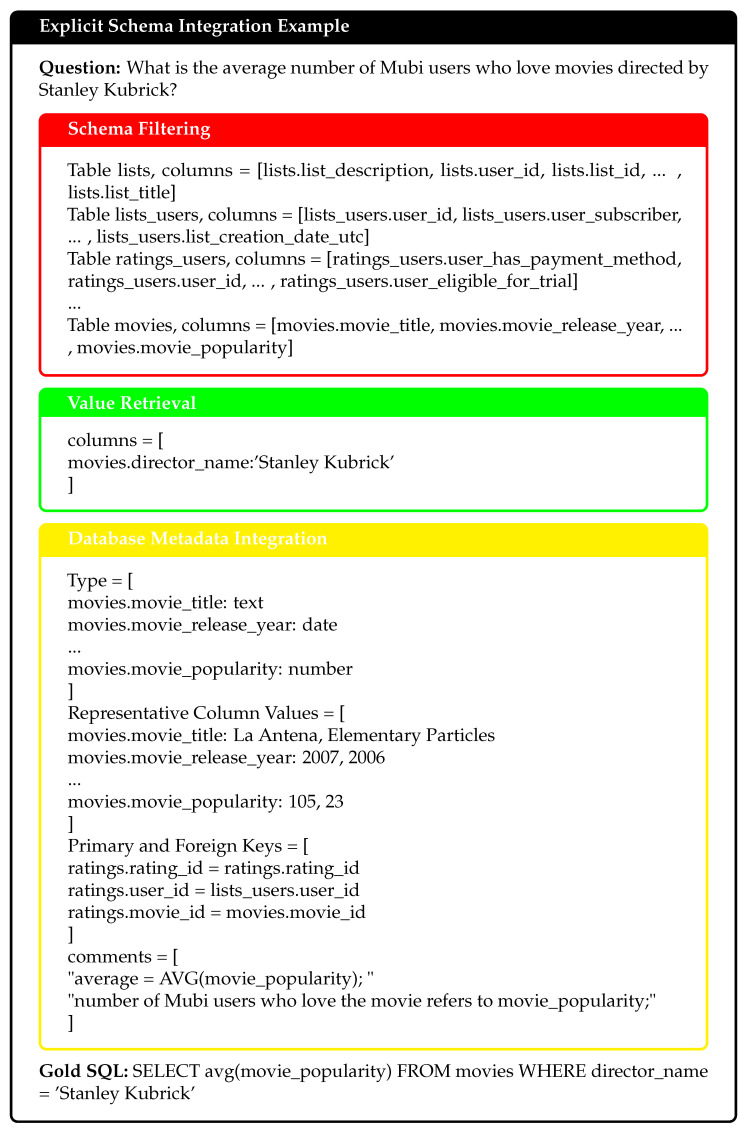
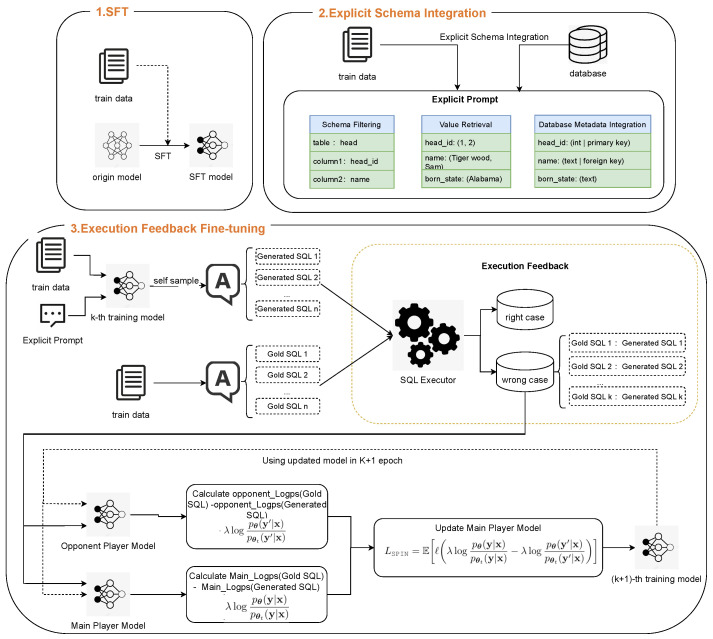
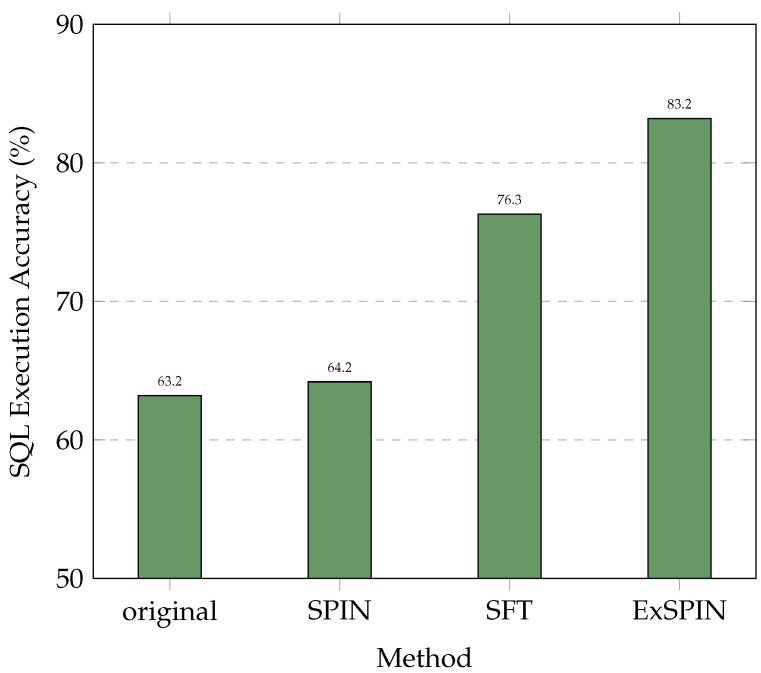
Recently, self-play fine-tuning (SPIN) has garnered widespread attention as it enables large language models (LLMs) to iteratively enhance their capabilities through simulated interactions with themselves, transforming a weak LLM into a strong one. However, applying SPIN to fine-tune text-to-SQL models presents substantial challenges. Notably, existing frameworks lack clear signal feedback during the training process and fail to adequately capture the implicit schema-linking characteristics between natural language questions and databases. To address these issues, we propose a novel self-play fine-tuning method for text-to-SQL models, termed ExSPIN, which incorporates explicit feedback. Specifically, during fine-tuning, the SQL query execution results predicted by the LLM are fed back into the model's parameter update process. This feedback allows both the main player and the opponent to more accurately distinguish between negative and positive samples, thereby improving the fine-tuning outcomes. Additionally, we employ in-context learning techniques to provide explicit schema hints, enabling the LLM to better understand the schema-linking between the database and natural language queries during the self-play process. Evaluations on two real-world datasets show that our method significantly outperforms the state-of-the-art approaches.
期刊介绍:
Entropy (ISSN 1099-4300), an international and interdisciplinary journal of entropy and information studies, publishes reviews, regular research papers and short notes. Our aim is to encourage scientists to publish as much as possible their theoretical and experimental details. There is no restriction on the length of the papers. If there are computation and the experiment, the details must be provided so that the results can be reproduced.




 京公网安备 11010802042870号
京ICP备2023020795号-1
京公网安备 11010802042870号
京ICP备2023020795号-1

 分享
分享
 求助内容:
求助内容: 应助结果提醒方式:
 扫码关注我们
