Physiological responses of wild birds to artificial grass during introduction to laboratory housing.
IF 2.9 3区 生物学Q2 MULTIDISCIPLINARY SCIENCESPeerJPub Date : 2025-03-24eCollection Date: 2025-01-01DOI:10.7717/peerj.19095
Bradley P Pedro, L Michael Romero
{"title":"Physiological responses of wild birds to artificial grass during introduction to laboratory housing.","authors":"Bradley P Pedro, L Michael Romero","doi":"10.7717/peerj.19095","DOIUrl":null,"url":null,"abstract":"<p><p>Introduction of wild animals to captivity induces chronic stress often leading to weight loss, increases in baseline corticosterone, and increased DNA damage. To mitigate these effects, providing enrichment to the captive environment has been proposed. Yet, studies investigating the physiological effects of captive environment enrichments are rare in wild birds. Here, we test the potential of a single enrichment factor by monitoring weight, baseline corticosterone, and DNA damage in two groups of house sparrows (<i>Passer domesticus)</i> during introduction to captivity: (1) birds in standard laboratory cages with food dishes and (2) birds in cages where food is spread across artificial grass to simulate a more natural foraging environment. After 3 weeks, all birds switched environments for 3 additional weeks. Weight was monitored bi-weekly while baseline corticosterone and DNA damage were measured weekly. Initially, both groups lost significant weight and weight plateaued by about 2 weeks of captivity. However, after switching housing environments, only initially grass-caged birds continued to lose weight. After one week of captivity, grass-caged birds had lower DNA damage compared to standard-caged birds. Over time, standard-caged birds remained unchanged and initially grass-caged birds increased damage after switching housing environments. There were no significant differences in baseline corticosterone across groups or over time. Our findings provide limited support for artificial grass as a substantial enrichment in mitigating the physiological consequences associated with introduction to captivity. Furthermore, given the challenges to husbandry of using artificial grass, the data are insufficiently strong to recommend the use of artificial grass as a stress-reducing enrichment to laboratory housing.</p>","PeriodicalId":19799,"journal":{"name":"PeerJ","volume":"13 ","pages":"e19095"},"PeriodicalIF":2.9000,"publicationDate":"2025-03-24","publicationTypes":"Journal Article","fieldsOfStudy":null,"isOpenAccess":false,"openAccessPdf":"https://www.ncbi.nlm.nih.gov/pmc/articles/PMC11949117/pdf/","citationCount":"0","resultStr":null,"platform":"Semanticscholar","paperid":null,"PeriodicalName":"PeerJ","FirstCategoryId":"99","ListUrlMain":"https://doi.org/10.7717/peerj.19095","RegionNum":3,"RegionCategory":"生物学","ArticlePicture":[],"TitleCN":null,"AbstractTextCN":null,"PMCID":null,"EPubDate":"2025/1/1 0:00:00","PubModel":"eCollection","JCR":"Q2","JCRName":"MULTIDISCIPLINARY SCIENCES","Score":null,"Total":0}
引用次数: 0
Abstract
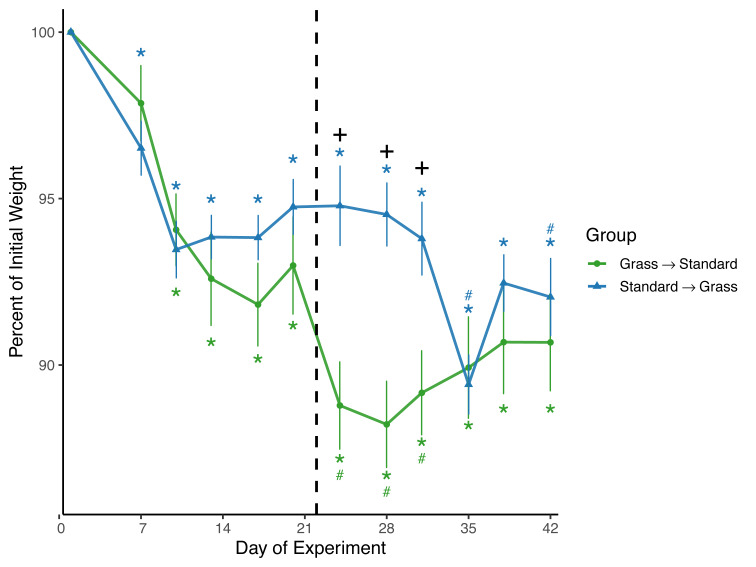
Introduction of wild animals to captivity induces chronic stress often leading to weight loss, increases in baseline corticosterone, and increased DNA damage. To mitigate these effects, providing enrichment to the captive environment has been proposed. Yet, studies investigating the physiological effects of captive environment enrichments are rare in wild birds. Here, we test the potential of a single enrichment factor by monitoring weight, baseline corticosterone, and DNA damage in two groups of house sparrows (Passer domesticus) during introduction to captivity: (1) birds in standard laboratory cages with food dishes and (2) birds in cages where food is spread across artificial grass to simulate a more natural foraging environment. After 3 weeks, all birds switched environments for 3 additional weeks. Weight was monitored bi-weekly while baseline corticosterone and DNA damage were measured weekly. Initially, both groups lost significant weight and weight plateaued by about 2 weeks of captivity. However, after switching housing environments, only initially grass-caged birds continued to lose weight. After one week of captivity, grass-caged birds had lower DNA damage compared to standard-caged birds. Over time, standard-caged birds remained unchanged and initially grass-caged birds increased damage after switching housing environments. There were no significant differences in baseline corticosterone across groups or over time. Our findings provide limited support for artificial grass as a substantial enrichment in mitigating the physiological consequences associated with introduction to captivity. Furthermore, given the challenges to husbandry of using artificial grass, the data are insufficiently strong to recommend the use of artificial grass as a stress-reducing enrichment to laboratory housing.
期刊介绍:
PeerJ is an open access peer-reviewed scientific journal covering research in the biological and medical sciences. At PeerJ, authors take out a lifetime publication plan (for as little as $99) which allows them to publish articles in the journal for free, forever. PeerJ has 5 Nobel Prize Winners on the Board; they have won several industry and media awards; and they are widely recognized as being one of the most interesting recent developments in academic publishing.







 京公网安备 11010802042870号
京ICP备2023020795号-1
京公网安备 11010802042870号
京ICP备2023020795号-1

 分享
分享
 求助内容:
求助内容: 应助结果提醒方式:
 扫码关注我们
