Uriel Fernando Carreño Sayago, Vladimir Ballesteros Ballesteros, Angelica María Lozano
{"title":"Development of a Treatment System of Water with Cr (VI) Through Models Using <i>E. crassipes</i> Biomass with Iron Chloride.","authors":"Uriel Fernando Carreño Sayago, Vladimir Ballesteros Ballesteros, Angelica María Lozano","doi":"10.3390/toxics13030230","DOIUrl":null,"url":null,"abstract":"<p><p>In the context of critical water quality issues, there is a pressing need for more pragmatic approaches to water research. Adsorbent biomass, derived from abundant and effective natural sources, holds considerable promise as a solution. <i>E. crassipes</i>, a type of plant biomass, has emerged as a particularly promising material due to its high adsorption capacity. When combined with iron chloride, this capacity is significantly enhanced, and the addition of EDTA is essential for the reuse of treated water. The economic viability of this material in water treatment has been thoroughly evaluated, and the project was developed with the aim of building treatment systems using <i>E. crassipes</i> biomass in conjunction with iron chloride. The development process involved the creation of a special material composed of 85% dried and ground <i>E. crassipes</i> and 15% iron chloride. The process was scaled up with the most effective biomass for treatment and subsequent elutions with EDTA. The outlet conditions, the quantity of pollutant removed, and the treated volume were established, and subsequently the extraparticle diffusion constant Kf, the intraparticle diffusion constant, and the characteristic isotherm were determined. The identification of the intraparticle diffusion model, Ks, was made possible by the results of the model, which indicated the specific route for the construction of a pilot-scale treatment system. The pilot-scale prototype was constructed using 1000 g of EC (2) of biomass (850 g of <i>E. crassipes</i> and 150 g of chloride of iron). The prototype developed in the present investigation could be used to treat effluents contaminated with heavy metals, especially chromium, and is an advanced environmental research project that contributes to the improvement of water quality.</p>","PeriodicalId":23195,"journal":{"name":"Toxics","volume":"13 3","pages":""},"PeriodicalIF":4.1000,"publicationDate":"2025-03-20","publicationTypes":"Journal Article","fieldsOfStudy":null,"isOpenAccess":false,"openAccessPdf":"https://www.ncbi.nlm.nih.gov/pmc/articles/PMC11945796/pdf/","citationCount":"0","resultStr":null,"platform":"Semanticscholar","paperid":null,"PeriodicalName":"Toxics","FirstCategoryId":"93","ListUrlMain":"https://doi.org/10.3390/toxics13030230","RegionNum":3,"RegionCategory":"环境科学与生态学","ArticlePicture":[],"TitleCN":null,"AbstractTextCN":null,"PMCID":null,"EPubDate":"","PubModel":"","JCR":"Q2","JCRName":"ENVIRONMENTAL SCIENCES","Score":null,"Total":0}
引用次数: 0
Abstract
In the context of critical water quality issues, there is a pressing need for more pragmatic approaches to water research. Adsorbent biomass, derived from abundant and effective natural sources, holds considerable promise as a solution. E. crassipes, a type of plant biomass, has emerged as a particularly promising material due to its high adsorption capacity. When combined with iron chloride, this capacity is significantly enhanced, and the addition of EDTA is essential for the reuse of treated water. The economic viability of this material in water treatment has been thoroughly evaluated, and the project was developed with the aim of building treatment systems using E. crassipes biomass in conjunction with iron chloride. The development process involved the creation of a special material composed of 85% dried and ground E. crassipes and 15% iron chloride. The process was scaled up with the most effective biomass for treatment and subsequent elutions with EDTA. The outlet conditions, the quantity of pollutant removed, and the treated volume were established, and subsequently the extraparticle diffusion constant Kf, the intraparticle diffusion constant, and the characteristic isotherm were determined. The identification of the intraparticle diffusion model, Ks, was made possible by the results of the model, which indicated the specific route for the construction of a pilot-scale treatment system. The pilot-scale prototype was constructed using 1000 g of EC (2) of biomass (850 g of E. crassipes and 150 g of chloride of iron). The prototype developed in the present investigation could be used to treat effluents contaminated with heavy metals, especially chromium, and is an advanced environmental research project that contributes to the improvement of water quality.
在关键的水质问题的背景下,迫切需要更务实的方法来研究水。从丰富而有效的自然资源中提取的吸附剂生物质作为一种解决方案具有相当大的前景。石楠是一种植物生物量,由于其高吸附能力而成为一种特别有前途的材料。当与氯化铁结合时,这种能力显着增强,并且EDTA的添加对于处理后的水的再利用至关重要。这种材料在水处理中的经济可行性已经进行了彻底的评估,该项目的目的是建立处理系统,将棘草生物质与氯化铁结合使用。开发过程涉及到一种特殊材料的创造,该材料由85%的干燥和研磨的石笋和15%的氯化铁组成。该工艺扩大了最有效的生物质处理和随后的EDTA洗脱。确定了出水条件、污染物去除率和处理体积,确定了颗粒外扩散常数Kf、颗粒内扩散常数Kf和特征等温线。该模型的结果使颗粒内扩散模型Ks的识别成为可能,为中试规模处理系统的建设指明了具体路线。使用1000 g EC(2)生物质(850 g E. crassipes和150 g氯铁)构建中试规模原型。本研究开发的原型可用于处理重金属,特别是铬污染的废水,是一项有助于改善水质的先进环境研究项目。
ToxicsChemical Engineering-Chemical Health and Safety
CiteScore
4.50
自引率
10.90%
发文量
681
审稿时长
6 weeks
期刊介绍:
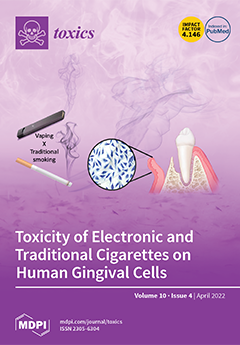
Toxics (ISSN 2305-6304) is an international, peer-reviewed, open access journal which provides an advanced forum for studies related to all aspects of toxic chemicals and materials. It publishes reviews, regular research papers, and short communications. Our aim is to encourage scientists to publish their experimental and theoretical results in detail. There is, therefore, no restriction on the maximum length of the papers, although authors should write their papers in a clear and concise way. The full experimental details must be provided so that the results can be reproduced. Electronic files or software regarding the full details of calculations and experimental procedure can be deposited as supplementary material, if it is not possible to publish them along with the text.





 京公网安备 11010802042870号
京ICP备2023020795号-1
京公网安备 11010802042870号
京ICP备2023020795号-1

 分享
分享
 求助内容:
求助内容: 应助结果提醒方式:
 扫码关注我们
