CongBang Ngo, Jane M Morrell, Ingrid Hansson, Padet Tummaruk, Aleksandar Cojkic
{"title":"Effect of Colloid Centrifugation and Cold Storage of Boar Semen at 4 °C on Bacterial Load and Sperm Quality.","authors":"CongBang Ngo, Jane M Morrell, Ingrid Hansson, Padet Tummaruk, Aleksandar Cojkic","doi":"10.3390/antibiotics14030267","DOIUrl":null,"url":null,"abstract":"<p><p><b>Background/Objectives</b>: Alternatives to antibiotics in semen extenders used for pig breeding are needed. Cold storage of boar semen is possible in certain extenders; however, bacteria can still survive. Colloid centrifugation can remove bacteria; therefore, a combination of colloid centrifugation and cold storage on the bacterial load and sperm quality of boar semen was investigated. <b>Results</b>: The sperm quality in the original samples were similar in samples with and without antibiotics, respectively. At Day 4, the bacterial count was not different between controls stored at 17 °C with antibiotics and SLC cold-stored samples without antibiotics. The proportion of dead sperm increased in controls at 16-18 °C (28.12 ± 21.72% vs. 32.88 ± 20.94%; <i>p</i> < 0.05), and DNA fragmentation increased from 1.5 ± 1.02% at Day 0 to 6.1 ± 3.64% at Day 4 (<i>p</i> < 0.01), whereas it did not deteriorate in the cold-stored samples (Day 4: %DFI 2.00 ± 1.65% and 1.90 ± 1.05% for SLC samples with and without antibiotics, respectively). <b>Methods</b>: Aliquots of boar ejaculates were extended in Androstar Premium with and without antibiotics. The samples without antibiotics were processed by Single Layer Centrifugation (SLC) through Porcicoll; sperm pellets were resuspended in AndroStar Premium, with or without antibiotics, cooled slowly, and stored for 4 days at 4 °C. Controls (aliquots extended in AndroStar Premium with antibiotics) were stored at 17 °C. The bacterial load and sperm quality were assessed in the original samples and after 4 days of storage. <b>Conclusions</b>: Single Layer Centrifugation combined with cold storage is an effective method for reducing the bacterial load in boar semen, with or without antibiotics.</p>","PeriodicalId":54246,"journal":{"name":"Antibiotics-Basel","volume":"14 3","pages":""},"PeriodicalIF":4.6000,"publicationDate":"2025-03-06","publicationTypes":"Journal Article","fieldsOfStudy":null,"isOpenAccess":false,"openAccessPdf":"https://www.ncbi.nlm.nih.gov/pmc/articles/PMC11939358/pdf/","citationCount":"0","resultStr":null,"platform":"Semanticscholar","paperid":null,"PeriodicalName":"Antibiotics-Basel","FirstCategoryId":"3","ListUrlMain":"https://doi.org/10.3390/antibiotics14030267","RegionNum":2,"RegionCategory":"医学","ArticlePicture":[],"TitleCN":null,"AbstractTextCN":null,"PMCID":null,"EPubDate":"","PubModel":"","JCR":"Q1","JCRName":"INFECTIOUS DISEASES","Score":null,"Total":0}
引用次数: 0
Abstract
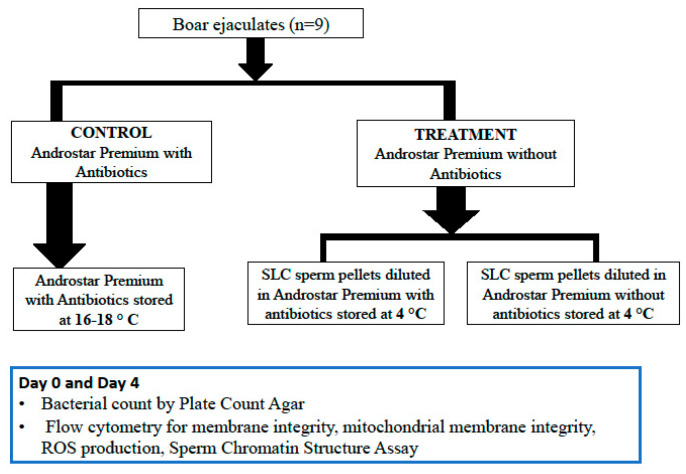
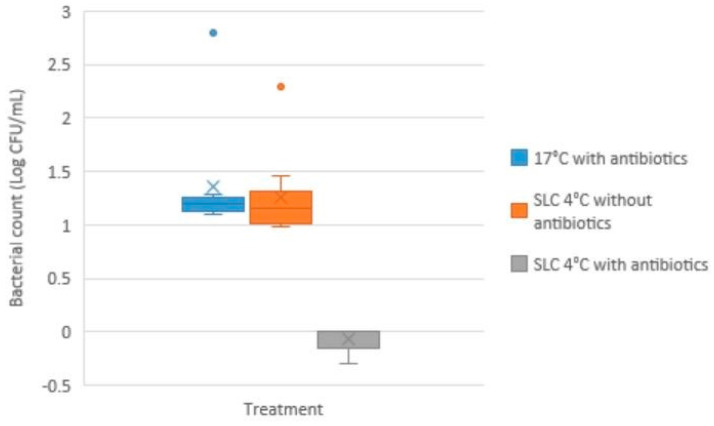
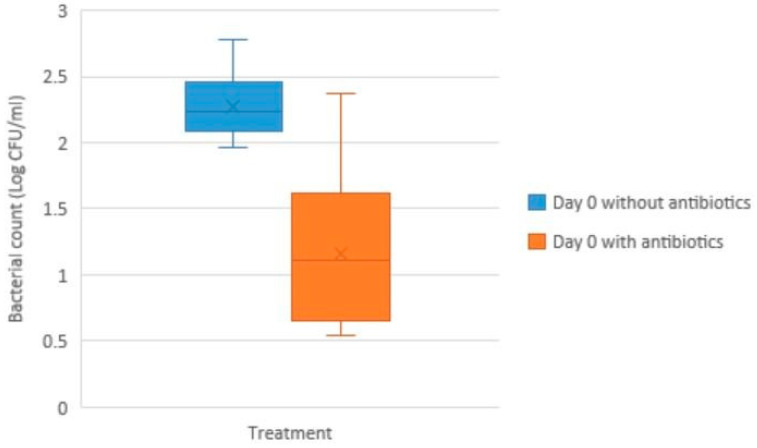
Background/Objectives: Alternatives to antibiotics in semen extenders used for pig breeding are needed. Cold storage of boar semen is possible in certain extenders; however, bacteria can still survive. Colloid centrifugation can remove bacteria; therefore, a combination of colloid centrifugation and cold storage on the bacterial load and sperm quality of boar semen was investigated. Results: The sperm quality in the original samples were similar in samples with and without antibiotics, respectively. At Day 4, the bacterial count was not different between controls stored at 17 °C with antibiotics and SLC cold-stored samples without antibiotics. The proportion of dead sperm increased in controls at 16-18 °C (28.12 ± 21.72% vs. 32.88 ± 20.94%; p < 0.05), and DNA fragmentation increased from 1.5 ± 1.02% at Day 0 to 6.1 ± 3.64% at Day 4 (p < 0.01), whereas it did not deteriorate in the cold-stored samples (Day 4: %DFI 2.00 ± 1.65% and 1.90 ± 1.05% for SLC samples with and without antibiotics, respectively). Methods: Aliquots of boar ejaculates were extended in Androstar Premium with and without antibiotics. The samples without antibiotics were processed by Single Layer Centrifugation (SLC) through Porcicoll; sperm pellets were resuspended in AndroStar Premium, with or without antibiotics, cooled slowly, and stored for 4 days at 4 °C. Controls (aliquots extended in AndroStar Premium with antibiotics) were stored at 17 °C. The bacterial load and sperm quality were assessed in the original samples and after 4 days of storage. Conclusions: Single Layer Centrifugation combined with cold storage is an effective method for reducing the bacterial load in boar semen, with or without antibiotics.
Antibiotics-BaselPharmacology, Toxicology and Pharmaceutics-General Pharmacology, Toxicology and Pharmaceutics
CiteScore
7.30
自引率
14.60%
发文量
1547
审稿时长
11 weeks
期刊介绍:
Antibiotics (ISSN 2079-6382) is an open access, peer reviewed journal on all aspects of antibiotics. Antibiotics is a multi-disciplinary journal encompassing the general fields of biochemistry, chemistry, genetics, microbiology and pharmacology. Our aim is to encourage scientists to publish their experimental and theoretical results in as much detail as possible. Therefore, there is no restriction on the length of papers.




 京公网安备 11010802042870号
京ICP备2023020795号-1
京公网安备 11010802042870号
京ICP备2023020795号-1

 分享
分享
 求助内容:
求助内容: 应助结果提醒方式:
 扫码关注我们
