Mohammed Maan Al-Salihi, Maryam Sabah Al-Jebur, Ahmed Abd Elazim, Ram Saha, Ahmed Saleh, Farhan Siddiq, Ali Ayyad, Adnan I Qureshi
{"title":"Association Between Stroke and Traumatic Brain Injury: A Systematic Review and Meta-Analysis.","authors":"Mohammed Maan Al-Salihi, Maryam Sabah Al-Jebur, Ahmed Abd Elazim, Ram Saha, Ahmed Saleh, Farhan Siddiq, Ali Ayyad, Adnan I Qureshi","doi":"10.3390/neurosci6010021","DOIUrl":null,"url":null,"abstract":"<p><strong>Background: </strong>Stroke and traumatic brain injury (TBI) represent two major health concerns worldwide. There is growing evidence suggesting a potential association between TBI and stroke. In this systematic review and meta-analysis, we aim to explore the association between TBI and stroke risk, with a specific focus on overall stroke risk and subgroup variations based on stroke type, severity, and the post-TBI time period.</p><p><strong>Methods: </strong>PubMed, Web of Science (WOS), Scopus, and Cochrane Library were systematically searched for studies exploring the link between stroke and TBI. The pooled hazard ratios (HRs) with a 95% confidence interval (CI) were calculated. The Comprehensive Meta-Analysis (CMA) software was used for the analysis. Subgroup analyses were conducted based on stroke type, TBI severity, and post-TBI phase. The Newcastle-Ottawa Scale (NOS) was utilized for the quality assessment.</p><p><strong>Results: </strong>We included a total of 13 observational studies, with data from 8 studies used for quantitative analysis. A history of TBI was associated with a significantly higher odds of stroke compared to controls (HR = 2.3, 95% CI (1.79 to 2.958), <i>p</i> < 0.001). The risk was greater for hemorrhagic stroke (HR = 4.8, 95% CI (3.336 to 6.942), <i>p</i> < 0.001) than for ischemic stroke (HR = 1.56, 95% CI (1.28 to 1.9), <i>p</i> < 0.001). Both moderate-to-severe TBI (HR = 3.64, 95% CI (2.158 to 6.142), <i>p</i> < 0.001) and mild TBI (HR = 1.81, 95% CI (1.17 to 2.8), <i>p</i> = 0.007) were associated with a significantly higher risk of stroke. The risk was also higher in the early post-TBI phase (1-30 days) (HR = 4.155, 95% CI (2.25 to 7.67), <i>p</i> < 0.001) compared to later phases (HR = 1.68, 95% CI (1.089 to 2.59), <i>p</i> = 0.019) from 30 days to 1 year and (HR = 1.87, 95% CI (1.375 to 2.544), <i>p</i> < 0.001) after 1 year.</p><p><strong>Conclusions: </strong>This systematic review confirms a significant association between TBI and an increased risk of stroke, regardless of TBI severity, type, or timing of stroke. The findings highlight the need for early monitoring and advocating preventive strategies for stroke in patients with a history of TBI.</p>","PeriodicalId":74294,"journal":{"name":"NeuroSci","volume":"6 1","pages":""},"PeriodicalIF":2.0000,"publicationDate":"2025-03-04","publicationTypes":"Journal Article","fieldsOfStudy":null,"isOpenAccess":false,"openAccessPdf":"https://www.ncbi.nlm.nih.gov/pmc/articles/PMC11944542/pdf/","citationCount":"0","resultStr":null,"platform":"Semanticscholar","paperid":null,"PeriodicalName":"NeuroSci","FirstCategoryId":"1085","ListUrlMain":"https://doi.org/10.3390/neurosci6010021","RegionNum":0,"RegionCategory":null,"ArticlePicture":[],"TitleCN":null,"AbstractTextCN":null,"PMCID":null,"EPubDate":"","PubModel":"","JCR":"Q3","JCRName":"CLINICAL NEUROLOGY","Score":null,"Total":0}
引用次数: 0
Abstract
Background: Stroke and traumatic brain injury (TBI) represent two major health concerns worldwide. There is growing evidence suggesting a potential association between TBI and stroke. In this systematic review and meta-analysis, we aim to explore the association between TBI and stroke risk, with a specific focus on overall stroke risk and subgroup variations based on stroke type, severity, and the post-TBI time period.
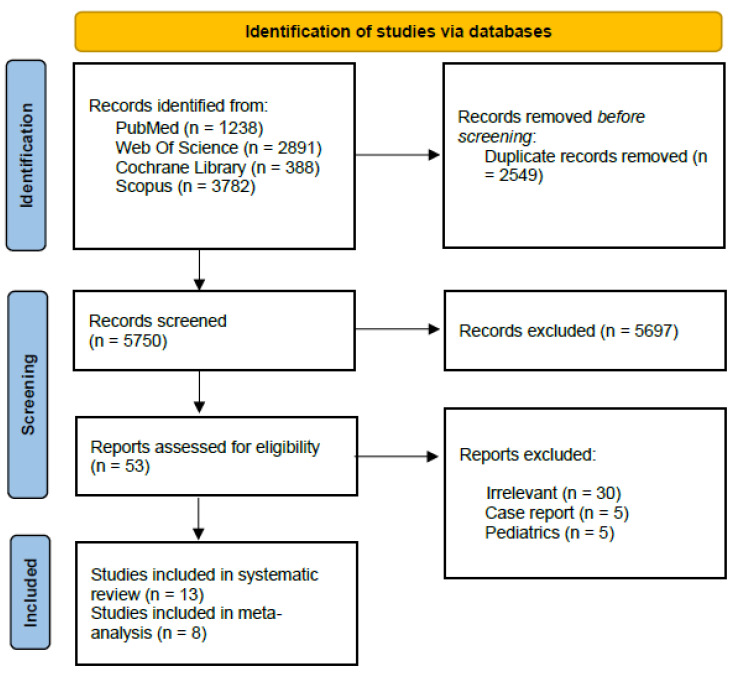
Methods: PubMed, Web of Science (WOS), Scopus, and Cochrane Library were systematically searched for studies exploring the link between stroke and TBI. The pooled hazard ratios (HRs) with a 95% confidence interval (CI) were calculated. The Comprehensive Meta-Analysis (CMA) software was used for the analysis. Subgroup analyses were conducted based on stroke type, TBI severity, and post-TBI phase. The Newcastle-Ottawa Scale (NOS) was utilized for the quality assessment.
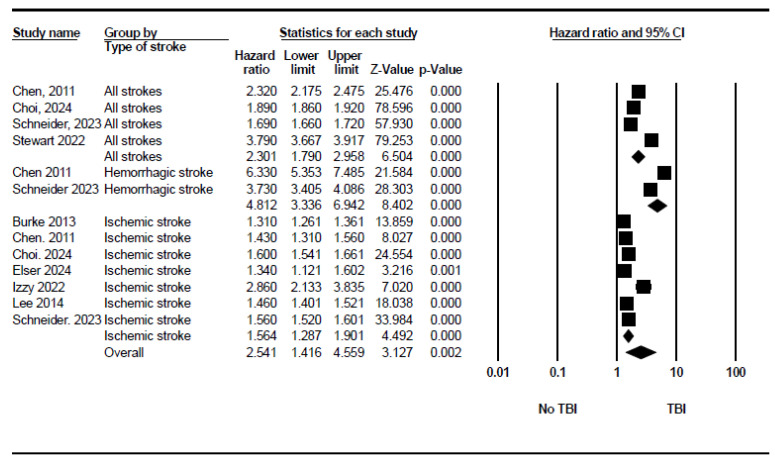
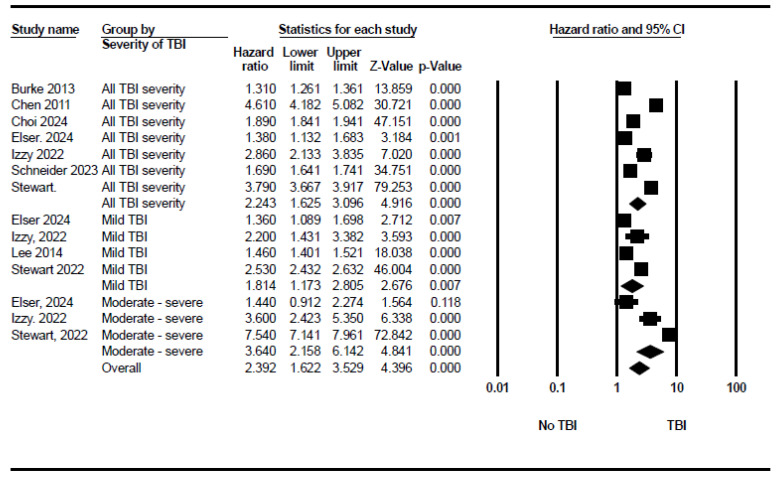
Results: We included a total of 13 observational studies, with data from 8 studies used for quantitative analysis. A history of TBI was associated with a significantly higher odds of stroke compared to controls (HR = 2.3, 95% CI (1.79 to 2.958), p < 0.001). The risk was greater for hemorrhagic stroke (HR = 4.8, 95% CI (3.336 to 6.942), p < 0.001) than for ischemic stroke (HR = 1.56, 95% CI (1.28 to 1.9), p < 0.001). Both moderate-to-severe TBI (HR = 3.64, 95% CI (2.158 to 6.142), p < 0.001) and mild TBI (HR = 1.81, 95% CI (1.17 to 2.8), p = 0.007) were associated with a significantly higher risk of stroke. The risk was also higher in the early post-TBI phase (1-30 days) (HR = 4.155, 95% CI (2.25 to 7.67), p < 0.001) compared to later phases (HR = 1.68, 95% CI (1.089 to 2.59), p = 0.019) from 30 days to 1 year and (HR = 1.87, 95% CI (1.375 to 2.544), p < 0.001) after 1 year.
Conclusions: This systematic review confirms a significant association between TBI and an increased risk of stroke, regardless of TBI severity, type, or timing of stroke. The findings highlight the need for early monitoring and advocating preventive strategies for stroke in patients with a history of TBI.



 京公网安备 11010802042870号
京ICP备2023020795号-1
京公网安备 11010802042870号
京ICP备2023020795号-1

 分享
分享

 求助内容:
求助内容: 应助结果提醒方式:
 扫码关注我们
