{"title":"Neuroprotective Role of Cyclic AMP Signaling in Dopaminergic Degeneration Induced by a Parkinson's Disease Toxin, Rotenone.","authors":"Sazan Ismael, Sarah Baitamouni, Daewoo Lee","doi":"10.3390/neurosci6010024","DOIUrl":null,"url":null,"abstract":"<p><p>Parkinson's disease (PD) is a progressive neurodegenerative disorder characterized by the selective loss of dopaminergic (DA) neurons in the midbrain. While dopamine precursor levodopa and D2 receptor agonists are commonly used to alleviate PD symptoms, these treatments do not halt or reverse disease progression. Thus, developing effective neuroprotective strategies remains a critical goal. In this study, we explored neuroprotective mechanisms in a <i>Drosophila</i> primary neuronal culture model of PD, created by administering the environmental toxin rotenone. Using the chemogenetic DREADD (designer receptors exclusively activated by designer drugs) system, we selectively activated cAMP signaling in DA neurons within the rotenone-induced model. Our results demonstrate that increasing cAMP signaling via Gs-coupled DREADD (rM3Ds) is protective against DA neurodegeneration. Furthermore, overexpression of the catalytic PKA-C1 subunit fully rescued DA neurons from rotenone-induced degeneration, with this effect restricted to DA neurons where PKA-C1 was specifically overexpressed. These findings reveal that cAMP-PKA signaling activation is neuroprotective in DA neurons against rotenone-induced degeneration, offering promising insights for developing targeted therapeutic strategies to slow or prevent PD pathology progression.</p>","PeriodicalId":74294,"journal":{"name":"NeuroSci","volume":"6 1","pages":""},"PeriodicalIF":2.0000,"publicationDate":"2025-03-11","publicationTypes":"Journal Article","fieldsOfStudy":null,"isOpenAccess":false,"openAccessPdf":"https://www.ncbi.nlm.nih.gov/pmc/articles/PMC11946696/pdf/","citationCount":"0","resultStr":null,"platform":"Semanticscholar","paperid":null,"PeriodicalName":"NeuroSci","FirstCategoryId":"1085","ListUrlMain":"https://doi.org/10.3390/neurosci6010024","RegionNum":0,"RegionCategory":null,"ArticlePicture":[],"TitleCN":null,"AbstractTextCN":null,"PMCID":null,"EPubDate":"","PubModel":"","JCR":"Q3","JCRName":"CLINICAL NEUROLOGY","Score":null,"Total":0}
引用次数: 0
Abstract
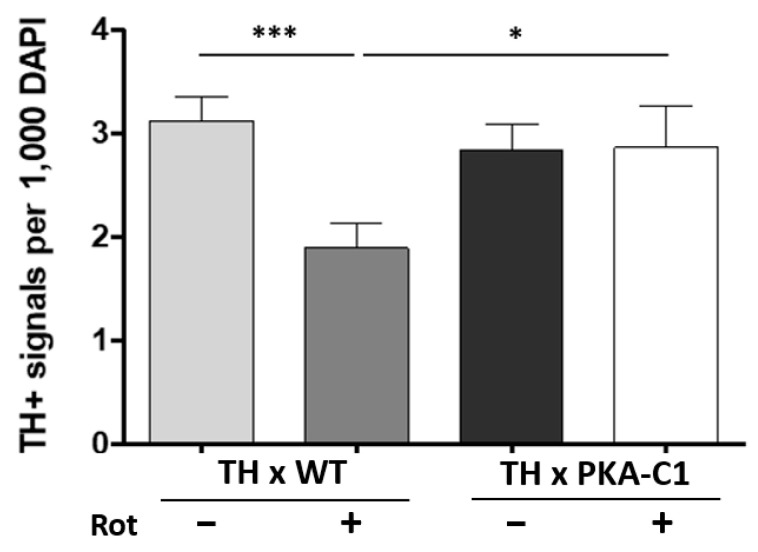
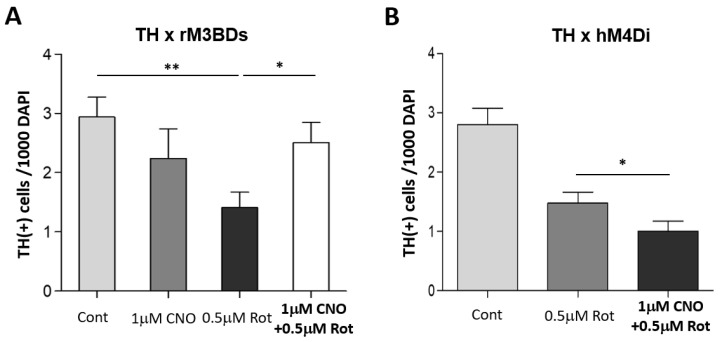
Parkinson's disease (PD) is a progressive neurodegenerative disorder characterized by the selective loss of dopaminergic (DA) neurons in the midbrain. While dopamine precursor levodopa and D2 receptor agonists are commonly used to alleviate PD symptoms, these treatments do not halt or reverse disease progression. Thus, developing effective neuroprotective strategies remains a critical goal. In this study, we explored neuroprotective mechanisms in a Drosophila primary neuronal culture model of PD, created by administering the environmental toxin rotenone. Using the chemogenetic DREADD (designer receptors exclusively activated by designer drugs) system, we selectively activated cAMP signaling in DA neurons within the rotenone-induced model. Our results demonstrate that increasing cAMP signaling via Gs-coupled DREADD (rM3Ds) is protective against DA neurodegeneration. Furthermore, overexpression of the catalytic PKA-C1 subunit fully rescued DA neurons from rotenone-induced degeneration, with this effect restricted to DA neurons where PKA-C1 was specifically overexpressed. These findings reveal that cAMP-PKA signaling activation is neuroprotective in DA neurons against rotenone-induced degeneration, offering promising insights for developing targeted therapeutic strategies to slow or prevent PD pathology progression.



 京公网安备 11010802042870号
京ICP备2023020795号-1
京公网安备 11010802042870号
京ICP备2023020795号-1

 分享
分享

 求助内容:
求助内容: 应助结果提醒方式:
 扫码关注我们
