Kefeng Ouyang, Sheng Chen, Lidong Yu, Hongyu Qin, Ao Liu, Youfa Liu, Quan Wu, Bingjie Ran, Shubing Wei, Fei Gao, Kun Zhang, Jin Hu and Yan Huang
{"title":"An electrochemically paralleled biomass electrolyte additive facilitates the integrated modification of multi-dimensional Zn metal batteries†","authors":"Kefeng Ouyang, Sheng Chen, Lidong Yu, Hongyu Qin, Ao Liu, Youfa Liu, Quan Wu, Bingjie Ran, Shubing Wei, Fei Gao, Kun Zhang, Jin Hu and Yan Huang","doi":"10.1039/D5EE00237K","DOIUrl":null,"url":null,"abstract":"<p >A diverse array of Zn metal batteries (ZMBs) are swiftly emerging as a prominent force in the energy storage sector. Electrolyte modification is integral to improving the performance of ZMBs by effectively optimizing the behavior of both the anode and cathode. However, most existing electrolytes are specifically tailored to individual battery systems, thereby limiting their broader applicability across different ZMB technologies. Herein, a universal electrolyte additive design strategy, termed “electrochemical parallelism”, has been proposed to address this issue. By addressing critical challenges such as poor reversibility of the Zn anode, severe pH fluctuation at the MnO<small><sub>2</sub></small> electrode/electrolyte interface, solvent evaporation in open systems, and corrosion induced by polyiodide ions, a multifunctional pyrrolidone carboxylate sodium (PCA-Na) additive is developed. Its integrated functionalities include Zn anode interfacial modification, Zn<small><sup>2+</sup></small> solvation regulation, pH buffering, hydrogen bond network restructuring and polyiodide ion repulsion. As a result, it enables the Zn anode of a symmetric pouch cell with a cumulative plating capacity of 704 A h, a Zn‖MnO<small><sub>2</sub></small> pouch cell with a discharge capacity exceeding 370 mA h, a Zn–air battery with an electrolyte shelf life surpassing 1000 h, and a 3.7 A h-level Zn‖I<small><sub>2</sub></small> pouch cell with a capacity retention of 83% after 130 cycles. These advancements collectively realize the electrochemical parallel integration of ZMBs.</p>","PeriodicalId":72,"journal":{"name":"Energy & Environmental Science","volume":" 9","pages":" 4416-4430"},"PeriodicalIF":30.8000,"publicationDate":"2025-03-29","publicationTypes":"Journal Article","fieldsOfStudy":null,"isOpenAccess":false,"openAccessPdf":"","citationCount":"0","resultStr":null,"platform":"Semanticscholar","paperid":null,"PeriodicalName":"Energy & Environmental Science","FirstCategoryId":"88","ListUrlMain":"https://pubs.rsc.org/en/content/articlelanding/2025/ee/d5ee00237k","RegionNum":1,"RegionCategory":"材料科学","ArticlePicture":[],"TitleCN":null,"AbstractTextCN":null,"PMCID":null,"EPubDate":"","PubModel":"","JCR":"Q1","JCRName":"CHEMISTRY, MULTIDISCIPLINARY","Score":null,"Total":0}
引用次数: 0
Abstract
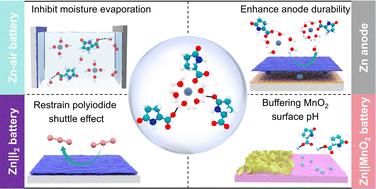
A diverse array of Zn metal batteries (ZMBs) are swiftly emerging as a prominent force in the energy storage sector. Electrolyte modification is integral to improving the performance of ZMBs by effectively optimizing the behavior of both the anode and cathode. However, most existing electrolytes are specifically tailored to individual battery systems, thereby limiting their broader applicability across different ZMB technologies. Herein, a universal electrolyte additive design strategy, termed “electrochemical parallelism”, has been proposed to address this issue. By addressing critical challenges such as poor reversibility of the Zn anode, severe pH fluctuation at the MnO2 electrode/electrolyte interface, solvent evaporation in open systems, and corrosion induced by polyiodide ions, a multifunctional pyrrolidone carboxylate sodium (PCA-Na) additive is developed. Its integrated functionalities include Zn anode interfacial modification, Zn2+ solvation regulation, pH buffering, hydrogen bond network restructuring and polyiodide ion repulsion. As a result, it enables the Zn anode of a symmetric pouch cell with a cumulative plating capacity of 704 A h, a Zn‖MnO2 pouch cell with a discharge capacity exceeding 370 mA h, a Zn–air battery with an electrolyte shelf life surpassing 1000 h, and a 3.7 A h-level Zn‖I2 pouch cell with a capacity retention of 83% after 130 cycles. These advancements collectively realize the electrochemical parallel integration of ZMBs.
期刊介绍:
Energy & Environmental Science, a peer-reviewed scientific journal, publishes original research and review articles covering interdisciplinary topics in the (bio)chemical and (bio)physical sciences, as well as chemical engineering disciplines. Published monthly by the Royal Society of Chemistry (RSC), a not-for-profit publisher, Energy & Environmental Science is recognized as a leading journal. It boasts an impressive impact factor of 8.500 as of 2009, ranking 8th among 140 journals in the category "Chemistry, Multidisciplinary," second among 71 journals in "Energy & Fuels," second among 128 journals in "Engineering, Chemical," and first among 181 scientific journals in "Environmental Sciences."
Energy & Environmental Science publishes various types of articles, including Research Papers (original scientific work), Review Articles, Perspectives, and Minireviews (feature review-type articles of broad interest), Communications (original scientific work of an urgent nature), Opinions (personal, often speculative viewpoints or hypotheses on current topics), and Analysis Articles (in-depth examination of energy-related issues).



 京公网安备 11010802042870号
京ICP备2023020795号-1
京公网安备 11010802042870号
京ICP备2023020795号-1

 分享
分享
 求助内容:
求助内容: 应助结果提醒方式:
 扫码关注我们
