Chelsea Withfield, Wynand Malherbe, Johannes H. Erasmus
{"title":"Monitoring total mercury concentrations in the freshwater clam Corbicula sp. in aquatic ecosystems from different sources","authors":"Chelsea Withfield, Wynand Malherbe, Johannes H. Erasmus","doi":"10.1016/j.envpol.2025.126171","DOIUrl":null,"url":null,"abstract":"<div><div>South Africa stands out as a prominent global contributor of mercury (Hg) emissions, a matter of great concern due to its toxic nature and potential serious health effects on biota if it enters the environment. Mercury enters freshwater systems through various anthropogenic activities, such as emissions from coal-fired power stations and artisanal gold mining. Studies have indicated that bivalves accumulate metals from their aquatic environment. The freshwater bivalve genus <em>Corbicula</em> is widely distributed across South Africa and is relatively abundant. Given the widespread presence of <em>Corbicula</em> clams in South Africa, they have the potential to serve as bioindicators for Hg pollution in freshwater ecosystems. A total of 34 sites were sampled across the northeastern part of South Africa, with <em>Corbicula</em> clams found at 15 of these sites. At each site, a minimum of five clams were collected, alongside water and sediment samples. Total Hg (THg) concentrations were determined in sediment and clam samples using a flow injection mercury system. Total Hg concentrations in sediment samples correlated with different land-use activities, where sites closer to Hg sources had higher THg concentrations. This study also found higher environmental THg concentrations in the Olifants, and Inkomati Water Management Areas as reported 12 years ago. Clam THg concentrations were found to be higher than in the corresponding sediment samples, specifically in larger clams, suggesting longer Hg exposure at some sites. A weak positive correlation was found between sediment and clam THg concentrations, suggested that bioaccumulation may be influenced more by exposure period, rather than exposure concentrations. This study highlights the potential for these clams to serve as effective bioindicators since the accumulation of THg in their tissue can provide a better overview of the bioavailable THg in the aquatic system, compared to abiotic environmental samples alone.</div></div>","PeriodicalId":311,"journal":{"name":"Environmental Pollution","volume":"373 ","pages":"Article 126171"},"PeriodicalIF":7.3000,"publicationDate":"2025-05-15","publicationTypes":"Journal Article","fieldsOfStudy":null,"isOpenAccess":false,"openAccessPdf":"","citationCount":"0","resultStr":null,"platform":"Semanticscholar","paperid":null,"PeriodicalName":"Environmental Pollution","FirstCategoryId":"93","ListUrlMain":"https://www.sciencedirect.com/science/article/pii/S0269749125005445","RegionNum":2,"RegionCategory":"环境科学与生态学","ArticlePicture":[],"TitleCN":null,"AbstractTextCN":null,"PMCID":null,"EPubDate":"2025/3/29 0:00:00","PubModel":"Epub","JCR":"Q1","JCRName":"ENVIRONMENTAL SCIENCES","Score":null,"Total":0}
引用次数: 0
Abstract
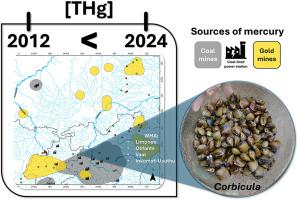
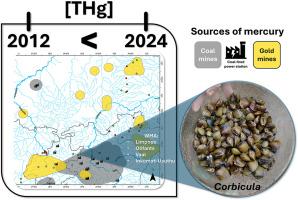
South Africa stands out as a prominent global contributor of mercury (Hg) emissions, a matter of great concern due to its toxic nature and potential serious health effects on biota if it enters the environment. Mercury enters freshwater systems through various anthropogenic activities, such as emissions from coal-fired power stations and artisanal gold mining. Studies have indicated that bivalves accumulate metals from their aquatic environment. The freshwater bivalve genus Corbicula is widely distributed across South Africa and is relatively abundant. Given the widespread presence of Corbicula clams in South Africa, they have the potential to serve as bioindicators for Hg pollution in freshwater ecosystems. A total of 34 sites were sampled across the northeastern part of South Africa, with Corbicula clams found at 15 of these sites. At each site, a minimum of five clams were collected, alongside water and sediment samples. Total Hg (THg) concentrations were determined in sediment and clam samples using a flow injection mercury system. Total Hg concentrations in sediment samples correlated with different land-use activities, where sites closer to Hg sources had higher THg concentrations. This study also found higher environmental THg concentrations in the Olifants, and Inkomati Water Management Areas as reported 12 years ago. Clam THg concentrations were found to be higher than in the corresponding sediment samples, specifically in larger clams, suggesting longer Hg exposure at some sites. A weak positive correlation was found between sediment and clam THg concentrations, suggested that bioaccumulation may be influenced more by exposure period, rather than exposure concentrations. This study highlights the potential for these clams to serve as effective bioindicators since the accumulation of THg in their tissue can provide a better overview of the bioavailable THg in the aquatic system, compared to abiotic environmental samples alone.
期刊介绍:
Environmental Pollution is an international peer-reviewed journal that publishes high-quality research papers and review articles covering all aspects of environmental pollution and its impacts on ecosystems and human health.
Subject areas include, but are not limited to:
• Sources and occurrences of pollutants that are clearly defined and measured in environmental compartments, food and food-related items, and human bodies;
• Interlinks between contaminant exposure and biological, ecological, and human health effects, including those of climate change;
• Contaminants of emerging concerns (including but not limited to antibiotic resistant microorganisms or genes, microplastics/nanoplastics, electronic wastes, light, and noise) and/or their biological, ecological, or human health effects;
• Laboratory and field studies on the remediation/mitigation of environmental pollution via new techniques and with clear links to biological, ecological, or human health effects;
• Modeling of pollution processes, patterns, or trends that is of clear environmental and/or human health interest;
• New techniques that measure and examine environmental occurrences, transport, behavior, and effects of pollutants within the environment or the laboratory, provided that they can be clearly used to address problems within regional or global environmental compartments.



 京公网安备 11010802042870号
京ICP备2023020795号-1
京公网安备 11010802042870号
京ICP备2023020795号-1

 分享
分享
 求助内容:
求助内容: 应助结果提醒方式:
 扫码关注我们
