Bing Xie , Zipeng Zhao , Lang Xu , Xiaona Wang , Chen Zhang , Pan Kang
{"title":"Nitrogen deposition mitigates ozone-induced stress in Quercus aliena: Transcriptomic and metabolomic perspectives","authors":"Bing Xie , Zipeng Zhao , Lang Xu , Xiaona Wang , Chen Zhang , Pan Kang","doi":"10.1016/j.envpol.2025.126158","DOIUrl":null,"url":null,"abstract":"<div><div>Ozone (O<sub>3</sub>) pollution poses an increasingly serious threat to forest ecosystems. To investigate the effects of O<sub>3</sub> exposure on <em>Quercus aliena</em> and elucidate its defense mechanisms, we exposed <em>Q. aliena</em> to O<sub>3</sub> and monitored its responses using physiological, transcriptomic, and metabolomic analyses. The results revealed that after 84 days of O<sub>3</sub> exposure, the malondialdehyde (MDA) and proline contents in <em>Q. aliena</em> leaves significantly increased, while catalase (CAT) activity and soluble sugar content significantly decreased. Notably, N addition markedly alleviated O<sub>3</sub>-induced oxidative stress. Integrated transcriptomic and metabolomic analyses revealed that N addition under O<sub>3</sub> stress modulated metabolic pathways associated with flavonoid biosynthesis and amino acid metabolism. Specifically, O<sub>3</sub> and N treatment increased the levels of rhoifolin, afzelechin, apigenin, luteoloside, kaempferol, and trifolin, while reducing the levels of phloretin, butin, cyanidin, taxifolin, myricetin, 2′-hydroxydaidzein, laricitrin, quercetin, prunin, luteolin, eriodictyol, quercitrin, and dihydromyricetin. Additionally, the co-treatment elevated the concentrations of L-glutamine, arginine, and ornithine, along with the levels of enzymes closely related to their synthesis, such as <em>glnA</em> (Uni0006561, Uni0006562, Uni0077758, Uni0101990), <em>GSH</em> (Uni0086646, Uni0101788), <em>GSS</em> (Uni0037737), and <em>GCLC</em> (Uni0034253). This study elucidates the metabolic alterations in <em>Q. aliena</em> under combined O<sub>3</sub> and N treatments, highlighting changes in flavonoid biosynthesis and amino acid metabolism pathways. Using a multi-omics approach, we provide comprehensive insights into the responses of <em>Q. aliena</em> to O<sub>3</sub> stress and N addition, offering significant implications for the management and conservation of forest ecosystems under environmental stress.</div></div>","PeriodicalId":311,"journal":{"name":"Environmental Pollution","volume":"373 ","pages":"Article 126158"},"PeriodicalIF":7.3000,"publicationDate":"2025-03-29","publicationTypes":"Journal Article","fieldsOfStudy":null,"isOpenAccess":false,"openAccessPdf":"","citationCount":"0","resultStr":null,"platform":"Semanticscholar","paperid":null,"PeriodicalName":"Environmental Pollution","FirstCategoryId":"93","ListUrlMain":"https://www.sciencedirect.com/science/article/pii/S0269749125005317","RegionNum":2,"RegionCategory":"环境科学与生态学","ArticlePicture":[],"TitleCN":null,"AbstractTextCN":null,"PMCID":null,"EPubDate":"","PubModel":"","JCR":"Q1","JCRName":"ENVIRONMENTAL SCIENCES","Score":null,"Total":0}
引用次数: 0
Abstract
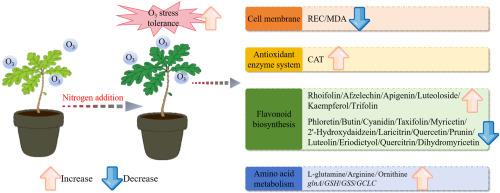
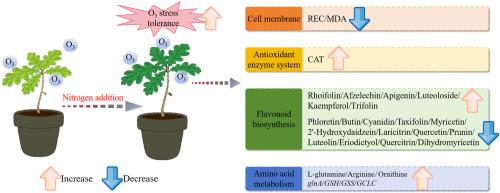
Ozone (O3) pollution poses an increasingly serious threat to forest ecosystems. To investigate the effects of O3 exposure on Quercus aliena and elucidate its defense mechanisms, we exposed Q. aliena to O3 and monitored its responses using physiological, transcriptomic, and metabolomic analyses. The results revealed that after 84 days of O3 exposure, the malondialdehyde (MDA) and proline contents in Q. aliena leaves significantly increased, while catalase (CAT) activity and soluble sugar content significantly decreased. Notably, N addition markedly alleviated O3-induced oxidative stress. Integrated transcriptomic and metabolomic analyses revealed that N addition under O3 stress modulated metabolic pathways associated with flavonoid biosynthesis and amino acid metabolism. Specifically, O3 and N treatment increased the levels of rhoifolin, afzelechin, apigenin, luteoloside, kaempferol, and trifolin, while reducing the levels of phloretin, butin, cyanidin, taxifolin, myricetin, 2′-hydroxydaidzein, laricitrin, quercetin, prunin, luteolin, eriodictyol, quercitrin, and dihydromyricetin. Additionally, the co-treatment elevated the concentrations of L-glutamine, arginine, and ornithine, along with the levels of enzymes closely related to their synthesis, such as glnA (Uni0006561, Uni0006562, Uni0077758, Uni0101990), GSH (Uni0086646, Uni0101788), GSS (Uni0037737), and GCLC (Uni0034253). This study elucidates the metabolic alterations in Q. aliena under combined O3 and N treatments, highlighting changes in flavonoid biosynthesis and amino acid metabolism pathways. Using a multi-omics approach, we provide comprehensive insights into the responses of Q. aliena to O3 stress and N addition, offering significant implications for the management and conservation of forest ecosystems under environmental stress.
期刊介绍:
Environmental Pollution is an international peer-reviewed journal that publishes high-quality research papers and review articles covering all aspects of environmental pollution and its impacts on ecosystems and human health.
Subject areas include, but are not limited to:
• Sources and occurrences of pollutants that are clearly defined and measured in environmental compartments, food and food-related items, and human bodies;
• Interlinks between contaminant exposure and biological, ecological, and human health effects, including those of climate change;
• Contaminants of emerging concerns (including but not limited to antibiotic resistant microorganisms or genes, microplastics/nanoplastics, electronic wastes, light, and noise) and/or their biological, ecological, or human health effects;
• Laboratory and field studies on the remediation/mitigation of environmental pollution via new techniques and with clear links to biological, ecological, or human health effects;
• Modeling of pollution processes, patterns, or trends that is of clear environmental and/or human health interest;
• New techniques that measure and examine environmental occurrences, transport, behavior, and effects of pollutants within the environment or the laboratory, provided that they can be clearly used to address problems within regional or global environmental compartments.



 京公网安备 11010802042870号
京ICP备2023020795号-1
京公网安备 11010802042870号
京ICP备2023020795号-1

 分享
分享
 求助内容:
求助内容: 应助结果提醒方式:
 扫码关注我们
