Wei Bao , Yunbao Gao , Jianing Zhang , Jing Jin , Na Zhang , Baijun Liu , Mingyao Zhang , Zhaohui Su , Hongwen Liang , Xiangling Ji , Wei Jiang
{"title":"Biodegradable poly (lactic acid) blends toughened with in situ formed core-shell structure by reactive processing","authors":"Wei Bao , Yunbao Gao , Jianing Zhang , Jing Jin , Na Zhang , Baijun Liu , Mingyao Zhang , Zhaohui Su , Hongwen Liang , Xiangling Ji , Wei Jiang","doi":"10.1016/j.polymer.2025.128330","DOIUrl":null,"url":null,"abstract":"<div><div>Biodegradable poly (lactic acid) (PLA) blends toughened with a core-shell structure were successfully prepared by melt-blending PLA with poly (butylene adipate-co-terephthalate) (PBAT) and poly (ether-block-amide) (PEBA). Scanning electron microscopy (SEM) and atomic force microscopy-infrared (AFM-IR) analyses confirmed the presence of core-shell structure in the PLA matrix, in which the core and the shell are PBAT and PEBA, respectively. To enhance the interfacial compatibility between PLA and PEBA, glycidyl methacrylate (GMA) was grafted onto PEBA, yielding the PEBA-GMA copolymer. The epoxy groups in PEBA-GMA reacted with the end groups (-OH, –COOH) of PBAT and PLA, which enhanced the interfacial compatibility of PLA/PEBA and PEBA/PBAT, thereby facilitating the formation of a smaller dispersed phase with core-shell structure. Consequently, a super-toughened PLA/PEBA-GMA/PBAT blend was prepared. The PLA/PEBA-GMA5/PBAT (70/15/15) blends achieved a notched Izod impact strength of 72.9 kJ/m<sup>2</sup>. Moreover, with a fixed PLA matrix content of 80 wt%, the upper limit of core PBAT content in PLA/PEBA-GMA3/PBAT blends was 18 wt%, while the minimum shell PEBA-GMA3 content was 2 wt% to ensure that the blends were ductile fracture. The composite of this blend had a lower stiffness loss, i.e., 26 %, demonstrating a well-balanced toughness and stiffness. Furthermore, the PLA/PEBA-GMA3/PBAT (70/25/5) blend exhibited excellent toughness at low temperatures, achieving a notched Izod impact strength of 47.1 kJ/m<sup>2</sup> at −20 °C. Enzyme degradation experiments confirmed that the PLA blends retained the biodegradability of PLA, PBAT, and PEBA, ensuring that the blends were environmentally friendly.</div></div>","PeriodicalId":405,"journal":{"name":"Polymer","volume":"326 ","pages":"Article 128330"},"PeriodicalIF":4.5000,"publicationDate":"2025-05-09","publicationTypes":"Journal Article","fieldsOfStudy":null,"isOpenAccess":false,"openAccessPdf":"","citationCount":"0","resultStr":null,"platform":"Semanticscholar","paperid":null,"PeriodicalName":"Polymer","FirstCategoryId":"92","ListUrlMain":"https://www.sciencedirect.com/science/article/pii/S0032386125003167","RegionNum":2,"RegionCategory":"化学","ArticlePicture":[],"TitleCN":null,"AbstractTextCN":null,"PMCID":null,"EPubDate":"2025/3/28 0:00:00","PubModel":"Epub","JCR":"Q2","JCRName":"POLYMER SCIENCE","Score":null,"Total":0}
引用次数: 0
Abstract
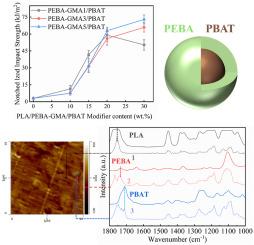
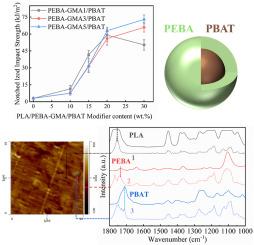
Biodegradable poly (lactic acid) (PLA) blends toughened with a core-shell structure were successfully prepared by melt-blending PLA with poly (butylene adipate-co-terephthalate) (PBAT) and poly (ether-block-amide) (PEBA). Scanning electron microscopy (SEM) and atomic force microscopy-infrared (AFM-IR) analyses confirmed the presence of core-shell structure in the PLA matrix, in which the core and the shell are PBAT and PEBA, respectively. To enhance the interfacial compatibility between PLA and PEBA, glycidyl methacrylate (GMA) was grafted onto PEBA, yielding the PEBA-GMA copolymer. The epoxy groups in PEBA-GMA reacted with the end groups (-OH, –COOH) of PBAT and PLA, which enhanced the interfacial compatibility of PLA/PEBA and PEBA/PBAT, thereby facilitating the formation of a smaller dispersed phase with core-shell structure. Consequently, a super-toughened PLA/PEBA-GMA/PBAT blend was prepared. The PLA/PEBA-GMA5/PBAT (70/15/15) blends achieved a notched Izod impact strength of 72.9 kJ/m2. Moreover, with a fixed PLA matrix content of 80 wt%, the upper limit of core PBAT content in PLA/PEBA-GMA3/PBAT blends was 18 wt%, while the minimum shell PEBA-GMA3 content was 2 wt% to ensure that the blends were ductile fracture. The composite of this blend had a lower stiffness loss, i.e., 26 %, demonstrating a well-balanced toughness and stiffness. Furthermore, the PLA/PEBA-GMA3/PBAT (70/25/5) blend exhibited excellent toughness at low temperatures, achieving a notched Izod impact strength of 47.1 kJ/m2 at −20 °C. Enzyme degradation experiments confirmed that the PLA blends retained the biodegradability of PLA, PBAT, and PEBA, ensuring that the blends were environmentally friendly.
期刊介绍:
Polymer is an interdisciplinary journal dedicated to publishing innovative and significant advances in Polymer Physics, Chemistry and Technology. We welcome submissions on polymer hybrids, nanocomposites, characterisation and self-assembly. Polymer also publishes work on the technological application of polymers in energy and optoelectronics.
The main scope is covered but not limited to the following core areas:
Polymer Materials
Nanocomposites and hybrid nanomaterials
Polymer blends, films, fibres, networks and porous materials
Physical Characterization
Characterisation, modelling and simulation* of molecular and materials properties in bulk, solution, and thin films
Polymer Engineering
Advanced multiscale processing methods
Polymer Synthesis, Modification and Self-assembly
Including designer polymer architectures, mechanisms and kinetics, and supramolecular polymerization
Technological Applications
Polymers for energy generation and storage
Polymer membranes for separation technology
Polymers for opto- and microelectronics.



 京公网安备 11010802042870号
京ICP备2023020795号-1
京公网安备 11010802042870号
京ICP备2023020795号-1

 分享
分享
 求助内容:
求助内容: 应助结果提醒方式:
 扫码关注我们
