{"title":"Effect of divalent ions on the structure of polyelectrolyte gels","authors":"Ferenc Horkay , Jack F. Douglas","doi":"10.1016/j.polymer.2025.128311","DOIUrl":null,"url":null,"abstract":"<div><div>We perform an exploratory study of the influence of adding divalent metal ion salts such as CaCl<sub>2</sub> to the structure of model monovalent metal counterion polyelectrolyte gels to test the hypothesis that such counterions lead to a tendency of polyelectrolyte chains to form fiber-like structures. Our experimental methodology is based on osmotic pressure <em>Π</em> measurements and small angle neutron scattering measurements on typical synthetic [poly(acrylic acid) and polystyrene sulfonate] and biopolymer (DNA and hyaluronic acid) polyelectrolyte gels over large polymer and CaCl<sub>2</sub> concentration ranges. The results of the present combined small-angle neutron scattering (SANS) and <em>Π</em> measurements strongly suggest that the Ca<sup>2+</sup> counterions are causing a tendency of the polyelectrolyte chains to associate all along the chain axis to form semi-flexible fiber structures rather than as randomly positioned physical cross-links between the chains. This form of association is consistent with the added divalent salt giving rise to attractive interactions between the chains that reduce phase stability of such polymers and with the observed scaling properties of the osmotic pressure of the gels and their structure as inferred from small angle neutron scattering. Further studies are required to confirm this structural assignment to this class of hydrogels given the uncertainty in assigning a unique structure by neutron scattering.</div></div>","PeriodicalId":405,"journal":{"name":"Polymer","volume":"327 ","pages":"Article 128311"},"PeriodicalIF":4.5000,"publicationDate":"2025-05-16","publicationTypes":"Journal Article","fieldsOfStudy":null,"isOpenAccess":false,"openAccessPdf":"","citationCount":"0","resultStr":null,"platform":"Semanticscholar","paperid":null,"PeriodicalName":"Polymer","FirstCategoryId":"92","ListUrlMain":"https://www.sciencedirect.com/science/article/pii/S0032386125002976","RegionNum":2,"RegionCategory":"化学","ArticlePicture":[],"TitleCN":null,"AbstractTextCN":null,"PMCID":null,"EPubDate":"2025/3/28 0:00:00","PubModel":"Epub","JCR":"Q2","JCRName":"POLYMER SCIENCE","Score":null,"Total":0}
引用次数: 0
Abstract
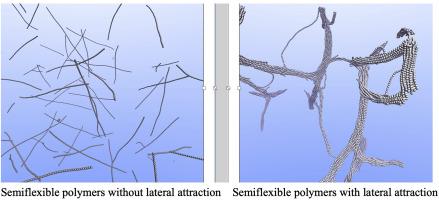
We perform an exploratory study of the influence of adding divalent metal ion salts such as CaCl2 to the structure of model monovalent metal counterion polyelectrolyte gels to test the hypothesis that such counterions lead to a tendency of polyelectrolyte chains to form fiber-like structures. Our experimental methodology is based on osmotic pressure Π measurements and small angle neutron scattering measurements on typical synthetic [poly(acrylic acid) and polystyrene sulfonate] and biopolymer (DNA and hyaluronic acid) polyelectrolyte gels over large polymer and CaCl2 concentration ranges. The results of the present combined small-angle neutron scattering (SANS) and Π measurements strongly suggest that the Ca2+ counterions are causing a tendency of the polyelectrolyte chains to associate all along the chain axis to form semi-flexible fiber structures rather than as randomly positioned physical cross-links between the chains. This form of association is consistent with the added divalent salt giving rise to attractive interactions between the chains that reduce phase stability of such polymers and with the observed scaling properties of the osmotic pressure of the gels and their structure as inferred from small angle neutron scattering. Further studies are required to confirm this structural assignment to this class of hydrogels given the uncertainty in assigning a unique structure by neutron scattering.
期刊介绍:
Polymer is an interdisciplinary journal dedicated to publishing innovative and significant advances in Polymer Physics, Chemistry and Technology. We welcome submissions on polymer hybrids, nanocomposites, characterisation and self-assembly. Polymer also publishes work on the technological application of polymers in energy and optoelectronics.
The main scope is covered but not limited to the following core areas:
Polymer Materials
Nanocomposites and hybrid nanomaterials
Polymer blends, films, fibres, networks and porous materials
Physical Characterization
Characterisation, modelling and simulation* of molecular and materials properties in bulk, solution, and thin films
Polymer Engineering
Advanced multiscale processing methods
Polymer Synthesis, Modification and Self-assembly
Including designer polymer architectures, mechanisms and kinetics, and supramolecular polymerization
Technological Applications
Polymers for energy generation and storage
Polymer membranes for separation technology
Polymers for opto- and microelectronics.





 京公网安备 11010802042870号
京ICP备2023020795号-1
京公网安备 11010802042870号
京ICP备2023020795号-1

 分享
分享
 求助内容:
求助内容: 应助结果提醒方式:
 扫码关注我们
