{"title":"Mutagenesis and Characterization of Hyaluronidase Production by a New Isolate of Citrobacter portucalensis","authors":"Yaya Yao, Wei Feng, Feiyang Li, Yang Qu, Yuanying Zhu, Xuepeng Li, Shihong Feng, Haitao Yue","doi":"10.1021/acs.jafc.5c00145","DOIUrl":null,"url":null,"abstract":"Hyaluronidase, a glycosidase, has the capacity to degrade hyaluronic acid. It is employed within both the medical and cosmetic domains and represents an efficacious methodology for the preparation of hyaluronic acid oligosaccharides. The increase in the activity of hyaluronidase has been demonstrated to be an effective method of promoting the production of low molecular weight hyaluronic acid. In the present study, we identified the active hyaluronan-degrading strain <i>Citrobacter portucalensis</i> HA23 from a sodium hyaluronate solution kept at natural room temperature, with independent intellectual property rights. To enhance the strain’s enzyme-producing capacity, we employed atmospheric and room temperature plasma (ARTP) technology to select and breed the mutant HA2301 with augmented enzyme-producing capabilities. The enzyme activity of the mutant strain HA2301 was observed to have increased by 58.82% in comparison to that of HA23. It was established that pH 5.5, 37 °C, and 250 rpm represented the optimal culture conditions, with the enzyme activity of the strain reaching 25808 U mL<sup>–1</sup> in a medium comprising a carbon source of yeast flour and a nitrogen source of peanut cake flour. The reaction solution of the enzyme with sodium hyaluronate was characterized, with the main products identified as HA2 and HA4. The present text provides a reference for its industrial application.","PeriodicalId":41,"journal":{"name":"Journal of Agricultural and Food Chemistry","volume":"215 1","pages":""},"PeriodicalIF":6.2000,"publicationDate":"2025-03-29","publicationTypes":"Journal Article","fieldsOfStudy":null,"isOpenAccess":false,"openAccessPdf":"","citationCount":"0","resultStr":null,"platform":"Semanticscholar","paperid":null,"PeriodicalName":"Journal of Agricultural and Food Chemistry","FirstCategoryId":"97","ListUrlMain":"https://doi.org/10.1021/acs.jafc.5c00145","RegionNum":1,"RegionCategory":"农林科学","ArticlePicture":[],"TitleCN":null,"AbstractTextCN":null,"PMCID":null,"EPubDate":"","PubModel":"","JCR":"Q1","JCRName":"AGRICULTURE, MULTIDISCIPLINARY","Score":null,"Total":0}
引用次数: 0
Abstract
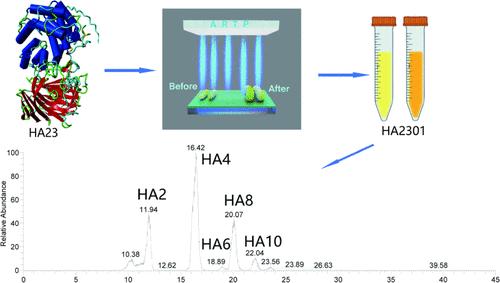
Hyaluronidase, a glycosidase, has the capacity to degrade hyaluronic acid. It is employed within both the medical and cosmetic domains and represents an efficacious methodology for the preparation of hyaluronic acid oligosaccharides. The increase in the activity of hyaluronidase has been demonstrated to be an effective method of promoting the production of low molecular weight hyaluronic acid. In the present study, we identified the active hyaluronan-degrading strain Citrobacter portucalensis HA23 from a sodium hyaluronate solution kept at natural room temperature, with independent intellectual property rights. To enhance the strain’s enzyme-producing capacity, we employed atmospheric and room temperature plasma (ARTP) technology to select and breed the mutant HA2301 with augmented enzyme-producing capabilities. The enzyme activity of the mutant strain HA2301 was observed to have increased by 58.82% in comparison to that of HA23. It was established that pH 5.5, 37 °C, and 250 rpm represented the optimal culture conditions, with the enzyme activity of the strain reaching 25808 U mL–1 in a medium comprising a carbon source of yeast flour and a nitrogen source of peanut cake flour. The reaction solution of the enzyme with sodium hyaluronate was characterized, with the main products identified as HA2 and HA4. The present text provides a reference for its industrial application.
期刊介绍:
The Journal of Agricultural and Food Chemistry publishes high-quality, cutting edge original research representing complete studies and research advances dealing with the chemistry and biochemistry of agriculture and food. The Journal also encourages papers with chemistry and/or biochemistry as a major component combined with biological/sensory/nutritional/toxicological evaluation related to agriculture and/or food.



 京公网安备 11010802042870号
京ICP备2023020795号-1
京公网安备 11010802042870号
京ICP备2023020795号-1

 分享
分享
 求助内容:
求助内容: 应助结果提醒方式:
 扫码关注我们
