Cyanobacterial blooms specifically alter the dispersal-mediated taxonomic and functional vertical similarity of microbial communities in a subtropical reservoir
Shuzhen Li , Xue Yan , Huihuang Chen , Erik Jeppesen , Peng Xiao , Lei Jin , Zijie Xu , Jun Zuo , Kexin Ren , Jun Yang
{"title":"Cyanobacterial blooms specifically alter the dispersal-mediated taxonomic and functional vertical similarity of microbial communities in a subtropical reservoir","authors":"Shuzhen Li , Xue Yan , Huihuang Chen , Erik Jeppesen , Peng Xiao , Lei Jin , Zijie Xu , Jun Zuo , Kexin Ren , Jun Yang","doi":"10.1016/j.watres.2025.123574","DOIUrl":null,"url":null,"abstract":"<div><div>Harmful cyanobacterial blooms, including <em>Raphidiopsis raciborskii</em> (basionym <em>Cylindrospermopsis raciborskii</em>), are an increasing environmental concern in freshwater ecosystems globally. However, the ecological consequences of cyanobacterial blooms for the vertical similarity of microbial community structure have yet to be thoroughly investigated, especially in deep waters. Here, we explored the taxonomic and functional similarity of microbial communities at different depths in a subtropical reservoir over a 7-year period following multiple <em>R. raciborskii</em> blooms. Our results showed that vertical microbial dispersal, rather than ecological niche, is the main process determining vertical similarity. Both particle-attached (PA) and free-living (FL) bacteria from the surface water were able to reach the deep water, particle size being a contributing factor to their vertical dispersal. Cyanobacterial blooms enhanced the vertical microbial transport of PA, impacting the composition and biogeochemical processes of deep microbial communities. During the mixing period, microbial taxonomic and functional similarities between the different water layers were high whereas they were minimal across the oxycline during the stratification period, suggesting a bottleneck in microbial vertical dispersal. In the deep water layers, the abundances of specific taxa, such as those of Burkholderiales and Desulfomonilales in PA and FL fractions respectively in stratification periods, increased during blooms. Additionally, cyanobacterial blooms enhanced sulfur compound respiration in both PA and FL fractions and suppressed nitrification in PA bacteria and denitrification in FL bacteria, simultaneously reducing light-utilization capacity in PA bacteria and altering organic matter degradation. Several mechanisms are proposed to drive variations in microbial vertical connectivity by cyanobacteria, including ecological niche shifts and alterations of physicochemical properties and nutrient dynamics. Overall, our results reveal complex effects of cyanobacterial blooms on microbial taxonomic and functional vertical similarity and highlight the contribution of surface communities to the biodiversity and biogeography of deep communities.</div></div>","PeriodicalId":443,"journal":{"name":"Water Research","volume":"281 ","pages":"Article 123574"},"PeriodicalIF":12.4000,"publicationDate":"2025-08-01","publicationTypes":"Journal Article","fieldsOfStudy":null,"isOpenAccess":false,"openAccessPdf":"","citationCount":"0","resultStr":null,"platform":"Semanticscholar","paperid":null,"PeriodicalName":"Water Research","FirstCategoryId":"93","ListUrlMain":"https://www.sciencedirect.com/science/article/pii/S0043135425004877","RegionNum":1,"RegionCategory":"环境科学与生态学","ArticlePicture":[],"TitleCN":null,"AbstractTextCN":null,"PMCID":null,"EPubDate":"2025/3/29 0:00:00","PubModel":"Epub","JCR":"Q1","JCRName":"ENGINEERING, ENVIRONMENTAL","Score":null,"Total":0}
引用次数: 0
Abstract
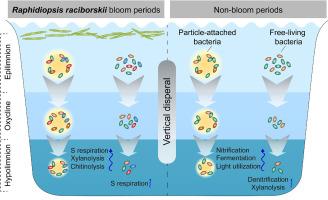
Harmful cyanobacterial blooms, including Raphidiopsis raciborskii (basionym Cylindrospermopsis raciborskii), are an increasing environmental concern in freshwater ecosystems globally. However, the ecological consequences of cyanobacterial blooms for the vertical similarity of microbial community structure have yet to be thoroughly investigated, especially in deep waters. Here, we explored the taxonomic and functional similarity of microbial communities at different depths in a subtropical reservoir over a 7-year period following multiple R. raciborskii blooms. Our results showed that vertical microbial dispersal, rather than ecological niche, is the main process determining vertical similarity. Both particle-attached (PA) and free-living (FL) bacteria from the surface water were able to reach the deep water, particle size being a contributing factor to their vertical dispersal. Cyanobacterial blooms enhanced the vertical microbial transport of PA, impacting the composition and biogeochemical processes of deep microbial communities. During the mixing period, microbial taxonomic and functional similarities between the different water layers were high whereas they were minimal across the oxycline during the stratification period, suggesting a bottleneck in microbial vertical dispersal. In the deep water layers, the abundances of specific taxa, such as those of Burkholderiales and Desulfomonilales in PA and FL fractions respectively in stratification periods, increased during blooms. Additionally, cyanobacterial blooms enhanced sulfur compound respiration in both PA and FL fractions and suppressed nitrification in PA bacteria and denitrification in FL bacteria, simultaneously reducing light-utilization capacity in PA bacteria and altering organic matter degradation. Several mechanisms are proposed to drive variations in microbial vertical connectivity by cyanobacteria, including ecological niche shifts and alterations of physicochemical properties and nutrient dynamics. Overall, our results reveal complex effects of cyanobacterial blooms on microbial taxonomic and functional vertical similarity and highlight the contribution of surface communities to the biodiversity and biogeography of deep communities.
包括 Raphidiopsis raciborskii(原名 Cylindrospermopsis raciborskii)在内的有害蓝藻水华日益成为全球淡水生态系统中的环境问题。然而,蓝藻藻华对微生物群落结构垂直相似性的生态影响尚未得到深入研究,尤其是在深水区。在此,我们探索了一个亚热带水库在多次 R. raciborskii 藻华发生后的 7 年间不同深度微生物群落的分类和功能相似性。我们的研究结果表明,决定垂直相似性的主要过程是微生物的垂直扩散,而不是生态位。来自表层水的颗粒附着细菌(PA)和自由生活细菌(FL)都能到达深层水,颗粒大小是它们垂直扩散的一个促成因素。蓝藻水华增强了 PA 的垂直微生物迁移,影响了深层微生物群落的组成和生物地球化学过程。在混合期间,不同水层之间的微生物分类学和功能相似性很高,而在分层期间,不同水层之间的微生物分类学和功能相似性很小,这表明微生物的垂直扩散存在瓶颈。在深水层,特定门类和纲的丰度在藻华期间有所增加,如在分层期 PA 和 FL 部分的 Burkholderiales 和 Desulfomonilales。此外,蓝藻藻华增强了 PA 和 FL 部分的硫化合物呼吸作用,抑制了 PA 细菌的硝化作用和 FL 细菌的反硝化作用,同时降低了 PA 细菌的光利用能力并改变了有机物降解。蓝藻微生物垂直连通性的变化有多种驱动机制,包括生态位转移、理化性质和营养动态的改变。总之,我们的研究结果揭示了蓝藻藻华对微生物分类和功能垂直相似性的复杂影响,并强调了表层群落对深层群落生物多样性和生物地理学的贡献。
期刊介绍:
Water Research, along with its open access companion journal Water Research X, serves as a platform for publishing original research papers covering various aspects of the science and technology related to the anthropogenic water cycle, water quality, and its management worldwide. The audience targeted by the journal comprises biologists, chemical engineers, chemists, civil engineers, environmental engineers, limnologists, and microbiologists. The scope of the journal include:
•Treatment processes for water and wastewaters (municipal, agricultural, industrial, and on-site treatment), including resource recovery and residuals management;
•Urban hydrology including sewer systems, stormwater management, and green infrastructure;
•Drinking water treatment and distribution;
•Potable and non-potable water reuse;
•Sanitation, public health, and risk assessment;
•Anaerobic digestion, solid and hazardous waste management, including source characterization and the effects and control of leachates and gaseous emissions;
•Contaminants (chemical, microbial, anthropogenic particles such as nanoparticles or microplastics) and related water quality sensing, monitoring, fate, and assessment;
•Anthropogenic impacts on inland, tidal, coastal and urban waters, focusing on surface and ground waters, and point and non-point sources of pollution;
•Environmental restoration, linked to surface water, groundwater and groundwater remediation;
•Analysis of the interfaces between sediments and water, and between water and atmosphere, focusing specifically on anthropogenic impacts;
•Mathematical modelling, systems analysis, machine learning, and beneficial use of big data related to the anthropogenic water cycle;
•Socio-economic, policy, and regulations studies.





 京公网安备 11010802042870号
京ICP备2023020795号-1
京公网安备 11010802042870号
京ICP备2023020795号-1

 分享
分享
 求助内容:
求助内容: 应助结果提醒方式:
 扫码关注我们
