Xiaomin Wu , Yuwen Wang , James P. Meador , Guang-Jie Zhou , Wenju Xu , Feng Hua , Wenhua Liu , Xiaojuan Liu , Zhen Wang
{"title":"Biodegradation pathways and mechanisms of 17α-ethynylestradiol via functional enzymes in the freshwater microalga Scenedesmus quadricauda","authors":"Xiaomin Wu , Yuwen Wang , James P. Meador , Guang-Jie Zhou , Wenju Xu , Feng Hua , Wenhua Liu , Xiaojuan Liu , Zhen Wang","doi":"10.1016/j.watres.2025.123569","DOIUrl":null,"url":null,"abstract":"<div><div>17α-ethynylestradiol (EE2) is a potent synthetic hormone exhibiting very high estrogenic activity and low rates of biodegradation. The removal capabilities of EE2 by bacteria, fungi and algal-bacterial symbiotic systems have attracted considerable attention recently. Specifically, algal biodegradation has been explored recently; however, the pathway and mechanisms of EE2 degradation have remained largely unknown. Therefore, we investigated the pathways and mechanisms by which EE2 is degraded by the freshwater microalga <em>Scenedesmus quadricauda</em>. After exposure for 10.5 d, the algal species was able to metabolize 58 % of a 15 mg/L solution of EE2, with the highest removal rate of 13 % occurring at 1.5 d An Ultra Performance Liquid Chromatography-Q-Exactive Orbitrap Mass Spectrometry was used innovatively to identify the biodegradation products of EE2 through non-target screening, followed by the verification of standard compounds. Transcriptomic analysis and molecular docking analysis revealed several degradation pathways and mechanisms by this algal species. One pathway was the demethylation of EE2 to estradiol (E2) by short-chain dehydrogenase/reductase. Subsequently, we also observed interconversion of estrone (E1) and E2 by 17β-hydroxysteroid dehydrogenase through hydroxylation or ketonization, hydroxylation of E1 to 16α-hydroxyestrone (16-OH E1) by cytochrome P450 and flavin-containing monooxygenase. A second pathway was methoxylation of E2 to estradiol acetate by catechol O-methyltransferase. As a result, the ethynyl group was degraded to hydroxy, ketone and methoxyl groups, which promotes EE2 degradation. Considering that EE2 pollution could result in adverse effects for aquatic organisms, the results of this study provide insights and a comprehensive approach for practical and effective bioremediation of EE2 contamination in aquatic ecosystems.</div></div>","PeriodicalId":443,"journal":{"name":"Water Research","volume":"281 ","pages":"Article 123569"},"PeriodicalIF":12.4000,"publicationDate":"2025-08-01","publicationTypes":"Journal Article","fieldsOfStudy":null,"isOpenAccess":false,"openAccessPdf":"","citationCount":"0","resultStr":null,"platform":"Semanticscholar","paperid":null,"PeriodicalName":"Water Research","FirstCategoryId":"93","ListUrlMain":"https://www.sciencedirect.com/science/article/pii/S0043135425004828","RegionNum":1,"RegionCategory":"环境科学与生态学","ArticlePicture":[],"TitleCN":null,"AbstractTextCN":null,"PMCID":null,"EPubDate":"2025/3/29 0:00:00","PubModel":"Epub","JCR":"Q1","JCRName":"ENGINEERING, ENVIRONMENTAL","Score":null,"Total":0}
引用次数: 0
Abstract
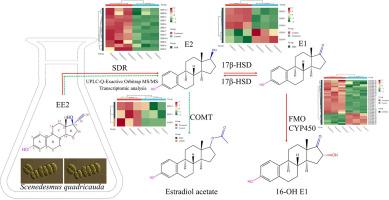
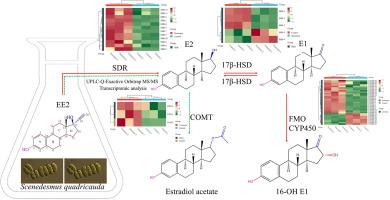
17α-ethynylestradiol (EE2) is a potent synthetic hormone exhibiting very high estrogenic activity and low rates of biodegradation. The removal capabilities of EE2 by bacteria, fungi and algal-bacterial symbiotic systems have attracted considerable attention recently. Specifically, algal biodegradation has been explored recently; however, the pathway and mechanisms of EE2 degradation have remained largely unknown. Therefore, we investigated the pathways and mechanisms by which EE2 is degraded by the freshwater microalga Scenedesmus quadricauda. After exposure for 10.5 d, the algal species was able to metabolize 58 % of a 15 mg/L solution of EE2, with the highest removal rate of 13 % occurring at 1.5 d An Ultra Performance Liquid Chromatography-Q-Exactive Orbitrap Mass Spectrometry was used innovatively to identify the biodegradation products of EE2 through non-target screening, followed by the verification of standard compounds. Transcriptomic analysis and molecular docking analysis revealed several degradation pathways and mechanisms by this algal species. One pathway was the demethylation of EE2 to estradiol (E2) by short-chain dehydrogenase/reductase. Subsequently, we also observed interconversion of estrone (E1) and E2 by 17β-hydroxysteroid dehydrogenase through hydroxylation or ketonization, hydroxylation of E1 to 16α-hydroxyestrone (16-OH E1) by cytochrome P450 and flavin-containing monooxygenase. A second pathway was methoxylation of E2 to estradiol acetate by catechol O-methyltransferase. As a result, the ethynyl group was degraded to hydroxy, ketone and methoxyl groups, which promotes EE2 degradation. Considering that EE2 pollution could result in adverse effects for aquatic organisms, the results of this study provide insights and a comprehensive approach for practical and effective bioremediation of EE2 contamination in aquatic ecosystems.
期刊介绍:
Water Research, along with its open access companion journal Water Research X, serves as a platform for publishing original research papers covering various aspects of the science and technology related to the anthropogenic water cycle, water quality, and its management worldwide. The audience targeted by the journal comprises biologists, chemical engineers, chemists, civil engineers, environmental engineers, limnologists, and microbiologists. The scope of the journal include:
•Treatment processes for water and wastewaters (municipal, agricultural, industrial, and on-site treatment), including resource recovery and residuals management;
•Urban hydrology including sewer systems, stormwater management, and green infrastructure;
•Drinking water treatment and distribution;
•Potable and non-potable water reuse;
•Sanitation, public health, and risk assessment;
•Anaerobic digestion, solid and hazardous waste management, including source characterization and the effects and control of leachates and gaseous emissions;
•Contaminants (chemical, microbial, anthropogenic particles such as nanoparticles or microplastics) and related water quality sensing, monitoring, fate, and assessment;
•Anthropogenic impacts on inland, tidal, coastal and urban waters, focusing on surface and ground waters, and point and non-point sources of pollution;
•Environmental restoration, linked to surface water, groundwater and groundwater remediation;
•Analysis of the interfaces between sediments and water, and between water and atmosphere, focusing specifically on anthropogenic impacts;
•Mathematical modelling, systems analysis, machine learning, and beneficial use of big data related to the anthropogenic water cycle;
•Socio-economic, policy, and regulations studies.




 京公网安备 11010802042870号
京ICP备2023020795号-1
京公网安备 11010802042870号
京ICP备2023020795号-1

 分享
分享
 求助内容:
求助内容: 应助结果提醒方式:
 扫码关注我们
